


Carrier Factory Authorized Dealer
Carrier President’s Award
TSSA-Registered Fuels Contractor
BBB Accredited Business
Free In-Home Estimates
“Should I repair or replace my furnace?” is a common question, and the right answer depends on the unit’s age, condition, repair history, safety, efficiency, and the installation options available. Our heating team helps Peel Region homeowners make this call every day.
The short answer: A younger furnace with an isolated, repairable fault may be a repair candidate; an older unit with repeated or costly failures may be worth comparing with replacement. A cracked heat exchanger is a safety finding that requires a qualified technician’s recommendation. The 50-percent and $5,000 formulas below are rough heuristics, not guarantees.
Aire One Peel can explain the findings and provide written options so you can compare them; the decision stays yours. Call 905-564-8545 for a free assessment, and we have served Peel Region since 1990.
Repair or replace: the deciding factors
Weigh these six factors together rather than any one alone. If most point the same way, your answer is usually clear.
| Factor | Lean toward repair | Lean toward replace |
|---|---|---|
| Age | Under 15 years | 15 to 20 years or more |
| Repair cost | Minor, well under half of new | Approaching half the cost of new |
| Breakdowns | First or rare | Frequent, most seasons |
| Efficiency and bills | Fairly new, high-efficiency | Old, low AFUE, rising bills |
| Heat exchanger | Intact | Cracked (safety issue; technician guidance needed) |
| Comfort | Even, reliable heating | Uneven heat, cold rooms |
When repair makes sense
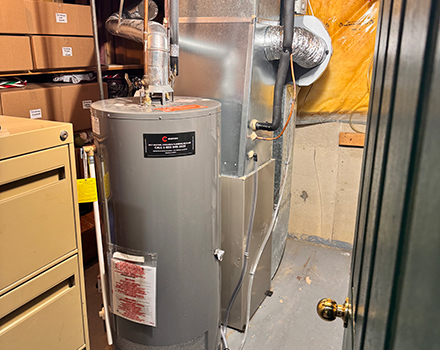
Repair may make sense when the furnace is relatively young, the fault is isolated and repairable, the unit has been reliable, and the written repair option is reasonable compared with replacement.
A furnace under warranty may have covered parts, subject to its written terms.
When replacement makes sense
Replacement is worth comparing when the furnace is older, repairs are recurring or costly, safety is in question, or comfort and efficiency remain poor.
A cracked heat exchanger requires immediate professional guidance because it can create a carbon-monoxide risk. Follow a qualified technician’s shutdown and repair-or-replacement recommendation. Do not use age or an online price alone to make the decision; compare inspection findings and written options.
Installed costs vary by model, home, ductwork, venting, electrical or gas work, and current offers. Get a current written quote, and it may also be useful to compare a heat pump at the same time, since heat-pump incentive eligibility depends on current program rules.
The 50 percent and $5,000 rules
The 50-percent and $5,000 formulas are commonly used budgeting heuristics. They can help organize a conversation, but they are not engineering rules and should not override safety, warranty coverage, repair history, fuel use, installation scope, or a qualified diagnosis.
Use current written prices rather than the example alone; do not treat a multiplication result as a universal replacement rule. A 16-year-old furnace with a $400 repair is only an illustration, not a recommendation for every home.
Use the formulas as prompts for a fuller comparison, not as a substitute for a qualified diagnosis.
The efficiency payoff of replacing
Replacing an older furnace can change fuel use, comfort, and operating cost, but the result depends on the current AFUE, usage, fuel prices, equipment choice, installation scope, and maintenance.
Compare the numbers using current written quotes; do not assume an upgrade will pay back within a particular period.
How we help you decide
Not sure which option fits? Our team can walk you through the findings.
When our technician assesses your furnace, we check its age, the condition of the heat exchanger and key components, its efficiency rating, and its safety, then give you a written price to repair alongside a quote to replace so you can compare real numbers. We can explain the findings and help you compare the options; the decision stays yours.
If replacement is the way to go, we can quote a furnace installation and walk you through any rebates you qualify for.
From our Peel Region service calls:
We give you a written price to repair and to replace, with a straight recommendation, from a licensed team serving Mississauga, Brampton, Etobicoke, Milton, Georgetown, Caledon, and Bolton since 1990.
Frequently asked questions
Should I repair or replace my furnace?
The choice is not one-size-fits-all.
Compare the furnace’s age, condition, safety, repair history, warranty, comfort, and current written repair and replacement options. The formulas on this page are heuristics, not a substitute for a qualified diagnosis.
How long does a furnace last?
A gas furnace often serves for roughly 15 to 20 years, but service life varies with model, installation, usage, maintenance, and condition. Past the typical range, compare repair history, safety, efficiency, warranty, and current written options; age alone does not decide.
Is it worth repairing a 15 year old furnace?
Sometimes. A minor repair on a 15-year-old furnace that still heats well may be reasonable.
If the repair is costly, breakdowns are frequent, or a safety issue is identified, compare replacement as well. The 50-percent and $5,000 formulas can organize the conversation but do not decide it.
What is the 50 percent rule for furnaces?
The 50-percent rule is a rough budgeting heuristic: if a repair approaches half the cost of a new system, compare both options. It is not a universal decision rule.
Does a new furnace lower my energy bills?
It can, but the result depends on the current AFUE, usage, fuel prices, equipment, installation scope, and maintenance. Compare current written estimates and avoid assuming a fixed savings or payback period.
The bottom line
Use the unit’s age, condition, safety, repair history, warranty, comfort, and current written estimates together.
Ask a qualified technician to explain the findings and compare repair with replacement; age, repair history, safety, efficiency, and comfort all matter.
The 50-percent and $5,000 formulas can organize the conversation, but a qualified in-home assessment and current written prices are more useful than a formula alone. Book a free furnace assessment or call 905-564-8545.
The right choice depends on the unit’s age, condition, repair history, safety, warranty, and current written options.
A qualified technician can explain the safest next step.
Related reading
- Best furnace repair near you in Mississauga
- Furnace installation and replacement
- Heat pumps and Ontario rebates
- HVAC protection and maintenance plans
Sources and references
- Natural Resources Canada, ENERGY STAR and furnace efficiency
- Technical Standards and Safety Authority (TSSA), Ontario
- Health Canada, Carbon monoxide safety
Pricing and efficiency details verified July 2026 and subject to change.