



Furnace lifespan is one of those numbers that gets quoted as a single figure when it is really a range, and where your furnace lands inside that range depends far more on how it was installed and maintained than on the badge on the front. Ontario’s heating season can put significant runtime on equipment. This guide gives the honest range, what moves you up or down inside it, and the signs that mean stop using it today rather than plan a replacement for next year. If yours is already struggling, start with furnace repair.
The short answer: a gas furnace in Ontario typically lasts 15 to 20 years is a common planning range, but actual service life varies with model, installation, usage, maintenance, and condition. Annual maintenance is one important controllable factor.
Aire One Peel is a TSSA-registered fuels contractor and Carrier Factory Authorized Dealer serving Mississauga, Brampton, Caledon, Bolton, Milton, Georgetown and Etobicoke, with furnace installation in Mississauga on replacement.
Key takeaways
- Plan on 15 to 20 years. Start budgeting at 15, not at the first breakdown.
- Ontario's heating season is long, so annual run hours are high. Maintenance matters more here than in milder climates.
- A cracked heat exchanger is the one failure that ends the conversation. It is a carbon monoxide risk, not a repair decision.
- For covered residential gas furnaces manufactured for Canada on or after July 3, 2019, federal efficiency rules set a 95 per cent AFUE minimum. Product and replacement exceptions can apply; confirm the exact equipment and current requirements with your contractor.
- As of January 1, 2026, Ontario requires a carbon monoxide alarm on every storey of a home with a fuel-burning appliance, not just near bedrooms.
Call 905-564-8545 Book a free in-home estimate
What this guide covers
- The real lifespan range, by furnace type
- What shortens and extends furnace life in Ontario
- Warning signs, sorted by urgency
- What to do at each age
- Repair or replace: the arithmetic
- Ontario rules that apply when you replace
- Furnace lifespan finder
- See how we work
- How we know this
- Frequently asked questions
The Real Lifespan Range, by Furnace Type
A modern condensing gas furnace in Ontario typically lasts 15 to 20 years, and the type of unit you own sets the range before maintenance moves you inside it. The pattern across equipment generations is consistent: simpler, less efficient furnaces ran longer but wasted far more fuel, while modern high-efficiency units extract more heat at the cost of more components that can fail.
| Equipment | Typical lifespan | Why it lands there |
|---|---|---|
| Condensing gas furnace, 90 per cent AFUE and above | 15 to 20 years | Secondary heat exchanger and condensate handling add failure points |
| Mid-efficiency gas furnace, roughly 80 per cent AFUE | 18 to 25 years | Fewer components, but no longer available new in Canada |
| Older atmospheric furnace, pre-1990s | 25 years or more | Very simple, very inefficient, often oversized |
| Electric furnace | 20 to 30 years | No combustion, so no heat exchanger to crack |
| Air-source heat pump | 12 to 18 years | Runs in both seasons, so annual hours are much higher |
| Heat exchanger specifically | Often the limiting part | A crack ends the furnace regardless of the age of everything else |
The practical takeaway is that a 22-year-old furnace still heating your house is not evidence that it is fine. It is usually evidence that it is simple and inefficient, and it says nothing about the condition of the heat exchanger inside it.
What Shortens and Extends Furnace Life in Ontario
Maintenance, correct sizing and installation quality account for most of the spread between a furnace that dies at 12 and one that reaches 20. Ontario's heating season runs roughly from October through April, which puts more annual run hours on equipment here than in most of the continent, so the same neglect costs more.
| Factor | Effect on lifespan | What to do about it |
|---|---|---|
| Annual maintenance | Largest controllable factor | Book one service visit per year, before heating season |
| Filter changes | Restricted airflow overheats the exchanger and shortens its life | Check monthly, replace every 1 to 3 months |
| Correct sizing | An oversized furnace short-cycles and wears out early | Insist on a CSA F280 load calculation at replacement |
| Installation quality | Poor venting, gas pressure or ducting causes years of strain | Use a TSSA-registered contractor and keep the paperwork |
| Duct design and static pressure | High static pressure stresses the blower and exchanger | Have static pressure measured during service |
| Thermostat setpoint swings | Deep setbacks cause long recovery runs | Moderate setbacks beat dramatic ones |
| Ontario heating season length | More run hours per year than milder climates | Not controllable, but it is why maintenance matters more here |
| Combustion air supply | Starved combustion damages the exchanger | Keep the area around the furnace clear and unobstructed |
Of these, annual maintenance is one of the most practical actions, because it is also when a technician catches the early signs on this page before they become emergencies. Our protection plans bundle it annually, and the filter guide covers the part you handle yourself.
Warning Signs, Sorted by Urgency
Not every furnace symptom means the same thing, and the difference between "book a service call" and "shut it off now" is worth knowing before you need it. The table below sorts the common signs by what they actually require.
| Sign | What it usually means | Urgency |
|---|---|---|
| CO alarm sounding | Possible combustion or venting failure | Leave the house, then call 911 |
| Headaches or nausea that ease when you leave the house | Possible CO exposure | Leave and call 911 |
| Yellow or flickering burner flame instead of blue | Incomplete combustion | Shut it off, call the same day |
| Soot, rust flakes or scorching near the furnace | Combustion or venting problem | Shut it off, call the same day |
| Rumbling or booming on ignition | Delayed ignition, often a dirty burner | Book promptly |
| Short cycling on and off | Oversizing, airflow restriction or a control fault | Book a service visit |
| Uneven heat between rooms | Duct, airflow or capacity loss | Book a service visit |
| Rising gas bills with the same habits | Efficiency loss as the unit ages | Plan, not urgent |
| Repairs becoming frequent | The unit may need more frequent attention | Compare repair and replacement options |
The one failure that is not a repair decision. A damaged heat exchanger can create a carbon-monoxide risk. If a qualified technician identifies a safety problem, follow the technician’s shutdown and repair or replacement recommendation; the right option depends on the unit’s age, warranty, labour, and overall condition.
Never run a furnace you suspect of a combustion problem while you wait for an appointment. If a CO alarm sounds, get everyone out of the house first and call 911 from outside.
What to Do at Each Age
The right action depends less on symptoms than on where the furnace sits in its life, because the same repair bill means different things on a 9-year-old unit and a 19-year-old one. Use this as the frame, then let the warning signs above override it.
| Age | Where it sits | What to do |
|---|---|---|
| 0 to 8 years | Early life, usually under warranty | Annual maintenance, keep records, register the warranty |
| 9 to 14 years | Mid life | Annual maintenance, repair normally, no replacement planning needed |
| 15 to 17 years | Approaching end of range | Keep maintaining, start budgeting, get a quote before you need one |
| 18 to 20 years | At end of typical range | Weigh every repair against replacement, ask for a heat exchanger inspection |
| Over 20 years | Past typical range | Start planning and compare options before an urgent winter failure |
| Age unknown | Usually means old | Have it identified from the data plate at the next service visit |
Comparing options before winter can give you more time to review sizing, scope, and written terms.
Repair or Replace: The Arithmetic
The usual rule of thumb is to replace when a repair costs more than a third of a new system on a furnace past 15 years, and to repair almost anything on a unit under 10. Between those points the decision comes down to what else is likely to fail next and how much longer you plan to stay in the house.
Check the paperwork before you decide either way. A part still inside its term changes the arithmetic, and the furnace warranty in Ontario runs to 10 years on parts and lifetime on the heat exchanger when the unit was registered inside 90 days.
| Situation | Usual call | Reasoning |
|---|---|---|
| Igniter, flame sensor or thermostat, any age | Repair | Small consumable parts, routine |
| Inducer or blower motor, unit under 12 years | Repair | Larger part but well short of replacement cost |
| Control board, unit under 15 years | Usually repair | Worth it if the exchanger is sound |
| Repair over one third of replacement cost, unit over 15 years | Get both quotes | The classic crossover point |
| Cracked heat exchanger, out of warranty | Replace | Safety issue, and exchanger labour approaches a new system |
| Two or more repairs in two years, unit over 15 | Replace | The failure phase has started |
| Moving within 2 years | Repair if safe | You will not recover a replacement at resale |
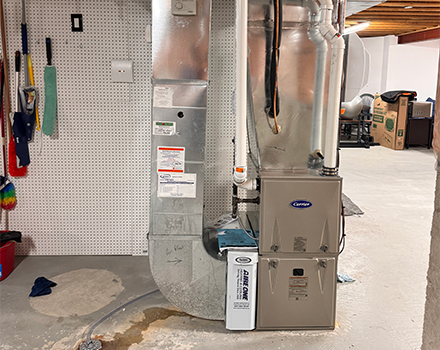
If replacement is on the table, check the current offers and rebates before committing, and ask about financing and rent-to-own. Renting shifts the cost from capital to monthly and includes service, which suits some households and not others; the honest version of that trade-off belongs in the estimate conversation, not in a headline.
Possible downside, stated plainly. Replacing a working 16-year-old furnace purely on age is usually premature, and we will say so rather than sell you one. Whether efficiency improvements justify replacement depends on the current AFUE, usage, fuel prices, installation scope, and time in the home; calculate with current written quotes. The strong cases for replacing early are a failing heat exchanger, repeated repairs, or a unit that was oversized from the start and has never heated the house evenly.
Ontario Rules That Apply When You Replace
Replacing a furnace in Ontario is a regulated job, and two rules in particular catch homeowners by surprise. The first sets what you are allowed to buy, and the second changed on January 1, 2026.
| Rule | What it requires | Source |
|---|---|---|
| Minimum furnace efficiency | New residential gas furnaces manufactured for Canada must meet at least 95 per cent AFUE | Canada's Energy Efficiency Regulations, applying to units manufactured on or after July 3, 2019 |
| Existing furnaces | Your current furnace may keep operating legally whatever its efficiency | The standard applies to manufacture and sale, not to equipment already installed |
| Carbon monoxide alarms | An alarm adjacent to each sleeping area AND on every storey, including basements and floors without bedrooms | O. Reg. 87/25 amending the Ontario Fire Code, O. Reg. 213/07, in force January 1, 2026 |
| Who may do the work | Gas work must be performed by a certified gas technician working for a registered contractor | Technical Standards and Safety Authority (TSSA) |
| Sizing | Capacity determined by a proper heat loss calculation, not by matching the old unit | CSA F280, referenced by the building code |
The carbon monoxide change is the one worth acting on today, whatever the age of your furnace. The Fire Code previously required an alarm near sleeping areas in homes with a fuel-burning appliance. Since January 1, 2026, homes with a fuel-burning appliance, a fireplace or an attached garage also need an alarm on every storey, including the basement where the furnace usually lives. It applies to existing homes, not only new builds.
Furnace Lifespan Finder
Answer three questions and this places your furnace on the timeline and tells you whether to maintain, plan, or stop. Every answer it gives already appears in the tables above, and any combustion warning sign overrides the age arithmetic entirely.
Where is your furnace in its life?
How old is your furnace?
See How We Work
Furnace decisions are easier when you can see what the work actually involves. The first two videos below cover furnace repair, replacement and installation across Peel Region, and the third is a short overview of the company.
Furnace repair, replacement and installation services in Mississauga, covering what happens when a unit reaches the end of its service life.
Aire One Peel Heating & Cooling · Mississauga, Brampton, Caledon, Bolton, Milton, Georgetown and Etobicoke
How We Know This
The regulatory statements on this page are sourced directly rather than repeated from other contractors: the 95 per cent AFUE minimum from Canada's Energy Efficiency Regulations, and the expanded carbon monoxide alarm requirement from O. Reg. 87/25 amending the Ontario Fire Code, confirmed against the Technical Standards and Safety Authority's own notice of the change.
The lifespan ranges reflect general industry service life for this equipment combined with Aire One Peel's own replacement work across Mississauga, Brampton, Caledon, Bolton, Milton, Georgetown and Etobicoke.
Compiled by Mario Vaghei, General Manager, in July 2026. No installed price ranges appear on this page because none are client-confirmed.
What to Do Next
Book maintenance if your furnace is under 15 years and has not been serviced this year. It is the highest-return action on this page and it is when the early warning signs get caught. Book furnace service.
Get a quote now, before you need one, if the furnace is 15 or older and still working. If replacement is being considered, compare written options before the next heating season so you have time to review sizing, scope, and terms.
Shut it off and call today if you see a yellow or flickering flame, soot, or rust flakes near the furnace. Those are combustion signs, not comfort complaints.
Leave the house and call 911 if a carbon monoxide alarm sounds, or if headaches or nausea ease when you go outside. Call from outside, not from indoors.
Furnace past 15? Get the quote before winter.
A free in-home estimate can provide a current written quote and review sizing and installation scope. Compare the findings with your furnace’s age, condition, repair history, and warranty. Financing and rent-to-own may be available; review current terms.
Aire One Peel Heating & Cooling
1625 Courtneypark Dr E, Mississauga, ON L5T 1V9
905-564-8545 | [email protected]
Frequently Asked Questions
How long does a furnace last in Ontario?
A gas furnace in Ontario typically lasts 15 to 20 years. Well-maintained condensing units often reach the upper end, while neglected or oversized units can fail closer to 12. Older mid-efficiency furnaces sometimes ran 25 years or more, but at much lower efficiency. Annual maintenance, correct sizing and installation quality account for most of the difference.
How do I find out how old my furnace is?
Check the data plate inside or behind the front panel, which carries the model and serial number. Most manufacturers encode the manufacturing date in the serial number, and a technician can read it during a service visit. Installation paperwork, the permit record, or a sticker left by the installing contractor will also usually give you the date.
Should I replace a 20-year-old furnace that still works?
At 20 years, compare repair and replacement costs before the next major failure. Age alone does not decide; condition, safety, efficiency, repair history, warranty, and your plans for the home also matter.
What is a cracked heat exchanger and why does it end a furnace?
The heat exchanger separates combustion gases from the air circulating through your home, so a crack can let carbon monoxide into that airstream. It is a safety failure rather than a repair decision. A technician who finds one will shut the furnace down, and on an older unit the labour to replace an exchanger usually approaches the cost of a new system.
Do I need a carbon monoxide alarm on every floor in Ontario?
Yes, if your home has a fuel-burning appliance, a fireplace, or an attached garage. Ontario Regulation 87/25 amended the Fire Code effective January 1, 2026 to require an alarm adjacent to each sleeping area and on every storey, including basements and floors without bedrooms. It applies to existing homes, not only new construction.
Does a new furnace have to be high efficiency in Ontario?
For covered residential gas furnaces, Canada’s Energy Efficiency Regulations set a minimum of 95 per cent AFUE for units manufactured for Canada on or after July 3, 2019. Product and replacement exceptions can apply, so confirm the exact equipment and current requirements with your contractor. An existing furnace is not automatically required to be replaced because of its efficiency rating.
The Bottom Line
Use 15 years as a prompt to review condition and 20 years as a prompt to compare options; age alone is not a replacement order. Between those, the deciding factors are how often it needs repairs, whether the heat exchanger is sound, and how much longer you intend to stay in the house.
Everything else on this page is secondary to one thing: combustion warning signs override the arithmetic. A yellow flame, soot, or a sounding CO alarm is not a scheduling question at any age, and the fact that Ontario expanded its alarm requirements in January 2026 is a good reason to check your own coverage this week rather than next winter.
Sources and References
- Technical Standards and Safety Authority, changes to the Ontario Fire Code and new requirements for CO alarms
- Government of Ontario, carbon monoxide safety
- ENERGY STAR Canada, Natural Resources Canada
- Save on Energy, Home Renovation Savings Program
Related Reading
- Furnace repair in Mississauga
- How air filters affect HVAC efficiency
- Eco-friendly AC tips for Ontario homes
Regulatory references verified July 29, 2026, subject to change. This guide is general information, not a substitute for an on-site inspection by a certified gas technician. All amounts in CAD.