



By Mario Vaghei, General Manager, Aire One Peel Heating & Cooling · Published September 8, 2026 · Facts verified September 8, 2026
Most no-heat calls we take in the first cold week of the season are furnaces that were fine in May and have simply not been asked to do anything since. Getting your furnace ready for winter is mostly about asking it early, on a mild day, when a fault is a booking rather than an emergency.
This page is the homeowner half of that job: eight checks that need no tools, what the first firing should sound and smell like, what to do when it does not start, and the carbon monoxide alarm rule that changed on January 1, 2026. How often the furnace should see a technician, and what that visit covers, is a different question with its own guide on how often to service a furnace.
On this page
- When should you do this in Ontario?
- The 8 checks, and what each one rules out
- What the first firing should sound and smell like
- The carbon monoxide alarm rule that changed in 2026
- If it does not start: symptom, cause, and who handles it
- Who is allowed to touch what
- What the professional visit adds
- Is your furnace ready, or does it need a technician?
- How we know this
- Watch: the team behind the advice
- Frequently asked questions
- The short version
- Sources and references
Short answer
Get your furnace ready for winter in late September or early October, on a mild day: switch the thermostat to heat, fit a fresh filter, open every register, clear a metre around the furnace, check the outdoor vent pipes, test every carbon monoxide alarm, restart the humidifier, then run one test cycle and listen to it.
Since January 1, 2026, an Ontario home with a fuel-burning appliance needs a carbon monoxide alarm adjacent to each sleeping area and on each storey without one. Anything inside the furnace cabinet, and anything involving gas, belongs to a TSSA-certified gas technician.
Key takeaways
- A fault found on a 14 degree afternoon in September is a scheduled visit. The same fault on the first minus 5 night is an emergency call in the week every contractor in Peel Region is booked solid.
- The first firing has a fixed order: inducer fan, then igniter, then burners, then the blower about a minute later. Knowing the order tells you where it stopped.
- A dusty smell for the first half hour of the season is normal. Gas, or hot plastic and wiring, is not, and each has its own rule below.
- Ontario amended the Fire Code through O. Reg. 87/25. From January 1, 2026 a carbon monoxide alarm is required on each storey without a sleeping area, not only next to bedrooms.
- There is no provincial date for turning the heat on in your own home. The dates that exist are municipal landlord by-laws, and they differ between Mississauga, Brampton and Etobicoke.
When should you do this in Ontario?
Late September to early October is the window for getting a furnace ready for winter in Peel Region, and the trigger is the weather forecast rather than the calendar: do the checks on a mild afternoon before the first night the forecast drops below about 10 degrees, because that is the night you will otherwise find out. Nothing in Ontario law tells a homeowner when to turn the heat on in their own house. The dates people half-remember are landlord rules, set city by city, and they are worth knowing because they also tell a tenant exactly what to ask for.
| Your city | Minimum a landlord must keep | When it applies | Rule |
|---|---|---|---|
| Mississauga | 20 C | All year | Adequate Temperature By-law 0110-2018 |
| Brampton | 20 C in all occupied rooms | September 15 to June 1 | Vital Services By-law |
| Etobicoke (City of Toronto) | 21 C | October 1 to May 15, per the City page | Heating by-law, being renamed the Indoor Temperature Standards by-law |
| Caledon, Bolton, Milton, Georgetown | Not verified for this article | Not verified | Local property standards by-law; ask the town |
| Your own home, any city | No legal minimum | Your call | Test it before you need it |
Two things stand out in that table. Mississauga dropped its seasonal dates in 2018 and now requires 20 degrees year-round, which is why a Mississauga tenant does not have to wait for September 15. And Toronto's own page notes that between September 15 and October 15 the weather can keep an apartment above 21 degrees without the heat on at all, which is the honest version of the same advice this page gives a homeowner: the furnace should be proven ready in September and needed in October.
The 8 checks, and what each one rules out
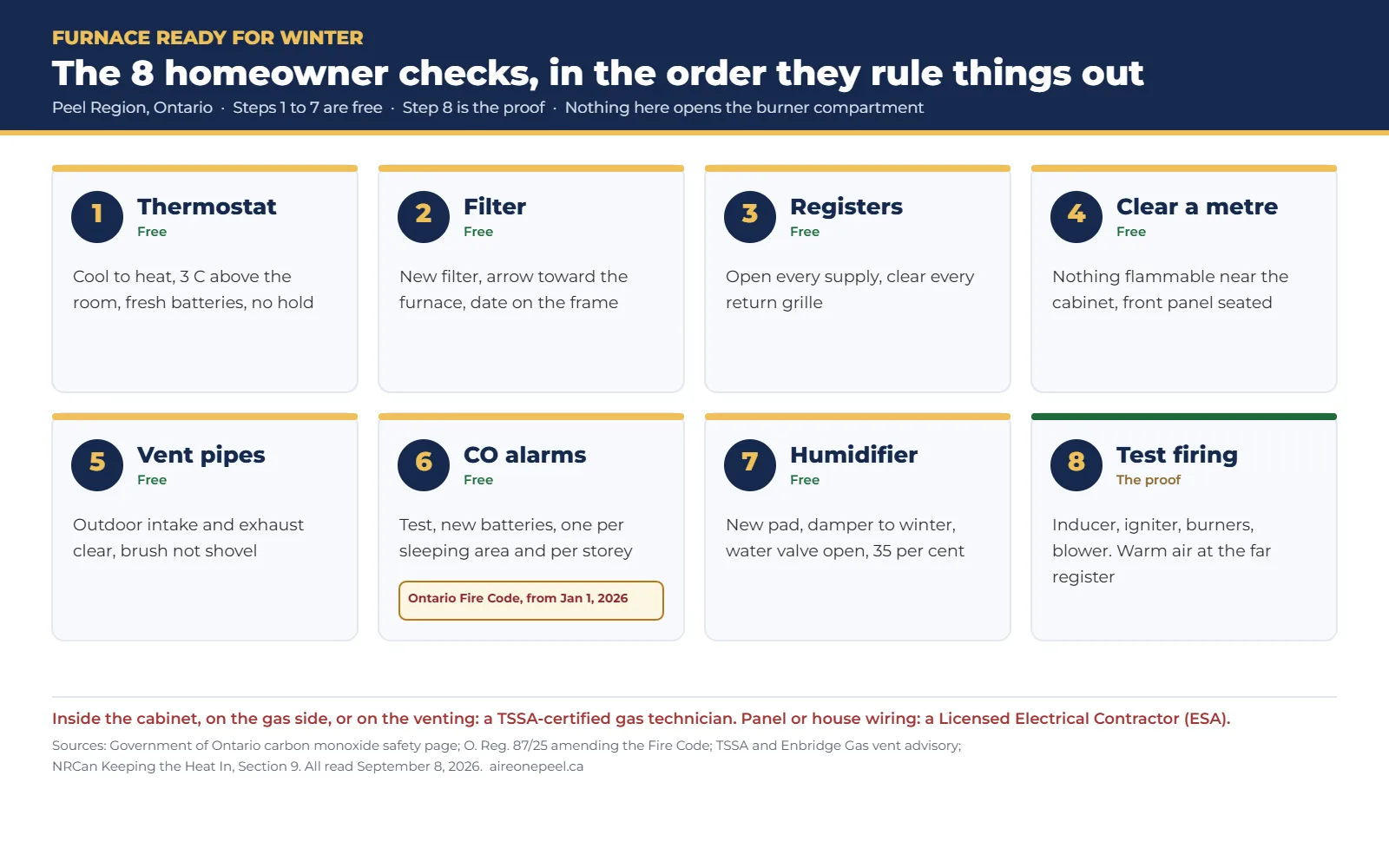
Run these in order, because each one is safe for a homeowner and each one eliminates a different family of first-cold-night failures. This is the furnace ready for winter checklist we walk customers through on the phone in September. Seven of the eight cost nothing. The eighth, the test firing, is the one that tells you whether the other seven worked.
| Check | What to do | What it rules out |
|---|---|---|
| 1. Thermostat | Switch from cool to heat, set it 3 degrees above the room, fresh batteries, and check no schedule or hold is overriding you | The furnace was never told to start |
| 2. Filter | Pull it and hold it to the light. Fit a new one, arrow pointing toward the furnace, and write the date on the frame | Airflow starvation, which trips the high-limit switch and shuts the burners off mid-cycle |
| 3. Registers and returns | Open every supply register, including the rooms you closed off for the summer, and pull furniture and curtains off the return grilles | Overheating and one room that never warms |
| 4. The metre around the furnace | Move paint, solvents, boxes, laundry and anything that burns well away from the cabinet. Confirm the front panel is pushed fully home | A fire risk, and a door-switch no-start |
| 5. Outdoor vent pipes | Find the white plastic intake and exhaust pipes on the outside wall. Clear leaves, nests and debris by hand or with a brush, never a shovel or a sharp tool, and keep them clear of snow all winter | A pressure-switch shutdown, and carbon monoxide backing up into the house |
| 6. Carbon monoxide alarms | Press the test button on every alarm, replace batteries, check the date printed on the back, and confirm there is one adjacent to each sleeping area and one on each storey without a bedroom | The one failure on this page that is not about comfort |
| 7. Humidifier | Fit a new pad, turn the bypass damper to winter, open the water valve, and set the humidistat around 35 per cent to start | Dry air, static and cracked trim in January, and a pad growing things since April |
| 8. Test firing | Call for heat and stand by the furnace for the full cycle. Listen for the order in the next section, then check warm air at the farthest register | Everything the other seven could not see |
On the filter, Natural Resources Canada's guidance is to change or clean it every three months or as it becomes loaded, and to keep return grilles and warm-air vents free of obstructions. If you are choosing a thicker filter or a higher MERV rating this season, the interval changes with the thickness, and our air filter replacement guide gives the schedule by size.
What the first firing should sound and smell like
A gas furnace starts in a fixed sequence, and each stage makes its own sound, so standing beside it for the first cycle of the season tells you more than any other check on this page. The inducer fan comes on first, not the burners, and there is a deliberate pause of half a minute or more before you should see or hear flame. That pause is the furnace clearing its heat exchanger and proving the vent is open. It is not a fault.
| Stage | What you hear or see | Roughly when | If it stops here |
|---|---|---|---|
| 1. Thermostat calls for heat | A click at the thermostat, then a click at the furnace | Immediately | Power, door switch or thermostat |
| 2. Inducer fan | A small motor spins up, a low whir from the top of the cabinet | Within seconds | Inducer motor |
| 3. Pressure switch proves the vent | Nothing audible; this is where a blocked outdoor pipe stops the sequence | A few seconds into the whir | Blocked vent, or the switch itself |
| 4. Igniter | An orange glow through the sight glass, or a rapid ticking spark | About 30 to 60 seconds after the call | Igniter |
| 5. Gas valve and burners | A soft whoomp, then a steady blue flame, one burner lighting the next | Seconds after the glow | Gas supply, valve, or the flame sensor if it lights and drops out |
| 6. Blower | The main fan starts and air moves at the registers | About 30 to 90 seconds after flame | Blower motor or capacitor |
| 7. Shutdown | Burners off first, blower runs on to cool the exchanger, then stops | Blower runs on for a minute or two | Normal. A blower that never stops is a fan-switch or board question |
Then the smell. A faint burnt-dust smell in the first ten to thirty minutes of the season is the summer's dust cooking off the heat exchanger and it clears on its own; open a window and let it. Two smells are different. Rotten egg, the odourant added to natural gas, means leave the house without touching switches and call Enbridge Gas or 911 from outside. Hot plastic or scorched wiring means switch the furnace off at its power switch and call for service, because an electrical smell does not clear on its own.
Safety
Everything on this page happens outside the burner compartment. Do not open the burner cover, do not touch the gas valve, do not bypass a switch that has shut the furnace down, and do not keep restarting a furnace that locks out. A furnace that shuts itself off three times in a row has found a fault and is protecting you from it.
If a carbon monoxide alarm sounds, the Government of Ontario's instruction is to get everyone out of the home immediately and call 911 or your local emergency number from outside. Do not go back in to find the source. TSSA reports that about 65 per cent of carbon monoxide incidents in Ontario happen in homes, and the furnace, the water heater and an attached garage are the usual sources.
The carbon monoxide alarm rule that changed in 2026
Since January 1, 2026, an Ontario home with a fuel-burning appliance, a flue or a fireplace must have a carbon monoxide alarm adjacent to each sleeping area and on each storey that has no sleeping area, under an amendment to the Ontario Fire Code made by O. Reg. 87/25. Before that date the requirement was the sleeping-area alarm alone, which is why a great many Peel Region houses with a bedroom-hallway alarm and nothing in the basement, beside the furnace that actually burns the gas, are now one alarm short.
The regulation's own words are worth reading once, because they settle the arguments about where the alarm goes. Where a fuel-burning appliance, flue or fireplace is installed in a residential suite, a carbon monoxide alarm shall be installed adjacent to each sleeping area in the suite, and on each storey without a sleeping area in the suite.
O. Reg. 87/25 was filed June 4, 2025, and its subsection 96(2) brings the relevant sections into force on January 1, 2026. Ontario's carbon monoxide safety page carries the same instruction in plain language, along with the maintenance rules: test every alarm monthly with the button, replace batteries every year, replace the alarm itself according to the manufacturer's instructions, and have fuel-burning appliances, chimneys and vents cleaned and inspected by professionals every year before cold weather sets in.
So for a typical two-storey Mississauga or Brampton house with the furnace in the basement, the count is now three: one outside the upstairs bedrooms, one on the main floor, one in the basement. Buy alarms certified to CSA 6.19, which is the standard the Fire Code names, and if yours are sealed ten-year units, check the manufacture date rather than assuming. Our guide to furnaces and carbon monoxide in Ontario covers what a cracked heat exchanger does and how a technician tests for it.
If it does not start: symptom, cause, and who handles it
Where the sequence stopped tells you what failed, and most first-of-season no-starts stop at stage one, before the furnace has done anything at all. Those are yours to fix. Anything past the inducer fan is usually a part inside the cabinet, and in Ontario the gas side of that cabinet belongs to a certified person.
| What it is doing | Likely cause | Who handles it |
|---|---|---|
| Nothing at all, no click, no fan | Thermostat still on cool or dead batteries, the light-switch style power switch beside the furnace turned off over the summer, a tripped breaker, or the front panel not seated on its door switch | You. Reset the breaker once; if it trips again, stop |
| Inducer runs, never lights, then stops and tries again | Blocked outdoor vent pipe first, then the pressure switch or the igniter | You for the pipe. A gas technician for the rest |
| Lights, runs a few seconds, flame drops out | A flame sensor coated over the summer, or a gas supply problem | Gas technician |
| Heats, then shuts off before the house is warm, over and over | Airflow: a loaded filter or closed registers tripping the high-limit switch. Occasionally an oversized furnace | You for filter and registers. If it persists, a technician |
| Blower runs, air is cold | A different fault family with its own guide | See furnace blowing cold air |
| Water on the floor around a high-efficiency furnace | A condensate trap or drain line that dried and clogged over the summer | Technician. Mop up first; the furnace may have shut itself down deliberately |
| Carbon monoxide alarm sounds | Not a diagnosis question | Everyone out, 911 from outside |
One habit worth breaking: the furnace power switch is not a reset button to be flipped until something happens. Turning it off for thirty seconds and back on clears a lockout once. If the furnace locks out again on the next attempt, the fault is real, and every further restart puts unburned gas through a heat exchanger for nothing. That is the point where the question becomes who to call, and if it is already the first cold night the answer is on our furnace not working, who to call page.
Who is allowed to touch what
Ontario splits furnace work across credentials issued by different bodies, and for a gas furnace the one that matters is the gas technician certificate held by the person, backed by the fuels contractor registration held by the company. The eight checks on this page need neither. Everything past them does.
| The work | The credential | Who issues it |
|---|---|---|
| Burners, gas valve, igniter, flame sensor, heat exchanger, venting | A gas technician certificate, class G.3, G.2 or G.1, held by the person; the company holds a fuels contractor registration | Technical Standards and Safety Authority |
| Panel, breaker or house wiring faults | Licensed Electrical Contractor, licence in the form ECRA/ESA 7999999 | Electrical Safety Authority |
| Carbon monoxide alarm placement and count | None to install; the requirement itself is in the Ontario Fire Code, O. Reg. 213/07 as amended by O. Reg. 87/25 | Government of Ontario; your local fire department answers questions |
| Thermostat, filter, registers, vent pipes, humidifier pad, test firing | None. These are the eight checks above | You |
The note about our own badge row: our TSSA fuels contractor registration is FS R0076624709, and on this page, unlike on our air conditioning pages, it is the credential that actually applies. It is the company's registration, though, not a person's certificate. The question to ask anyone you book, including us, is which gas certificate class the attending technician holds. Our longer guide on choosing an HVAC repair company shows how to look a registration up on TSSA's public tool.
What the professional visit adds
The eight checks get a furnace ready for winter in the sense that it starts; they cannot see a heat exchanger crack, a burner running rich, a flame sensor two weeks from failing or a drain about to overflow, and those are what the fall visit is for. Natural Resources Canada's own list of what a contractor checks runs to gas connections, gas pressure, burner combustion and the heat exchanger, electrical connections and motor current, the condensate drain and every control.
The Government of Ontario puts the timing plainly: cleaned and inspected every year before cold weather sets in. How often that visit is really needed, what it includes and what it costs against a plan is its own decision, and it lives on our furnace servicing guide rather than here.
If you were going to book it anyway, the Bronze heating plan on our protection plans page bundles the annual inspection at $10.99 CAD a month as read on August 17, 2026, and the invoice from that visit is also the maintenance record most manufacturer warranties ask to see.
The possible downside of calling us: we install and service gas equipment, so an equipment answer is the one we are best placed to give. If your furnace would not start because the thermostat was still set to cool or the power switch was off, we would rather you found that in the first row of the table above than paid a technician to flip it.
Is your furnace ready, or does it need a technician?
Three questions. Every answer below already appears in the tables above.
1. What happened when you called for heat?
How we know this
Every regulation, date and threshold on this page was read off a Government of Ontario, Government of Canada, TSSA, Enbridge Gas or municipal source on September 8, 2026, and each is named with its date in a table caption or in the sources list. The Fire Code amendment was read from the text of O. Reg. 87/25 on e-Laws, including the subsection that fixes its commencement date. The start-up sequence and the symptom table reflect how our technicians walk a homeowner through a first firing on a service call in Peel Region; timings are given as ranges because they differ by model.
This page carries no first-party figure, and rather than invent one we are saying so. The number that would belong here is the share of our first-cold-week no-heat calls that resolved at the thermostat, the power switch or the filter, with the sample and the window, and it is not published because it has not been measured to a standard we would put our name to. General Manager is a company role and not a trade credential, and no certification is claimed for the author of this page.
Watch: the team behind the advice
Company and furnace clips from our own channel. None of them demonstrates a homeowner check or a start-up sequence, and none should be read as evidence for anything on this page.
Heating, Peel Region
Furnace ready for winter, checked by a certified gas technician
Book the fall inspection while it is still a booking. TSSA-registered fuels contractor FS R0076624709, Carrier Factory Authorized Dealer, free in-home estimates, and a 24/7 emergency line with no after-hours charge if the first cold night gets there before you do. Mississauga, Brampton, Etobicoke, Milton, Georgetown, Caledon and Bolton. 1625 Courtneypark Dr E, Mississauga, ON L5T 1V9.
Frequently asked questions
When should heat be turned on in Ontario?
There is no provincial date for a homeowner. The dates that exist are municipal landlord by-laws: Brampton requires 20 degrees in rental units from September 15 to June 1, Mississauga requires 20 degrees year-round, and the City of Toronto, which covers Etobicoke, requires 21 degrees from October 1 to May 15. In your own home, test the furnace on a mild day in late September and run it when the nights drop below about 10 degrees.
What turns on first on a furnace?
The inducer fan, a small motor at the top of the cabinet that clears the heat exchanger and proves the vent is open before any gas flows. Only after the pressure switch confirms that draft does the igniter glow, then the burners light, and the main blower starts about 30 to 90 seconds after flame. If your furnace goes quiet after that first whir, the sequence stopped at the vent or the igniter.
How long should it take for my furnace to kick on?
Expect flame within about 30 to 60 seconds of the thermostat calling, and warm air at the registers roughly a minute after that, because the blower is deliberately held off until the heat exchanger is warm. The pause before ignition is the inducer fan purging the exchanger and is normal. A furnace that takes several minutes, or that tries and stops repeatedly, has a fault in the ignition sequence.
Is it safe to run a furnace if it smells?
It depends on the smell. A faint burnt-dust smell in the first half hour of the season is summer dust cooking off the heat exchanger and clears on its own. Rotten egg is the odourant in natural gas: leave the house without touching switches and call Enbridge Gas or 911 from outside. Hot plastic or scorched wiring means switch the furnace off at its power switch and call for service.
What could cause a furnace to not kick on?
After a summer off, the common causes are unglamorous: the thermostat still on cool or with dead batteries, the light-switch style power switch beside the furnace turned off, a tripped breaker, or the front panel not seated on its door switch. Past those, a blocked outdoor vent pipe stops the sequence at the pressure switch, and a failed igniter or a coated flame sensor stops it at ignition. The first group is yours; the second is a gas technician's.
How do I reboot my furnace?
Turn the power switch beside the furnace off, wait thirty seconds, and turn it back on. That clears a lockout once and the furnace will retry from the start of its sequence. Do it one time. If it locks out again, the fault is real, and each further restart pushes unburned gas through the exchanger for nothing. Do not open the burner compartment or bypass any switch to force it.
The short version
Getting a furnace ready for winter is eight checks on a mild September afternoon: thermostat to heat, a new filter, every register open, a clear metre around the cabinet, clear outdoor pipes, tested alarms, the humidifier restarted, then one full cycle with you standing beside it. Seven cost nothing. The eighth tells you whether the other seven were enough.
The one check that changed this year is the alarm count. Under O. Reg. 87/25, from January 1, 2026 an Ontario home with a fuel-burning appliance needs a carbon monoxide alarm adjacent to each sleeping area and on each storey without one, which for most two-storey houses in Peel Region means three, including one in the basement beside the furnace.
If the test firing is clean and a technician has seen the furnace inside twelve months, you are done. If it locks out, does nothing after the free checks, or has not been inspected in a year, call 905-564-8545 or book furnace service while it is still a scheduled visit rather than an emergency one.
Mario Vaghei
General Manager, Aire One Peel Heating & Cooling
Wrote this guide on September 8, 2026 to replace a 2023 tip list about a cozy new year that was already covered, point for point, by three other pages on this site. Read the carbon monoxide alarm change off the text of O. Reg. 87/25 on e-Laws rather than off a news summary, and read the three municipal heat by-laws off each city's own page. Left Caledon, Milton and Georgetown marked as unverified in the table rather than guessing. General Manager is a company role and not a trade credential, and no certification is claimed for the author on this page.
Sources and references
- O. Reg. 87/25, amending O. Reg. 213/07 (Fire Code). The carbon monoxide alarm requirement adjacent to each sleeping area and on each storey without one, and subsection 96(2) bringing it into force on January 1, 2026. Filed June 4, 2025. Read September 8, 2026.
- Government of Ontario, carbon monoxide safety. Where alarms go in a house, monthly testing, annual battery replacement, annual professional inspection before cold weather, and what to do when an alarm sounds. Updated December 30, 2025. Read September 8, 2026.
- Technical Standards and Safety Authority, carbon monoxide safety. Annual inspection of fuel-burning appliances through a TSSA-registered fuel contractor, and the figure that about 65 per cent of Ontario carbon monoxide incidents occur in homes. Read September 8, 2026.
- Enbridge Gas and TSSA, keep gas meters and appliance vents free of snow and ice. Clear with a brush, not a shovel; blocked exhaust vents can cause carbon monoxide to build up in a home. December 15, 2022. Read September 8, 2026.
- Natural Resources Canada, Keeping the Heat In, Section 9. Change or clean filters every three months or as they become loaded; keep return-air grilles and warm-air vents free of obstructions. Read September 8, 2026.
- Natural Resources Canada, guide to maintaining your home heating and cooling system. What a contractor checks on a fall visit. Dated June 10, 2025. Read September 8, 2026.
- City of Mississauga, property standards. Adequate Temperature By-law 0110-2018: at least 20 degrees Celsius throughout the year in rental units. Read September 8, 2026.
- City of Brampton, vital services and adequate heat. 20 degrees Celsius in all occupied rooms between September 15 and June 1. Read September 8, 2026.
- City of Toronto, indoor temperatures in apartment units. 21 degrees Celsius between October 1 and May 15, and the September 15 to October 15 shoulder note. Read September 8, 2026.
- Electrical Safety Authority, hiring an electrician or contractor. Licensed Electrical Contractors and the ECRA/ESA licence format. Read September 8, 2026.