





Mario Vaghei, General Manager, Aire One Peel Heating & Cooling
Published September 8, 2026 · Facts verified September 8, 2026
Every winter the same argument plays out in Ontario houses: one person is cracking from dry air, the other is wiping water off the window ledge, and both are right. Winter humidity is not a comfort setting you pick once. It is a ceiling set by how cold your windows get, and the number underneath that ceiling is lower than most advice admits. The summer version of this problem, where the house is clammy instead, is covered separately in our guide to an air conditioner not removing humidity.
On this page
The number, and why two Health Canada pages differ
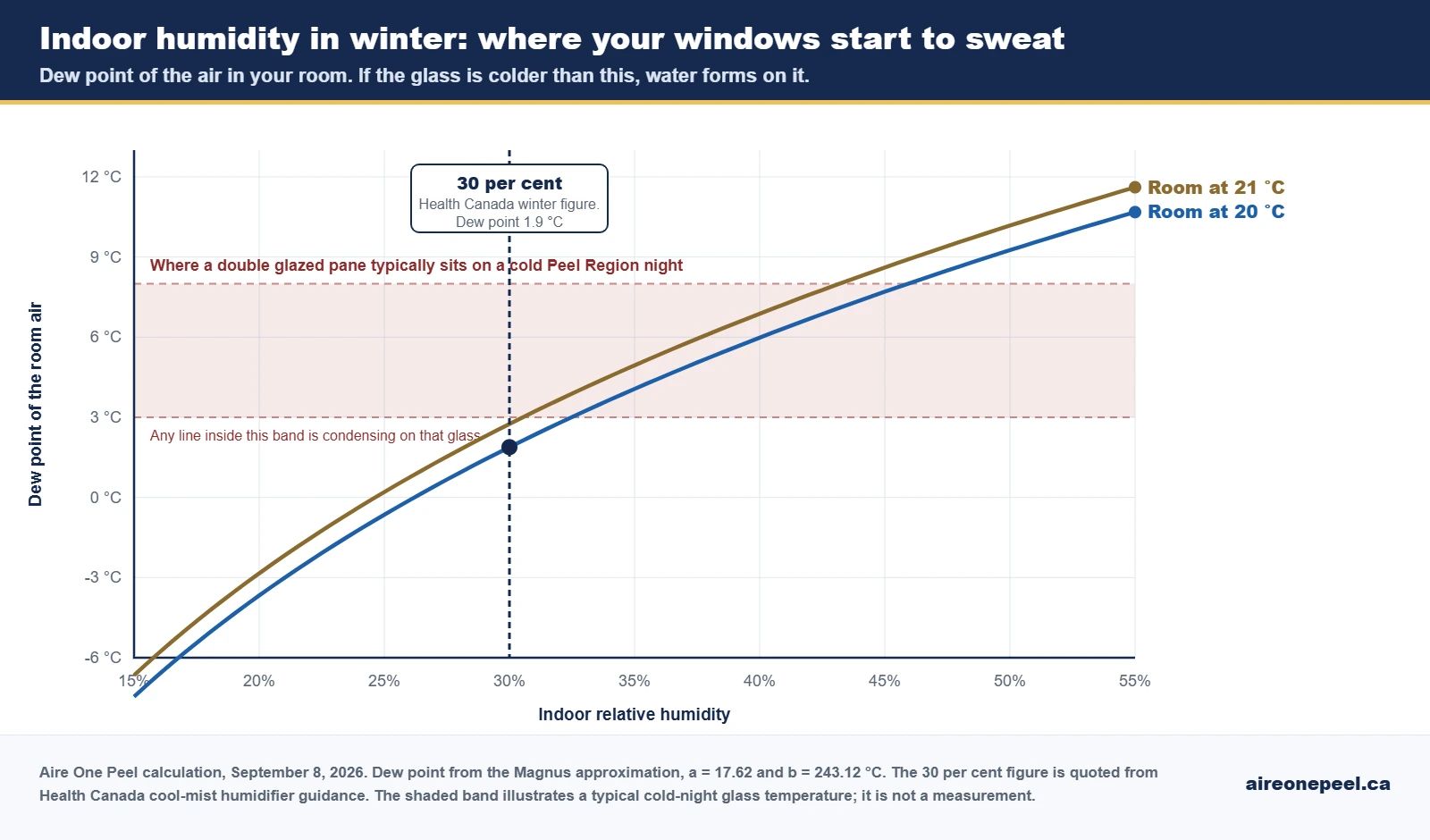
Indoor humidity in winter is capped by your windows
The arithmetic, so you can check it yourself
What too dry actually looks like
How to raise it, cheapest first
The part people skip, and why it matters
Too dry, or just a cold window?
How we know this
Watch: the team behind the advice
Frequently asked questions
The short version
Sources and references
Short answer
Around 30 per cent. Health Canada names 50 per cent in summer and 30 per cent in winter, and gives 30 to 50 per cent as the year-round band. In a cold snap the real limit is lower still, because the moment your window glass falls below the dew point of the room air, water forms on it.
Applies to Mississauga, Brampton, Etobicoke, Milton, Georgetown, Caledon and Bolton. The physics is identical everywhere; only your window and your outdoor temperature change.
The number, and why two Health Canada pages differ
Health Canada publishes two figures for indoor humidity, and they are not in conflict once you see what each is for. The mould guidance gives a band you should stay inside all year. The humidifier guidance gives a seasonal target within that band, and for winter that target is the bottom of it. Most pages quote the first and ignore the second, which is how "aim for 40 to 45 in winter" became common advice that neither document supports.
| Source page | What it says | Modified | What it is for |
|---|---|---|---|
| Mould | Maintain relative humidity levels between 30 and 50 per cent, stated year round with no seasonal split | February 13, 2023 | The band you should never leave |
| Cool-mist humidifiers | Keep the humidity at around 50 per cent in the summer and 30 per cent in the winter to prevent mould growth | October 14, 2012 | Where to sit inside that band, by season |
Read together, the instruction for an Ontario winter is clear enough: stay inside 30 to 50, and aim at the 30 end. Not because dry air is pleasant, but because the alternative in a cold climate is water on your building. That is the part the next section is about.
Indoor humidity in winter is capped by your windows, not your comfort
In winter your maximum indoor humidity is decided by the coldest surface in the room, and in almost every Ontario house that surface is a window. Warm indoor air holds a certain amount of water vapour, and when that air touches glass cold enough, the vapour turns back into liquid. The temperature at which that happens is the dew point of your indoor air, and it depends only on the room temperature and the humidity.
This is why the advice cannot be a single number. At 20 degrees and 30 per cent humidity, your dew point is about 2 degrees, so the glass has to get near freezing before anything forms. Push the same room to 50 per cent and the dew point climbs to about 9 degrees, which a double-glazed window in a Peel Region February reaches easily. The humidity did not become unhealthy. It became more than your windows can carry.
Key takeaway
Condensation on the inside of your windows is not a window fault and it is not weather. It is a reading. It means the humidity in that room is currently above what the coldest surface in it can tolerate, and the fix is to lower the humidity rather than to wipe the glass.
The arithmetic, so you can check it yourself
The table below is our own calculation rather than a chart borrowed from somewhere, and the formula is printed underneath so you can verify every row. Find your humidity reading in the first column, read across to the dew point, and compare it to how cold you think your glass gets on a bad night. If the glass is colder than that number, you will get condensation.
| Indoor humidity | Dew point at 20 °C | Dew point at 21 °C | Condensation forms when the glass is |
|---|---|---|---|
| 20 per cent | -3.7 °C | -2.8 °C | below freezing. Very hard to reach indoors |
| 30 per cent | 1.9 °C | 2.7 °C | near freezing. This is why 30 is the winter target |
| 35 per cent | 4.1 °C | 4.9 °C | cold, but reachable on an older window |
| 40 per cent | 6.0 °C | 6.9 °C | a normal double-glazed pane in a cold snap |
| 45 per cent | 7.7 °C | 8.6 °C | most windows, most of a Peel Region winter |
| 50 per cent | 9.3 °C | 10.2 °C | almost any window once it is properly cold out |
The formula, if you want to run it: dew point equals b times gamma divided by a minus gamma, where gamma is the natural log of the humidity as a fraction, plus a times the temperature divided by b plus the temperature. With a equals 17.62 and b equals 243.12 you will land on the same numbers we did.
What too dry actually looks like
Below about 30 per cent the complaints stop being about comfort and start being about your house. Static shocks off a door handle, timber floors opening at the seams, doors that suddenly stick or suddenly do not, instrument bodies and furniture joints moving: these are moisture leaving the wood, and they are the reason the lower bound exists rather than dropping to zero. The human side, dry eyes and dry skin and a scratchy nose, is real but it is the part we are least qualified to speak about, so this page treats it as a comfort signal rather than a medical one.
| What you notice | Likely reading | Which way to move |
|---|---|---|
| Static shocks, gaps opening in wood floors, furniture joints loosening | Under 30 per cent | Up, toward 30 |
| Comfortable, no condensation, nothing moving | Around 30 to 35 per cent | Nowhere. This is the target |
| A rim of water along the bottom of the glass on cold mornings | Above your window's ceiling | Down, until the glass stays dry |
| Water pooling on sills, paint lifting, dark spots at the frame corners | Well above it, for a while | Down now, and check for damage |
| Musty smell, damp basement, visible mould | Over 50 per cent somewhere | Down, and find the moisture source |
How to raise it, cheapest first
If your indoor humidity in winter is genuinely below 30, work down this list in order, because the first two cost nothing and the last one is a permanent install. Most Ontario houses that feel painfully dry are not short of a humidifier; they are running one that is switched off, set wrong, or blocked with scale. Only after those are ruled out is new equipment the answer.
| Option | Covers | The catch | Who fits it |
|---|---|---|---|
| Check the humidistat you already have | Whole house | Often left off from last spring, or set for a mild day | You, free |
| Run the bathroom fan less, air-dry laundry indoors | Whole house, modestly | Do not overdo it. This is how basements get damp | You, free |
| Portable humidifier | One room | You refill it and you clean it, weekly, without fail | You |
| Bypass or fan-powered humidifier on the furnace | Whole house | Needs a water line, a drain and an annual pad change | HVAC technician |
| Steam humidifier | Whole house, tighter control | Uses electricity to boil water, so it costs more to run | HVAC technician |
If you are weighing the whole-house options, our humidifiers page lists what we install, and a technician can tell you at a free in-home estimate whether your furnace already has the water line and drain that a bypass unit needs. Retrofitting those is often the real cost, not the humidifier.
The part people skip, and why it matters
A humidifier that is not cleaned stops being a comfort appliance and becomes a problem of its own. Health Canada is direct about this for portable cool-mist units: clean and disinfect the water reservoir on a regular basis and follow the manufacturer's directions, because bacteria collect and multiply in sitting water and a cool-mist unit does not boil the water, so it does not kill them. That is the whole argument for the weekly clean, and it is not ours, it is theirs.
On water, Health Canada's position is more relaxed than the marketing suggests: the number of particles released into the air is generally much lower with distilled water, but tap water is fine in most cases. So distilled is a dust question, not a safety requirement. For a furnace-mounted unit the equivalent job is the annual pad or panel change and a look at the drain, which is part of a normal heating service visit and is worth doing before the season rather than in February.
Safety
A furnace-mounted humidifier is plumbed and wired into a gas appliance. Fitting or moving one is work for a TSSA-registered fuels contractor, not a weekend job. If the furnace itself needs attention, that is a furnace repair; yearly servicing is covered on our protection plans page. Opening a furnace cabinet exposes you to gas, electrical and sharp-edged components at once.
Separately, no humidity setting protects you from carbon monoxide. Only a working CO alarm does. If one sounds, get everyone outside and call 911 from outside.
| The job | You can do it | Needs a technician |
|---|---|---|
| Read the humidity and set the humidistat | Yes, and it is the first thing to try | No |
| Clean a portable humidifier reservoir | Yes, weekly, per the manufacturer | No |
| Change the pad or panel on a furnace humidifier | Sometimes, if the access panel is external | Usually, and it rides along with a heating service |
| Clear a blocked humidifier drain | No | Yes |
| Fit a humidifier to the furnace | No | Yes. Gas appliance work, TSSA-registered fuels contractor |
Not sure whether your furnace can take a humidifier?
A technician can tell you in one visit whether the water line and drain are already there, what your current unit is actually doing, and whether the dryness is an equipment problem at all. That is a conversation, not a sale.
Book a free in-home estimate Call 905-564-8545Aire One Peel Heating & Cooling, 1625 Courtneypark Dr E, Mississauga, ON L5T 1V9
Too dry, or just a cold window?
Two questions, and it points you at a row of the tables above. Every answer already appears in the prose, so nothing here depends on the script running.
1. On a cold morning, what do the windows look like?
How we know this
Two kinds of claim appear on this page and they are sourced differently. The humidity targets and the humidifier cleaning guidance are quoted from two Health Canada pages, named and dated below, and where those two pages differ we show both rather than picking the one we prefer. The dew point table is our own arithmetic from the Magnus approximation, with the constants printed so you can reproduce it. Nothing here is a survey, an estimate, or a figure we read on another contractor's site.
Two things we are not claiming. We have no first-party figure on this page. The number that belongs here is the share of Peel Region homes we visit in winter that are already running a humidifier badly rather than lacking one, with the sample and the window, and we have not counted it to a standard we would put our name to. And the author's title is a company role, not a trade credential. Mario Vaghei is General Manager. No credentialed reviewer is confirmed for this page, so none is claimed.
The honest downside of calling us about this: the two most common fixes on this page cost nothing. A humidistat left switched off since spring, and a humidity level that needs lowering rather than raising, together explain most winter complaints we hear. We would rather you find that out here than on an invoice.
Watch: the team behind the advice
Company footage from our own channel. None of it demonstrates humidity control, so treat it as background on who would be doing the work rather than as evidence for anything above.
Frequently asked questions
What humidity should a house be at in winter in Canada?
Around 30 per cent. Health Canada's humidifier guidance names 50 per cent in summer and 30 per cent in winter to prevent mould growth, and its mould guidance gives 30 to 50 per cent as the band to stay inside year round. In a cold snap your own ceiling may be lower than 30, because the limit is set by how cold your window glass gets rather than by the calendar.
Is 20% humidity too low in winter?
It is below the band Health Canada names, so it is worth raising if your windows allow it. At 20 per cent you will notice static shocks and wood shrinking, which is moisture leaving your floors and furniture rather than a comfort preference. Raise it toward 30 and stop there, checking the glass on cold mornings as you go.
How dry is too dry for a house?
Below 30 per cent is where the lower bound sits, and the house tells you before a meter does. Static discharge off door handles, gaps opening between floorboards, and doors that change how they fit their frames are all the same signal. The building is giving up moisture to the air, and that is what the 30 per cent floor exists to prevent.
What is the ideal humidity level in a home during cold weather?
There is no single ideal number, and that is the honest answer. The target is around 30 per cent, but your actual ceiling is whatever your coldest window can tolerate before water forms on it. On a mild December day you might hold 35 comfortably; during a deep cold snap the same house may need to sit lower. Watch the glass, not the calendar.
Can mold grow at 55 humidity?
55 per cent is above the range Health Canada names, and its guidance is to maintain relative humidity between 30 and 50 per cent. Mould needs moisture, a surface and time, so a whole house at 55 is a risk rather than a certainty. The bigger danger in winter is local: one cold corner or window frame can sit far wetter than the room average.
At what percentage, do you keep humidity at home during winter season?
We set customers up around 30 per cent and then adjust down if their windows say to. That last part matters more than the starting number, because two houses on the same street with different windows have different ceilings. A humidistat set once in November and never looked at again is the most common thing we find on a winter call.
The short version
Aim for about 30 per cent in winter, and let your windows overrule that if they disagree. The 40 to 45 per cent figure repeated across most winter humidity advice is above what Health Canada names for the season and above what an ordinary double-glazed window in Peel Region can carry on a cold night.
Buy a hygrometer before you buy anything else. If the glass is wet, lower the humidity rather than wiping it. If the glass is dry and the reading is genuinely under 30, check the humidistat you already own before shopping. The full picture of what makes indoor air good or bad, in order of what matters, is on our indoor air quality guide, and if you would rather have someone look at your specific furnace and windows, our humidifier team does that as part of a free in-home estimate.
Sources and references
Both Health Canada pages were read on September 8, 2026.
Health Canada, Mould, modified February 13, 2023. Source of the 30 to 50 per cent year-round band.
Health Canada, Cool-mist humidifiers, modified October 14, 2012. Source of the 50 in summer and 30 in winter target, the reservoir cleaning guidance, and the position on distilled against tap water.
Dew point figures are our own calculation using the Magnus approximation with a equals 17.62 and b equals 243.12 degrees Celsius, computed September 8, 2026. No third-party chart was used.
Mario Vaghei
General Manager, Aire One Peel Heating & Cooling
Mario built this page after noticing that our own older winter humidity posts repeated the common 40 to 45 per cent advice without checking it against Health Canada's seasonal figure or against what an Ontario window can actually carry. Three of those posts now redirect here.