



24/7 Emergency, No After-Hours Charge
Carrier Factory Authorized Dealer
BBB Accredited Business
Free In-Home Estimates
Financing and Rent-to-Own

By Mario Vaghei, General Manager, Aire One Peel Heating & Cooling · Published July 30, 2024 · Facts verified August 31, 2026
Your thermostat is a switch with opinions. When it misreads the room, loses power, or sits in the wrong spot on the wall, the furnace or air conditioner behind it takes the blame, and homeowners book an air conditioner repair for what turns out to be two dead AA batteries. This guide walks through the eight most common thermostat problems we see across Peel Region, what each one does to your comfort and your bills, the six checks that are safe to do yourself, and where the line sits between a DIY fix, an HVAC technician, and a licensed electrician.
In this guide
How a thermostat causes bigger problems ·
Symptom to cause table ·
Checks you can do yourself ·
Blank screen ·
Not reaching the set temperature ·
Short cycling and non-stop running ·
Who fixes what ·
Repair or replace ·
FAQ ·
Final verdict
Short answer
Most common thermostat problems trace back to five causes: dead batteries, a tripped breaker or blown fuse, dust inside the housing, poor placement or an unlevel mount, and failed low-voltage wiring. Check power, batteries and settings first; if the screen is lit and the system still misbehaves, the fault usually needs a professional diagnosis.
The six checks below take about ten minutes and cost nothing.
Key takeaways
- A dark thermostat display means the system is not being told to run at all. Batteries, breaker and fuse solve most of these without a service call.
- A thermostat in direct sun, near a lamp, or over a draughty hallway reads the wrong room. Moving or shading it beats replacing it.
- Short cycling wears equipment faster than steady running. If cleaning and levelling do not stop it, the cause may be equipment-side, not the thermostat.
- Low-voltage thermostat work is open to careful DIY. Line-voltage (240 V baseboard) wiring belongs to a Licensed Electrical Contractor under Electrical Safety Authority rules.
How does a faulty thermostat cause bigger HVAC problems?
Common thermostat problems become bigger HVAC problems because the thermostat sends the wrong instructions: it can stop calling for heating or cooling entirely, call for it constantly, or start and stop the equipment every few minutes. That last pattern, short cycling, is the damaging one, because compressors and igniters take most of their wear at startup. A misreading thermostat also costs money quietly: a unit that thinks the room is 2 degrees Celsius cooler than it is will run the air conditioning that much harder all summer.
The good news is that the thermostat is the cheapest, most accessible component in the whole system, so it is the right place to start any diagnosis, the same way our technicians do on a service call. If you have already been through this page and suspect the equipment itself, our AC not cooling guide picks up where this one ends.
The eight common thermostat problems, mapped to causes
Eight symptoms cover nearly every thermostat complaint we hear: a blank screen, a lit screen with nothing running, a room that never reaches the setpoint, a reading that disagrees with the room, short cycling, non-stop running, and a programmable schedule that does not hold, and a thermostat that refuses a change because its controls are locked. The table below maps each to its most likely cause and to who usually ends up fixing it.
| Symptom | Most likely cause | Who usually fixes it |
|---|---|---|
| Screen blank or flickering | Dead batteries, tripped breaker, blown fuse | You |
| Screen lit, system never starts | Loose or corroded low-voltage wiring, failed control board | HVAC technician |
| Room never reaches the set temperature | Dust inside the housing, unlevel mechanical unit, undersized or struggling equipment | You first, then HVAC technician |
| Reading disagrees with the actual room | Placement in sun, near a lamp or appliance, or over a draught | You (shade or relocate) |
| Starts and stops every few minutes (short cycling) | Maladjusted heat anticipator, dirt, or an oversized system | You first, then HVAC technician |
| Runs non-stop, never satisfied | Stuck contacts, failing sensor, or genuine capacity shortfall in extreme weather | HVAC technician |
| Programmed schedule does not hold | Weak batteries losing the program, hold mode left on, clock or day set wrong | You |
| Will not accept a temperature change | Keypad or access lock enabled, or a hold or vacation schedule overriding the change | You |
What can I check myself before calling anyone?
Before calling anyone, run six checks: batteries, breaker, mode and setpoint, cleanliness, level, and a simple 3-degree response test. Every one of them is safe on a standard low-voltage thermostat with the power off, needs at most a screwdriver, a soft brush and a level, and together they resolve a large share of thermostat complaints on the spot.
| Check | How | Time |
|---|---|---|
| Batteries | Swap in fresh ones even if the display is faintly alive. Weak batteries corrupt programs before they kill the screen. | 2 minutes |
| Breaker and fuse | Check the panel for a tripped breaker on the furnace or air handler circuit; many furnaces also carry a small fuse on the control board. | 3 minutes |
| Mode and setpoint | Confirm Cool in summer, Heat in winter, fan on Auto, and a setpoint past the current room temperature. Check that hold mode is not overriding the schedule and that the keypad lock is off. | 1 minute |
| Clean the inside | Power off at the breaker, remove the cover, and clear dust from the components with a soft brush or short puffs of compressed air. | 5 minutes |
| Level | Hold a level against older mechanical models; a mercury-switch or bimetal thermostat mounted off level reads wrong by design. | 2 minutes |
| 3-degree response test | Set the thermostat 3 degrees Celsius past the room temperature and listen: you should hear a soft click, then the equipment starting within a few minutes. | 5 minutes |
Know where DIY ends: turn the power off at the breaker before opening any thermostat. If yours controls 240 V electric baseboard heat, it is line-voltage equipment, and the Electrical Safety Authority is clear that Licensed Electrical Contractors are the only businesses in Ontario legally authorized to do electrical work in your home. And if you ever smell gas while troubleshooting a furnace that will not start, stop, leave the house, and call Enbridge Gas’s 24 hour emergency line from outside before calling anyone else.
Why is my thermostat screen blank?
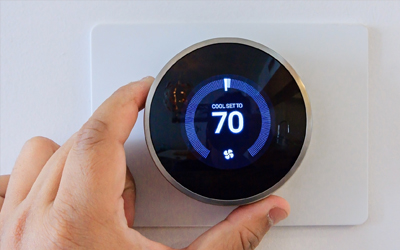
A blank thermostat screen almost always means the thermostat has lost power, so it is not telling your furnace or air conditioner to run at all. Batteries are the first suspect on battery-powered models. On models powered from the equipment, look for a tripped breaker, the furnace door switch not fully closed, a blown control-board fuse, or a condensate safety switch that has shut the system down.
If fresh batteries and a reset breaker do not wake the display, the fault has moved past the thermostat into the transformer or wiring, which is technician territory. Our separate guide on how to test an old thermostat covers the multimeter steps if you want to confirm the diagnosis before booking.
Why is my thermostat not reaching the set temperature?
When a room never reaches the set temperature, the thermostat is usually either dirty, unlevel, or reading a spot that is not representative of the room. Dust on the sensor insulates it; a mechanical thermostat mounted off level mis-tensions its bimetal coil; and a unit in direct sunlight, above a lamp or appliance, or across from a draughty hallway is measuring its own microclimate instead of your living space.
Clean it, level it, and honestly assess the wall it lives on. The right home for a thermostat is an interior wall in a main living area, away from sun, supply vents, and heat-producing electronics. If the placement is fine and the gap between setpoint and room persists, the shortfall is likely equipment-side, undersized or failing, and worth a professional look before it becomes a mid-heatwave breakdown.
Why does my system keep turning on and off, or never stop?
Short cycling, the pattern where heating or cooling starts and stops every few minutes, is most often caused by a clogged air filter, and at the thermostat by dirt on the components or a maladjusted heat anticipator on older mechanical models. Change the filter first, because it is the cheapest fix on this page and it resolves a large share of these calls. Nudge the anticipator arm in small increments toward a longer cycle, waiting a full cycle between adjustments. The opposite complaint, a system that never shuts off, points to stuck contacts, a failing sensor, or equipment that genuinely cannot keep up in extreme weather.
Both patterns deserve attention rather than tolerance. Startup is when compressors and igniters do most of their wearing, so a short-cycling system is aging in fast-forward, and a never-stopping one is paying peak-hour electricity prices for cooling it cannot deliver. If the thermostat checks come back clean, stop adjusting and book a diagnosis: the cause list beyond the thermostat (refrigerant charge, airflow, sizing) is not DIY ground.
Who fixes a thermostat problem: you, an HVAC technician, or an electrician?
Who fixes a thermostat problem depends on the voltage and on where the fault sits: homeowners can handle batteries, cleaning, levelling and settings on any low-voltage thermostat; HVAC technicians handle wiring faults, replacements and anything on the equipment side; and line-voltage thermostats for 240 V baseboard heat are legally a Licensed Electrical Contractor’s job in Ontario.
| Situation | The right person | Why |
|---|---|---|
| Batteries, cleaning, levelling, settings, schedules | You | Safe with the power off, no trade skills needed |
| Like-for-like swap of a low-voltage (24 V) thermostat | Confident DIY, or an HVAC technician | Low-voltage control wiring; label the wires before disconnecting anything |
| Wiring faults, C-wire additions, smart thermostat installs, equipment-side faults | HVAC technician | The fault often sits at the furnace control board, not the wall |
| Line-voltage (120/240 V) baseboard thermostat | Licensed Electrical Contractor | The ESA states LECs are the only businesses in Ontario legally authorized to do electrical work in your home; ask for the 7-digit ECRA/ESA licence number |
| Gas furnace fault behind a healthy thermostat | TSSA-certified gas technician | TSSA requires fuel-fired appliances to be maintained by TSSA-registered contractors employing certified gas technicians |
This is also where we come in, with a caveat worth stating plainly. Aire One Peel is a TSSA-registered fuels contractor and a Carrier Factory Authorized Dealer, and our technicians diagnose thermostat and control faults across Mississauga, Brampton, Etobicoke, Milton, Georgetown, Caledon and Bolton, 24/7 with no after-hours charge. The possible downside of calling us first: a service call has a real cost, and if your fix turns out to be two AA batteries, you did not need us. That is exactly why the homeowner checklist above comes before the phone number, and why our furnace repair and AC repair teams start every call by re-running those same checks.
When does replacing the thermostat make more sense than fixing it?
Replacing the thermostat makes more sense than repairing it when the unit is an older mechanical model, when it has failed more than once, or when you are already paying for a service visit, because the hardware is inexpensive relative to the labour of repeated calls. Replacement is also the moment to fix placement mistakes and to step up to a programmable or ENERGY STAR certified smart thermostat.
The setback numbers make the upgrade case on their own. Natural Resources Canada notes that space heating and cooling represent almost two thirds of home energy use, recommends programming 17 degrees Celsius when you are sleeping or away and 20 degrees Celsius when you are awake and at home, and calls a setback of 2 to 3 degrees Celsius the optimal balance of savings and comfort. A thermostat that cannot hold a schedule cannot capture any of that.
There is an Ontario-specific angle too. On the Ontario Energy Board’s summer Time-of-Use schedule, in effect since November 1, 2025, on-peak electricity runs weekdays from 11 a.m. to 5 p.m. at 20.3 cents per kWh, against 9.8 cents off-peak. A schedule-holding thermostat that pre-cools your home before 11 a.m. and coasts through the on-peak window is working the rate structure in your favour; a faulty one does the opposite six hours a day. Our guide to the types of thermostats compares the options if you land on replacement.
| Setting | Guidance | Source |
|---|---|---|
| Awake and at home (heating season) | 20 degrees Celsius | NRCan |
| Sleeping or away | 17 degrees Celsius | NRCan |
| Optimal setback depth | 2 to 3 degrees Celsius | NRCan |
| Costliest hours to run cooling (summer) | Weekdays 11 a.m. to 5 p.m., 20.3 cents per kWh on-peak vs 9.8 off-peak | Ontario Energy Board |
30-second thermostat triage
Two questions, same routing as the tables above.
The triage needs JavaScript; the symptom table and the who-fixes-it table above give the same answers.
How we know this
Setpoint guidance comes from Natural Resources Canada’s ENERGY STAR smart thermostat page, electrical rules from the Electrical Safety Authority, fuels rules from the Technical Standards and Safety Authority, and electricity prices from the Ontario Energy Board’s rate page (prices in effect since November 1, 2025), all read on August 31, 2026. The symptom-to-cause mapping reflects how Aire One Peel’s service department triages thermostat calls; we have not yet published counted first-party call data, so this page claims no percentages from it.
See who you would be calling
Three short videos from our own channel.
Video 1 of 3
Checks done and it still is not right?
Book a free in-home estimate or a diagnosis, 24/7 with no after-hours charge. Aire One Peel Heating & Cooling, TSSA-registered fuels contractor FS R0076624709, 1625 Courtneypark Dr E, Mississauga, ON L5T 1V9.
Frequently asked questions
What is the most common cause of a thermostat failure?
The most common cause is lost power rather than a broken thermostat: dead batteries, a tripped breaker, a blown control-board fuse, or a furnace door switch left open. Dust inside the housing and poor placement come next. Genuine component failure, such as a dead sensor or stuck contacts, is less common than any of these.
How do I know if a thermostat is bad?
Set it 3 degrees Celsius past the current room temperature and listen for a click followed by the system starting within a few minutes. No click, a blank display after fresh batteries, a reading that disagrees with a separate room thermometer, or a system that ignores the setpoint all point to a failing thermostat.
Why is my thermostat suddenly not working?
A thermostat that stops working suddenly has usually lost power. Replace the batteries, check the breaker panel for a tripped breaker on the furnace or air handler circuit, confirm the furnace door switch is fully closed, and look for a blown fuse on the control board. If the display stays dark after all four, the transformer or wiring has failed.
Why won’t my thermostat let me adjust the temperature?
Most thermostats that refuse an adjustment are locked. Many models carry a keypad or access lock, often set with a PIN, which homeowners can enable by accident. Check the manual for the unlock sequence. If it is not locked, a hold or vacation schedule may be overriding your change, or the touchscreen itself has failed.
Why is my thermostat not giving the correct temperature?
Usually because it is dirty, mounted off level, or reading an unrepresentative spot such as a sunny wall or a draughty hallway. Clean the inside with a soft brush, level it, and shade or relocate it if placement is the issue. Older mechanical models also drift over time and some support recalibration.
Is there a reset button on a thermostat?
Few thermostats have a dedicated reset button. On battery powered models, removing the batteries for about thirty seconds does the same job. On hardwired models, switching the furnace or air handler breaker off for a minute resets it. Many smart thermostats hold a factory reset in the settings menu, which erases your schedule.
Can I replace a thermostat myself in Ontario?
A like-for-like swap of a standard low-voltage (24 V) thermostat is open to careful DIY with the breaker off and the wires labelled. A line-voltage thermostat for 240 V baseboard heat is different: the Electrical Safety Authority states that Licensed Electrical Contractors are the only businesses legally authorized to do electrical work in Ontario homes.
Final verdict
Nearly all of the common thermostat problems above are cheaper to rule out than to ignore, so treat the thermostat as the first suspect. Run the six checks before you spend anything: batteries, breaker, settings, cleaning, level, and the 3-degree test. Escalate to a professional when a lit screen runs nothing, when short cycling survives the wall-level fixes, or when the room never catches the setpoint on clean, well-placed hardware, and route line-voltage wiring to a Licensed Electrical Contractor rather than anyone else. If it lands in our lane, we answer around the clock at no after-hours premium.
What we updated
August 31, 2026: full rebuild of the July 2024 article. Added the symptom-to-cause, homeowner-checks, who-fixes-it and setpoint tables, locked-controls and air-filter causes, the safety callout, the triage quiz, the video gallery, NRCan setpoint guidance, ESA and TSSA rules, and Ontario Energy Board Time-of-Use pricing. All facts re-verified on the date shown in the byline.
Sources and references
- Natural Resources Canada, ENERGY STAR certified smart thermostats: recommended setpoints and setback guidance
- Electrical Safety Authority, hiring a Licensed Electrical Contractor in Ontario
- Ontario Energy Board, current electricity rates and Time-of-Use hours
- Technical Standards and Safety Authority, hiring registered contractors and certified gas technicians
Mario Vaghei
General Manager, Aire One Peel Heating & Cooling
Mario oversaw this rebuild of our 2024 thermostat guide, drawing the symptom triage from how our service department actually handles these calls, and checked the regulator and pricing references against the NRCan, ESA, TSSA and OEB pages cited above on August 31, 2026.