





By Mario Vaghei, General Manager, Aire One Peel Heating & Cooling · Published June 5, 2025 · Facts verified September 2, 2026
A smart air quality monitor is a small sensor that sits on a shelf and tells you what is in the air of the room it is in. The honest question is not whether the technology works. It is whether the number on the screen will change anything you do. For most Peel Region homes the answer turns on one thing: will you open a window, or run the ventilation, when it tells you to? If the answer is no, the money is better spent elsewhere, and if your worry is safety rather than comfort, you need different equipment entirely. Aire One Peel does not sell air quality monitors, so nothing on this page is trying to move one. If your concern is the air the whole house breathes, our indoor air quality page covers the equipment that actually changes it.
On this page
- What a smart air quality monitor actually measures
- What Health Canada publishes a guideline for
- The two hazards a monitor will not save you from
- Three cases where a monitor earns its price
- Where cheap sensors get it wrong
- What to buy first if the budget is tight
- Do you actually need one?
- How we know this
- Watch: the team behind the advice
- Frequently asked questions
- The short version
- Sources and references
Short answer
A smart air quality monitor is worth it if you will act on what it shows you, because its real job is telling you when to ventilate. It is not worth it as a safety device: it does not replace the carbon monoxide alarms Ontario law requires, and it cannot detect radon at all.
The most useful number a monitor gives an Ontario homeowner is carbon dioxide, because high carbon dioxide means the room is under-ventilated and the fix is free. Health Canada sets the long-term residential guideline at 1,800 mg/m³, which is 1,000 ppm over 24 hours. Everything else on the screen is either a blended index you cannot compare to anything, or a pollutant that needs a different device.
Key takeaways
- Health Canada publishes residential indoor air quality guidelines for 11 pollutants. A typical consumer monitor gives you a directly comparable number for one of them.
- Carbon monoxide is governed by the Ontario Fire Code, and the rules got stricter on January 1, 2026. A monitor that displays a carbon monoxide number is not a certified alarm and does not satisfy the law.
- Radon has a Health Canada guideline of 200 Bq/m³ and needs a long-term test kit. Almost no air quality monitor detects it.
- The Government of Canada's own position on low-cost sensors is that they are less accurate than regulatory monitors but still useful. Useful, not authoritative.
What a smart air quality monitor actually measures
A consumer air quality monitor reads a handful of things directly and infers the rest. The distinction matters because the numbers you can trust and the numbers you cannot sit side by side on the same screen, in the same font, with no warning that one of them is a genuine measurement and the other is an index.
| What it reads | How it works | How far to trust it |
|---|---|---|
| Carbon dioxide | Optical sensor reading the gas directly | The one to act on. Comparable to a published Health Canada guideline |
| Fine particulate, PM2.5 and PM10 | Laser counts particles crossing a beam | Good for spotting a change, such as wildfire smoke or cooking. No Canadian residential threshold to compare it to |
| Total volatile organic compounds | One metal-oxide sensor reporting a single blended index | Treat as a trend, not a number. It cannot tell a lemon cleaner from formaldehyde |
| Carbon monoxide | Electrochemical cell, on some models only | Not a substitute for a certified alarm. See the safety section below |
| Temperature and humidity | Standard sensors, reliable | Reliable, and genuinely useful. Health Canada's mould guidance turns on humidity |
Health Canada publishes 11 residential guidelines. Your monitor reads one of them.
Health Canada has published Residential Indoor Air Quality Guidelines for eleven named pollutants, each with a number and an averaging time. A typical consumer monitor produces a figure you can hold against exactly one of those eleven, which is carbon dioxide. Six more are real chemicals with their own guidelines that vanish into a single blended index, and four need a different device altogether.
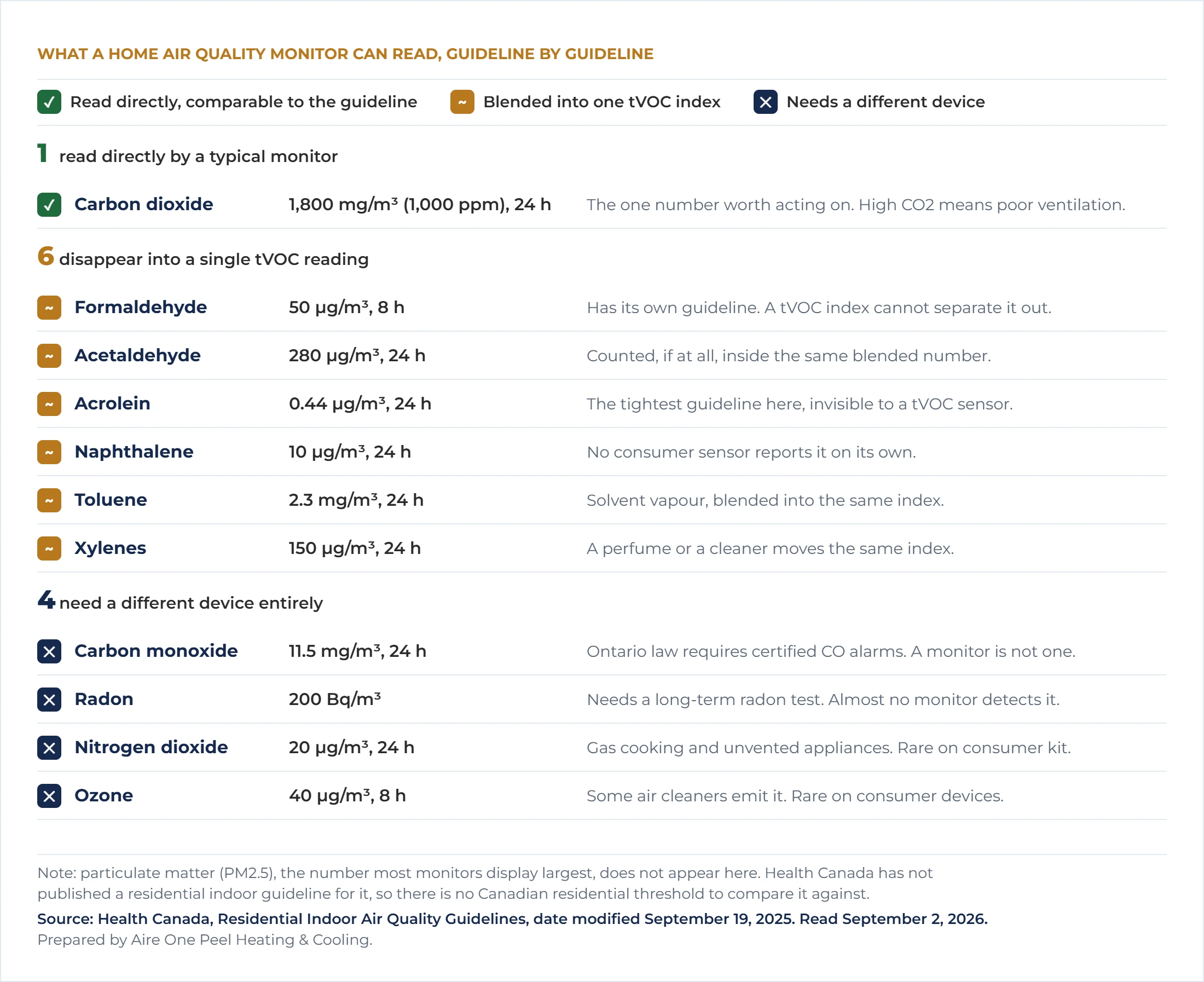
Health Canada, Residential Indoor Air Quality Guidelines, date modified September 19, 2025. Carbon dioxide values from the Residential Indoor Air Quality Guidelines: Carbon Dioxide. Read September 2, 2026.
| Group | Pollutants | What to do about it |
|---|---|---|
| 1 read directly | Carbon dioxide | Act on it. Above 1,000 ppm, ventilate the room |
| 6 blended into one index | Formaldehyde, acetaldehyde, acrolein, naphthalene, toluene, xylenes | Watch the trend after painting, cleaning or new furniture. Do not read it as a concentration |
| 4 need another device | Carbon monoxide, radon, nitrogen dioxide, ozone | Certified CO alarms and a long-term radon test. Not a monitor's job |
One absence is worth naming. Fine particulate, the reading most monitors display largest and colour most dramatically, is not on Health Canada's residential list at all. There is no Canadian residential indoor threshold to hold your PM2.5 number against, so the traffic-light colour on the screen is the manufacturer's opinion rather than a national guideline. That does not make the reading useless. It makes it a comparison against yesterday, not against a standard.
The two hazards a monitor will not save you from
The two indoor hazards in Ontario that are regulated because they kill people are carbon monoxide and radon, and a smart air quality monitor addresses neither of them properly. This is the single most important thing on this page, and it is the part most articles on the subject leave out.
Safety, not a preference
A carbon monoxide reading on an air quality monitor is not a carbon monoxide alarm. Ontario requires certified CO alarms by law, and the requirements were expanded on January 1, 2026 under Section 2.16 of Division B of the Fire Code, O. Reg. 213/07, as amended by O. Reg. 87/25. Alarms are now required adjacent to each sleeping area and on every storey of the home, including storeys with no bedroom, in homes with a fuel-burning appliance, a fireplace or an attached garage.
A consumer monitor is not certified to any alarm standard, it may be in the wrong room, and its battery and alert behaviour are not designed for a sleeping household. If you suspect carbon monoxide right now, leave the building and call 911 from outside.
| Where | Required from January 1, 2026 | Does a smart monitor satisfy it? |
|---|---|---|
| Adjacent to every sleeping area | Yes, in homes with a fuel-burning appliance, fireplace or attached garage | No |
| Every storey, including storeys with no bedroom | Yes, this is the part that changed | No |
| Radon testing | Not required by law. Health Canada's guideline is 200 Bq/m³ | No, use a long-term test |
Radon is the other one. It is a colourless gas that seeps in from the ground, Health Canada's guideline is 200 Bq/m³, and Health Canada advises corrective action above that level, sooner the higher the reading. It is measured with a long-term test kit over months, not by a shelf sensor over an evening. If a monitor's marketing implies it covers radon, check the specification before you believe it.
Three cases where a monitor earns its price
A monitor earns its money in the situations where a reading changes a decision you would otherwise get wrong. There are three of those in a typical Peel Region home, and outside them the device becomes an expensive thermometer.
| Case | What the reading changes | Skip it if |
|---|---|---|
| A stuffy bedroom or a tightly sealed newer home | Carbon dioxide climbing overnight tells you the room is under-ventilated, and the fix is opening a door, running the ventilation longer, or using the furnace fan to move air | You already know the room is stuffy and are willing to just ventilate it |
| Wildfire smoke season | Particulate readings tell you when to close windows and run a filter, and, just as usefully, when the indoor air has recovered and you can open up again | You would follow the public Air Quality Health Index anyway |
| Someone in the house has asthma or allergies | Trends link symptoms to real events, such as cooking, vacuuming or a humidity swing, which is information a doctor can use | The trigger is already known and the money would be better spent on filtration |
The possible downside of asking us. Aire One Peel sells equipment that changes the air, not devices that describe it, so our advice runs toward ventilation and filtration because that is what we install. That is a real bias and you should read it as one. If your only question is which monitor to buy, an independent reviewer who tests devices against reference instruments will serve you better than we will, and we would rather say that than pretend otherwise.
Where cheap sensors get it wrong
Low-cost sensors fail in specific, predictable ways, and knowing them is the difference between using the device and being alarmed by it. The Government of Canada's own science page puts the position plainly: low-cost sensors may not be as accurate as regulatory monitors, but they can still provide valuable information.
| What you see | What it usually is | What to do |
|---|---|---|
| A sudden red tVOC spike | Perfume, a cleaning product, or an alcohol wipe near the sensor | Ignore single spikes. Read the weekly trend instead |
| Particulate readings that climb on humid days | Optical counters can read water droplets as particles | Compare against the humidity reading on the same screen before reacting |
| Numbers drifting over months | Sensor drift, which is normal and why regulatory monitors are calibrated | Treat the device as a change detector, not an instrument of record |
| An index that does not match the public air quality number | Small sensors read fine particulate. The Air Quality Health Index includes other pollutants too | Do not treat your monitor's number as the AQHI. They are not the same measurement |
What to buy first if the budget is tight
If money is limited, the order of purchase matters more than the brand. We are not publishing a price band for monitors, because we do not sell them and a figure we have not verified today is worth nothing to you. What we can tell you is the order, and it is the same order a Peel Region homeowner should follow whether they ever buy a monitor or not.
- Certified carbon monoxide alarms, correctly placed. Required by the Ontario Fire Code, and the requirements got wider on January 1, 2026. This is not optional and it is not expensive.
- A long-term radon test. Health Canada's guideline is 200 Bq/m³ and the only way to know your number is to measure it over months.
- Working ventilation and a clean filter. Most of what a monitor will eventually tell you is that the house needs more air moved through it. In a tightly sealed home that often means a heat recovery ventilator rather than an open window in February. Our vent and air duct cleaning page covers when duct work is worth doing, and honestly, when it is not.
- Then, if you will act on it, the monitor. It is the diagnostic, not the cure.
If the readings end up pointing at equipment rather than habits, that is where we come in. A free in-home estimate covers ventilation, filtration and humidity across Mississauga, Brampton, Etobicoke, Milton, Georgetown, Caledon and Bolton.
Do you actually need one?
Three questions, and every answer it can give you also appears in the tables above, so nothing here is exclusive to the tool.
Air quality monitor finder
1 of 3. What are you actually trying to find out?
How we know this
Every number on this page is read from a government source you can open yourself, and the things we do not know are named rather than estimated.
The eleven guideline values and the pollutant list come from Health Canada's Residential Indoor Air Quality Guidelines, date modified September 19, 2025. The carbon dioxide figure of 1,800 mg/m³ and 1,000 ppm over 24 hours, and the list of ventilation actions, come from the Residential Indoor Air Quality Guidelines: Carbon Dioxide. The radon guideline of 200 Bq/m³ comes from the Government of Canada radon guideline page, date modified September 24, 2025. The low-cost sensor position comes from a Government of Canada science blog published June 4, 2024. The carbon monoxide alarm requirements come from Section 2.16 of Division B of the Fire Code, O. Reg. 213/07 as amended by O. Reg. 87/25, as summarised by the Technical Standards and Safety Authority on December 18, 2025. All were read on September 2, 2026.
What this page deliberately does not claim: any price for an air quality monitor, and any brand recommendation. We do not sell these devices, we have not tested them against reference instruments, and a number we cannot defend is worse than no number. Compiled by Mario Vaghei, General Manager. No trade credential is claimed on this page.
Watch: the team behind the advice
These are company and furnace clips from our own channel rather than air quality footage, which is honest rather than ideal. There is no air quality monitor video to show you, because we do not sell them.
Indoor air quality, Peel Region
If the readings point at the house, we can fix that part
Ventilation, filtration and humidity across Mississauga, Brampton, Etobicoke, Milton, Georgetown, Caledon and Bolton. Free in-home estimates, financing and rent-to-own available. 1625 Courtneypark Dr E, Mississauga, ON L5T 1V9.
Frequently asked questions
Are indoor air quality monitors worth it?
They are worth it if you will act on the reading, because the value is in the decision it changes rather than the number itself. The carbon dioxide reading is the most useful one in a Canadian home, since high carbon dioxide means the room needs ventilating and the fix costs nothing. They are not worth it as safety equipment, because they do not replace certified carbon monoxide alarms and they do not detect radon.
Do air quality monitors actually work?
Yes, within limits that the Government of Canada states plainly: low-cost sensors may not be as accurate as regulatory monitors, but they can still provide valuable information. Carbon dioxide, temperature and humidity readings are dependable. Particulate readings are good at spotting change. The total volatile organic compound index is a trend line rather than a measurement, because one sensor cannot separate a cleaning product from a harmful chemical.
Which air quality monitor is the most accurate for home use?
No Canadian regulator or consumer body publishes an accuracy ranking of home air quality monitors, so any list claiming one is opinion rather than measurement. Aire One Peel does not sell or test these devices and will not name a winner. What separates a good unit from a poor one is a true optical carbon dioxide sensor, a stated particulate size range, and a manufacturer honest enough to describe its volatile organic compound reading as an index.
What is the best air quality monitor for home use in Canada?
There is no published Canadian best, and a monitor bought in Canada faces the same limits as anywhere else. The Canada-specific question is different: whichever device you choose, it will not cover carbon monoxide to the standard the Ontario Fire Code requires, and it will not cover radon against Health Canada's 200 Bq/m³ guideline. Buy those two separately first, then choose a monitor on the sensors it actually carries.
Is indoor air quality testing worth it?
A one-off professional test is worth it when you have a specific, persistent problem and a decision hanging on the answer, such as a mould smell, a renovation, or symptoms that follow the house. For general curiosity it is poor value, because indoor air changes hour to hour and a single visit captures one moment. A long-term radon test is the exception: that one is worth doing in every Ontario home.
Are air quality tests worth it?
It depends entirely on what is being tested. Radon testing is worth it for every home, because the hazard is invisible, the guideline is published at 200 Bq/m³, and the test is inexpensive. Broad indoor air panels are usually worth less than they cost, because they return a long list of substances with no context and no threshold you can act on. Ask what decision the result will change before you book one.
What are signs of poor indoor air quality?
Stuffiness and headaches that clear when you go outside, windows that fog on cold mornings, a musty smell in a basement, dust settling faster than it used to, and symptoms that improve away from home are the practical signs. In Ontario, condensation and mustiness usually point at humidity and ventilation rather than at anything exotic. None of these signs indicate carbon monoxide, which has no smell and needs a certified alarm.
The short version
Buy a smart air quality monitor if you will open a window when it tells you to. That is the whole test. In an ordinary Peel Region home the reading that will change your behaviour is carbon dioxide, and Health Canada's guideline of 1,000 ppm over 24 hours gives you a real line to measure against. Everything else on the screen is either a trend line or somebody else's opinion of what counts as red.
Do not buy one for safety. Ontario law requires certified carbon monoxide alarms adjacent to every sleeping area and, since January 1, 2026, on every storey of a home with a fuel-burning appliance, a fireplace or an attached garage. Radon needs a long-term test against a 200 Bq/m³ guideline. A monitor does neither, and believing it does is the one way this device can actually make you less safe.
If what you really want is cleaner, better-ventilated air rather than a number describing it, that is equipment rather than electronics, and it is what we do. Call 905-564-8545 or book a free in-home estimate. Aire One Peel serves Mississauga, Brampton, Etobicoke, Milton, Georgetown, Caledon and Bolton.
Mario Vaghei
General Manager, Aire One Peel Heating & Cooling
Rebuilt this guide on September 2, 2026, reading the eleven guideline values off Health Canada's Residential Indoor Air Quality Guidelines, the carbon monoxide alarm rules off the Technical Standards and Safety Authority summary of O. Reg. 87/25, and the low-cost sensor position off a Government of Canada science page. General Manager is a company role and not a trade credential, and no certification is claimed anywhere on this page.
Sources and references
- Health Canada, Residential Indoor Air Quality Guidelines. The eleven pollutants with published residential guidelines and their values. Date modified September 19, 2025. Read September 2, 2026.
- Health Canada, Residential Indoor Air Quality Guidelines: Carbon Dioxide. The 1,800 mg/m³ and 1,000 ppm 24 hour limit, and the list of ventilation actions. Read September 2, 2026.
- Government of Canada radon guideline. The 200 Bq/m³ guideline and the advice to act sooner the higher the level. Date modified September 24, 2025. Read September 2, 2026.
- Government of Canada, monitoring air quality with low-cost sensors. Accuracy relative to regulatory monitors, and the statement that small sensor data is not a representation of the full Air Quality Health Index. Published June 4, 2024. Read September 2, 2026.
- Technical Standards and Safety Authority, changes to the Ontario Fire Code for carbon monoxide alarms. Section 2.16 of Division B of O. Reg. 213/07 as amended by O. Reg. 87/25, effective January 1, 2026. Published December 18, 2025. Read September 2, 2026.