




By Mario Vaghei, General Manager, Aire One Peel Heating & Cooling · Published July 11, 2025 · Facts verified September 1, 2026
An air conditioner has two jobs, and Peel Region homeowners usually only notice when it stops doing the second one. Dropping the temperature is the easy job. Pulling water out of the air is the harder one, and it is the job that decides whether 22 degrees Celsius feels crisp or feels like a damp cellar. If your rooms are cool but sticky, your windows fog at breakfast, or the basement smells musty in August, the fault is almost never that the unit is too weak. This guide covers the six causes we actually find behind an air conditioner that cools but will not dehumidify, the six checks you can run yourself before spending anything, and the point where the job legally stops being yours. If your air is not even cold, start with why is my AC not cooling instead.
In this guide
Why the house is still humid · Cooling versus drying · The six causes · How humid a Mississauga summer is · What counts as too humid · Six checks you can run · The short cycling test · Who handles what · Humidity finder · When a dehumidifier is the answer · How we know this · FAQ · Final verdict
Short answer
An AC not removing humidity is usually running too short to dry the air. The two most common reasons are a thermostat fan set to ON instead of AUTO, which re-evaporates water off the coil, and a system oversized for the house, which cools fast and shuts off before moisture can condense and drain away.
Start with the six checks below. The first one is free and fixes a surprising share of these calls.
Key takeaways
- Fan on AUTO, not ON. With the fan running continuously, the blower blows the water sitting on a wet coil straight back into the house between cooling cycles.
- A bigger air conditioner dehumidifies worse, not better. Moisture removal needs run time, and an oversized unit buys comfort in temperature by giving up run time.
- Health Canada advises keeping indoor relative humidity between 30 and 50 per cent. That is a single year-round range, not a summer-only one.
- Anything involving refrigerant is closed to homeowners in Ontario. O. Reg. 463/10 requires certification to service equipment containing refrigerant, and bans discharging it indoors or outdoors.
Why is my house still humid even though the AC is on?
Your house is still humid with the AC on because the system is removing heat without removing enough water, and those are separate results that depend on separate conditions. Water only leaves your air when it condenses on an evaporator coil that is colder than the dew point of the air passing over it, then drains away. Every cause on this page interferes with one of those three steps: getting the coil cold enough, keeping air moving across it long enough, or letting the water actually leave.
This is why the complaint sounds contradictory. The thermostat is satisfied, so the equipment believes it has done its job, while your skin reports otherwise. Sweat evaporates slowly in damp air, so a humid 22 degrees Celsius room feels warmer and stuffier than a dry 24 degrees Celsius one. Homeowners then push the setpoint down, which makes cycles shorter and the moisture problem worse, and the electricity bill climbs for a result that keeps getting less comfortable.
Cooling and drying are two different jobs
Cooling and drying are two different jobs because an air conditioner splits its capacity between lowering temperature, called sensible cooling, and condensing water vapour out of the air, called latent cooling. The split is not fixed. A unit running a long, steady cycle across a properly cold coil devotes a healthy share of its work to moisture. The same unit running four minutes at a time devotes almost none, because the coil spends most of that time cooling down rather than sitting wet and condensing.
Run time is the whole story, and it explains the counter-intuitive part: a system that is too big for the house is worse at humidity than a correctly sized one. It satisfies the thermostat quickly, shuts off, and leaves a coil covered in water that then evaporates back into the ductwork. That is why "just get a bigger unit" is one of the more expensive wrong answers in this trade, and why we size replacements to CSA F280:12 (R2025), the current Canadian residential heat-loss and heat-gain standard, rather than to the size of the box already sitting there.
The six causes of an AC not removing humidity
Six causes account for nearly every humidity complaint we attend on a working air conditioner: the fan left on continuously, an oversized system, a restricted air filter, a dirty evaporator coil, a low refrigerant charge, and return ductwork drawing damp air from a basement, crawl space or attic. A filter and a coil left dirty are exactly what a seasonal air conditioner maintenance visit is meant to catch. The table maps each to what you would notice, the fix, and who is allowed to do it.
| Cause | What you notice | The fix | Who does it |
|---|---|---|---|
| Thermostat fan set to ON | Air keeps blowing after the outdoor unit stops; humidity climbs between cycles | Switch the fan to AUTO | You, free |
| Oversized system | Cools fast, cycles every few minutes, never feels dry | Variable-speed staging, a whole-home dehumidifier, or correct sizing at replacement | HVAC technician |
| Restricted air filter | Weak airflow at the vents, sometimes a frosted line at the indoor unit | Replace the filter and check the rating is not choking the blower | You |
| Dirty evaporator coil | Gradual decline over seasons, musty smell when the fan starts | Professional coil cleaning; the coil sits behind sharp fins and a sealed cabinet | HVAC technician |
| Low refrigerant charge or a leak | Long run times, poor cooling as well as poor drying, ice on the line | Leak search and recharge. Never a top-up without finding the leak | Certified technician only, by law |
| Leaky return ducts | One damp floor, basement or attic smell in the supply air, dust around registers | Seal accessible return joints; assess the duct run | You for reachable joints, otherwise HVAC technician |
How humid is a Mississauga summer, really?
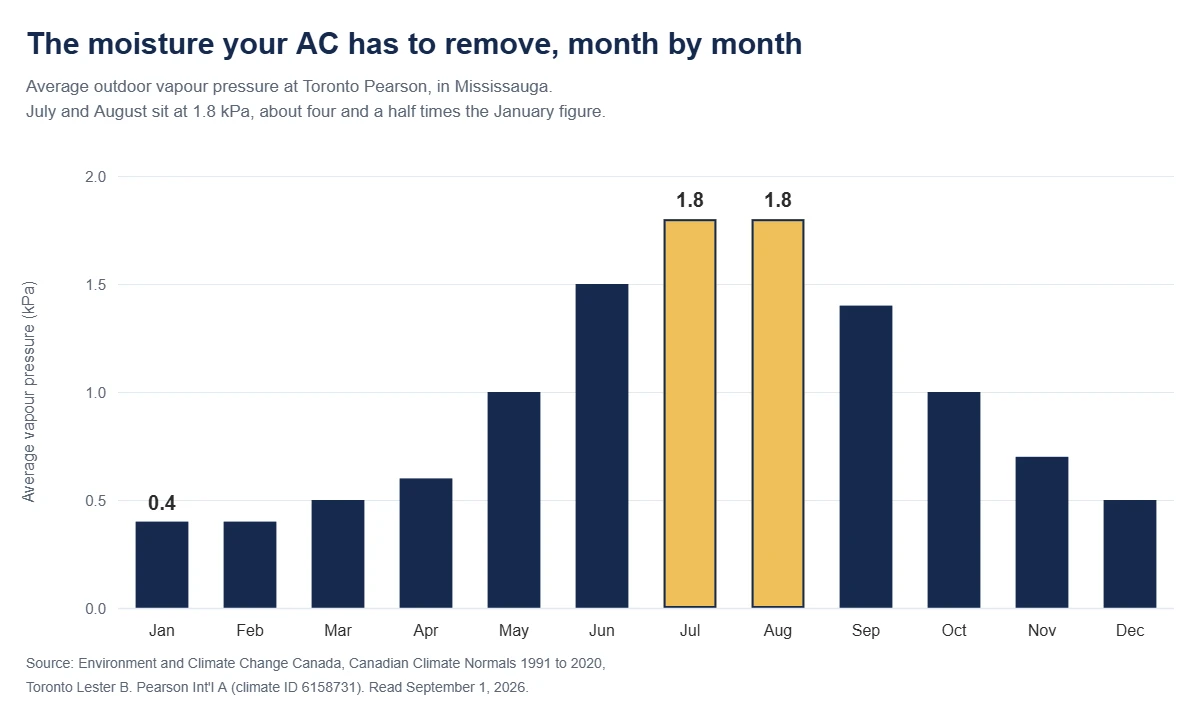
A Mississauga summer carries roughly four and a half times the outdoor moisture of a Mississauga winter, which is the load your air conditioner is quietly fighting from June to September. The weather station that defines the local climate record, Toronto Lester B. Pearson International Airport, sits inside Mississauga, so Environment and Climate Change Canada's Canadian Climate Normals for 1991 to 2020 describe this market directly rather than by approximation.
Two numbers from that record matter here. Average vapour pressure, the honest measure of how much water the outdoor air is actually carrying, peaks at 1.8 kPa in both July and August against 0.4 kPa in January. And a normal July at Pearson delivers 18.3 days with a humidex of 30 or higher, plus 8.0 days at 35 or higher. Relative humidity alone misleads, which is why we do not lead with it: the July afternoon average is only 52.9 per cent, but that is a percentage of what warm air can hold, and warm air can hold a great deal.
| Measure | June | July | August | January |
|---|---|---|---|---|
| Average vapour pressure (kPa) | 1.5 | 1.8 | 1.8 | 0.4 |
| Days with humidex 30 or higher | 10.0 | 18.3 | 16.2 | 0.0 |
| Days with humidex 35 or higher | 4.0 | 8.0 | 6.2 | 0.0 |
| Average relative humidity at 6 a.m. (per cent) | 77.6 | 79.3 | 83.7 | 79.2 |
| Average relative humidity at 3 p.m. (per cent) | 54.4 | 52.9 | 55.2 | 69.7 |
What counts as too humid indoors?
Health Canada advises maintaining indoor relative humidity between 30 and 50 per cent, and adds that a dehumidifier or air conditioner can be used to bring the level down if needed. Worth noting, because a great many pages get this wrong: that is a single year-round range on Health Canada's mould guidance, not a separate summer figure. Anything sustained above 50 per cent is outside the advice, and above 60 per cent you are in the band where condensation and mould growth become the practical concern rather than comfort.
A hygrometer costs very little and settles the argument in a day. Put one in the room that feels worst, not next to the thermostat, and read it in the early morning as well as the afternoon, because the Pearson record above shows outdoor moisture peaking overnight. If your reading sits above 60 per cent while the air conditioner is running normally, stop adjusting the temperature and work through the checks below instead.
| Indoor relative humidity | Where it sits | What you would notice |
|---|---|---|
| Below 30 per cent | Below the Health Canada range | Static, dry throat, shrinking trim. A winter problem in Peel Region, not a summer one |
| 30 to 50 per cent | The range Health Canada advises | Air feels crisp at the same thermostat setting; the target for a working system |
| 50 to 60 per cent | Above the advised range | Cool but clammy, slow-drying towels, sleep disturbed on humid nights |
| Above 60 per cent | Well above the advised range | Window and duct condensation, musty basement, the band where mould becomes the concern |
| 70 per cent and up | Far above the advised range | Treat as a fault, not a preference. Something in the six causes is active |
Six checks you can run in fifteen minutes
Six checks separate the free fixes from the ones that need a technician, and none of them requires opening sealed equipment or touching refrigerant. Run them in order, because they are arranged cheapest first, and stop as soon as one of them explains what you are seeing. Together they take about fifteen minutes and cost nothing beyond a filter.
| Check | How | Time |
|---|---|---|
| 1. Fan setting | Set the thermostat fan to AUTO, not ON. On AUTO the blower stops with the compressor and the water on the coil drains away instead of blowing back inside. | 1 minute |
| 2. Time a cooling cycle | Note when the outdoor unit starts and stops on a warm afternoon. Under 10 minutes points at short cycling; 15 minutes or more is healthy run time. | 20 minutes, mostly waiting |
| 3. Filter | Pull it and hold it to a light. If it is grey, replace it. A very high filtration rating on an older blower can choke airflow, so match what the equipment was built for. | 3 minutes |
| 4. Condensate drain | Find the drain line at the indoor unit and confirm it is dripping during a cooling cycle. No water at all in a Peel Region July means moisture is not leaving. | 3 minutes |
| 5. Measure the humidity | Place a hygrometer in the worst room and read it morning and afternoon against the 30 to 50 per cent range above. | 2 minutes, then a day |
| 6. Hunt the moisture source | Run bathroom and range fans while they are in use, check the dryer vents outdoors, and look for a damp basement wall. An air conditioner cannot outrun an active water source. | 6 minutes |
Where DIY stops: refrigerant is not a homeowner material in Ontario. Under O. Reg. 463/10, Ozone Depleting Substances and Other Halocarbons, section 22 states that no person shall service or test refrigeration equipment that contains a refrigerant unless the person is certified under section 34, and section 19 prohibits discharging refrigerant into the natural environment or within a building. Sealed-system top-up kits sold for cars are not a legal or safe answer for home equipment. Kill power at the disconnect and the breaker before removing any panel, and if a persistently damp basement comes with visible mould, deal with the water source before running any equipment harder.
How can I tell if my AC is short cycling?
You can tell your AC is short cycling by timing it: on a genuinely warm afternoon, a healthy residential system runs for 15 minutes or more once it starts, while a short-cycling one shuts off in under 10 and restarts soon after. Stand where you can hear the outdoor condenser, note the start and stop, and repeat it twice so you are not reading one unusual cycle.
Short run times have two very different explanations, and telling them apart matters because one is cheap and one is not. A restricted filter, a dirty coil or a low charge all make a system cut out early, and those are faults to repair. An oversized system, by contrast, is working exactly as installed and simply has more capacity than the house needs, which is a sizing decision made years ago rather than a breakage. That is where CSA F280:12 (R2025) belongs in the conversation: a proper heat-gain calculation for your house, not a rule of thumb based on square footage or on matching whatever was there before. Beware of any Ontario quote that cites Manual J, which is the American standard.
If the sizing is wrong, you are not obliged to replace the equipment to fix the humidity. Variable-speed or two-stage equipment can run longer at lower output, and a whole-home dehumidifier addresses moisture directly and independently of the cooling call. Where the moisture load itself is the problem rather than the cooling, our home air treatment page covers the equipment that handles it. Our guide to air conditioner installation cost in Mississauga sets out what a correctly sized replacement actually runs, for when the unit reaches the end of its life anyway.
What needs a licensed technician, and why
A licensed technician is required the moment the work touches refrigerant, the sealed cabinet, or house wiring, and homeowners keep everything else. The boundary is not a matter of confidence or skill; for refrigerant it is set by provincial regulation, and for electrical work it is set by the Electrical Safety Authority.
| Task | The right person | Why |
|---|---|---|
| Fan setting, filters, hygrometer, exhaust fans, reachable duct joints | You | No sealed system, no line voltage, no certification required |
| Evaporator coil cleaning, blower speed, airflow balancing | HVAC technician | Sealed cabinet, sharp fins, and a coil that is easily bent beyond repair |
| Refrigerant charge, leak search, any work opening the sealed circuit | 313A or 313D mechanic holding an ODP card | O. Reg. 463/10 s. 22 requires certification under s. 34; s. 19 prohibits discharge indoors or outdoors |
| Whole-home dehumidifier install and controls | HVAC technician | Ducted tie-in, condensate routing and a humidistat wired into the system |
| New circuits, panel work, hard-wiring a dehumidifier | Licensed Electrical Contractor | The ESA states LECs are the only businesses in Ontario legally authorized to do electrical work in your home; ask for the 7-digit ECRA/ESA number |
This is where we come in, with the caveat stated plainly. Aire One Peel is a TSSA-registered fuels contractor and a Carrier Factory Authorized Dealer, and our technicians handle humidity diagnostics, coil cleaning, airflow and dehumidifier installs across Mississauga, Brampton, Etobicoke, Milton, Georgetown, Caledon and Bolton, 24/7 with no after-hours charge. The possible downside of calling us first is real: a diagnostic visit costs money, and if your problem turns out to be a fan switch set to ON, you have paid for something you could have fixed in one second. That is exactly why the six checks sit above the phone number on this page, and why our air conditioner repair team starts every humidity call by re-running them with you.
Humidity finder: which of the six is yours?
Three questions narrow six causes down to one, using the same routing as the tables above. Answer them in order and the finder points at the specific cause, whether that means a free change on the thermostat or a diagnosis you should book.
Every answer below already exists in the tables on this page.
When a whole-home dehumidifier is the right answer
A whole-home dehumidifier is the right answer when the air conditioner is genuinely healthy and the house is still damp, because it removes moisture on its own schedule rather than only while the house happens to need cooling. That covers the two situations the six checks cannot fix: an oversized system you are not ready to replace, and shoulder-season weeks in May, June and September when it is humid outside but not hot enough for the AC to run much at all.
Being fair about the alternatives matters more than making the sale here. A portable dehumidifier costs a fraction of a ducted one and is the correct answer if the problem is confined to one basement room, with the trade-off that you empty a tank and listen to it run. Sealing an obvious moisture source, venting a dryer properly, or running the bathroom fan for its full cycle costs nothing at all and sometimes ends the whole conversation. A ducted unit earns its price when the damp is house-wide, when you want it wired to a humidistat and forgotten about, or when the basement is finished and a portable is not acceptable to live with. Our indoor air quality page covers the equipment, and vent and air duct cleaning is worth considering in the same visit if the ducts are part of the problem.
One thing we will not do is quote you a rebate figure on this page. Ontario program terms change, and part of doing this properly is naming a program, linking it, and dating it at the moment of the quote rather than leaving a stale number sitting in an article. Ask about current programs when you book, and we will check them live with you.
How we know this
Every number on this page comes from a named primary source that you can open and check yourself, and the ones we do not have are named as missing rather than estimated. Here is the full accounting.
The indoor humidity range and the dehumidifier guidance come from Health Canada's Mould page, last modified February 13, 2023. The Mississauga moisture figures are read directly from Environment and Climate Change Canada's Canadian Climate Normals for 1991 to 2020 at Toronto Lester B. Pearson Int'l A, climate ID 6158731, which is the station inside Mississauga. The refrigerant boundary is quoted from O. Reg. 463/10 by section, the electrical boundary from the Electrical Safety Authority, and the sizing standard is CSA F280:12, reaffirmed 2025. All were read on September 1, 2026.
What this page deliberately does not claim: any percentage drawn from our own service calls. We have not yet published a counted sample of humidity complaints and their outcomes, so the ordering of the six causes reflects how our service department triages these calls rather than a measured frequency, and it is described that way rather than dressed up with a number we cannot defend.
See who you would be calling
Three short videos from our own channel.
Checks done and the house is still damp?
Book a free in-home estimate or a humidity diagnosis, 24/7 with no after-hours charge. Aire One Peel Heating & Cooling, TSSA-registered fuels contractor FS R0076624709, 1625 Courtneypark Dr E, Mississauga, ON L5T 1V9.
Frequently asked questions
Why is my house still humid even though the AC is on?
Because cooling and drying are separate results. Water only leaves your air when it condenses on a cold coil and drains away, and that needs sustained run time. A thermostat fan left on ON, a system oversized for the house, a restricted filter, a dirty coil, a low refrigerant charge or leaky return ducts each interrupt that process while the temperature still falls.
How do I lower the humidity in my house with AC?
Set the thermostat fan to AUTO so the blower stops with the compressor, then replace a dirty filter and confirm the condensate line is draining. Resist lowering the setpoint, which shortens cycles and makes drying worse. If run times are under 10 minutes on a warm afternoon, the fix is a diagnosis or a dehumidifier, not a colder setting.
Can an oversized AC cause humidity?
Yes, and it is one of the most common causes. An oversized system reaches the set temperature quickly and shuts off before enough water has condensed on the coil, then that water evaporates back into the ductwork. Moisture removal depends on run time, so extra capacity actively works against it. Correct sizing follows CSA F280:12, the Canadian standard.
How can I tell if my AC is short cycling?
Time it on a genuinely warm afternoon. Note when the outdoor unit starts and when it stops, and repeat it twice. A healthy residential system runs 15 minutes or more per cycle. Under 10 minutes is short cycling, and the causes are a restricted filter, a dirty coil, a low refrigerant charge, or a system oversized for the house.
How to tell if your AC is oversized?
The signature is fast cooling with short cycles and persistent dampness: the house hits temperature quickly, the unit stops within 10 minutes, and it never feels dry. Confirm it by ruling out a dirty filter, a dirty coil and a low charge first, since those produce the same short cycles. A CSA F280:12 heat-gain calculation settles it properly.
Is 70% humidity too high in a house?
Yes. Health Canada advises maintaining indoor relative humidity between 30 and 50 per cent, so 70 per cent is well outside that range and should be treated as a fault rather than a preference. At that level condensation and mould growth become the practical concern, not just comfort. Health Canada notes a dehumidifier or air conditioner can be used to bring it down.
How to decrease humidity in house quickly?
The fastest free step is switching the thermostat fan from ON to AUTO, which stops the blower re-evaporating water off the coil between cycles. After that, run bathroom and kitchen exhaust fans for their full cycle, confirm the dryer vents outdoors, replace a dirty filter, and run a dehumidifier in the dampest room while you work through the underlying cause.
Final verdict
Treat an AC not removing humidity as a run-time problem rather than a capacity problem, and the diagnosis order almost writes itself. Switch the fan to AUTO first because it is free and it is the most common cause. Time a cooling cycle second, because that single number splits the remaining causes into cheap ones and expensive ones. Replace the filter, confirm the condensate line is draining, and measure the room against Health Canada's 30 to 50 per cent range before spending anything. Escalate when run times stay short on a clean filter, when the air is barely cool, or when the equipment is healthy and the house is still damp, and route anything touching refrigerant to a certified technician because Ontario law leaves you no other option. What you should not do is buy a bigger air conditioner to solve a humidity complaint, which is the one move that reliably makes it worse.
What we updated
September 1, 2026: full rebuild of the July 2025 article. The previous version was a general summer AC preparation checklist that duplicated our AC ready for summer guide, so this rebuild moves the page onto the humidity half of the original title, which nothing else on the site covers. Added the six-cause table, the Toronto Pearson moisture data from Environment and Climate Change Canada, the Health Canada indoor humidity range, the six homeowner checks, the who-handles-what table, the refrigerant safety callout quoting O. Reg. 463/10 by section, the humidity finder, the video gallery, a named author and full schema. Slug changed from the 2025 sentence slug, with a 301 from the old URL.
Sources and references
- Health Canada, Mould: recommended indoor relative humidity of 30 to 50 per cent and dehumidifier guidance
- Environment and Climate Change Canada, Canadian Climate Normals 1991 to 2020, Toronto Lester B. Pearson Int'l A, climate ID 6158731
- O. Reg. 463/10, Ozone Depleting Substances and Other Halocarbons, sections 19, 22 and 34
- CSA Group, CSA F280:12 (R2025), determining the required capacity of residential space heating and cooling appliances
- Electrical Safety Authority, hiring a Licensed Electrical Contractor in Ontario
- Technical Standards and Safety Authority, hiring registered contractors and certified technicians
Related reading
- Improve indoor air quality: the three steps, in order
- Why is my AC not cooling? for when the air is not even cold.
- Get your AC ready for summer in Ontario for the seasonal maintenance checklist.
- Air conditioner making noise for diagnosing sounds rather than symptoms.
- Common thermostat problems for the fan setting and everything else on the wall.
- indoor humidity in winter. The opposite problem. When the heat is on, the risk flips from too much moisture to too little, and the ceiling is set by your windows.
Mario Vaghei
General Manager, Aire One Peel Heating & Cooling
Mario directed this rebuild, set the order of the six causes from how our service department triages humidity calls, and checked the Health Canada, Environment and Climate Change Canada, O. Reg. 463/10, CSA, ESA and TSSA references cited above on September 1, 2026.