



By Mario Vaghei, General Manager, Aire One Peel Heating & Cooling · Published June 27, 2024 · Facts verified September 7, 2026
Almost every guide telling you how to improve indoor air quality is a list of tips in no particular order, and most of them are written for houses in the United States. Health Canada publishes its own list, it puts the items in a deliberate sequence, and the sequence is the useful part. This page follows that order and adds the Ontario rules that decide which of these your house already has. If you came here from a duct cleaning question, the evidence on that specific service is in our guide to air duct cleaning in Ontario.
On this page
- Three steps to improve indoor air quality, in order
- What good air looks like as a number
- Step one: reduce the source
- Step two: ventilate, and the fan your house may already be required to have
- Step three: filter, and where the MERV 13 advice goes wrong
- The two hazards you cannot smell, see or filter
- Before you open the window: your AQHI community
- Where air duct cleaning actually fits
- What should you fix first?
- How we know this
- Watch: the team behind the advice
- Frequently asked questions
- The short version
- Sources and references
Short answer
To improve indoor air quality, work in Health Canada’s order: reduce the source of the pollutant first, ventilate with outdoor air second, and filter what is left third. Health Canada states plainly that the best ways to improve indoor air are to remove the source and to ventilate, and filtration is the fallback for what those two cannot reach.
Then test for the two things you cannot sense. Radon has a Canadian guideline of 200 becquerels per cubic metre and needs a test of at least 91 days. Carbon monoxide needs a certified alarm, which Ontario law requires near sleeping areas.
Key takeaways
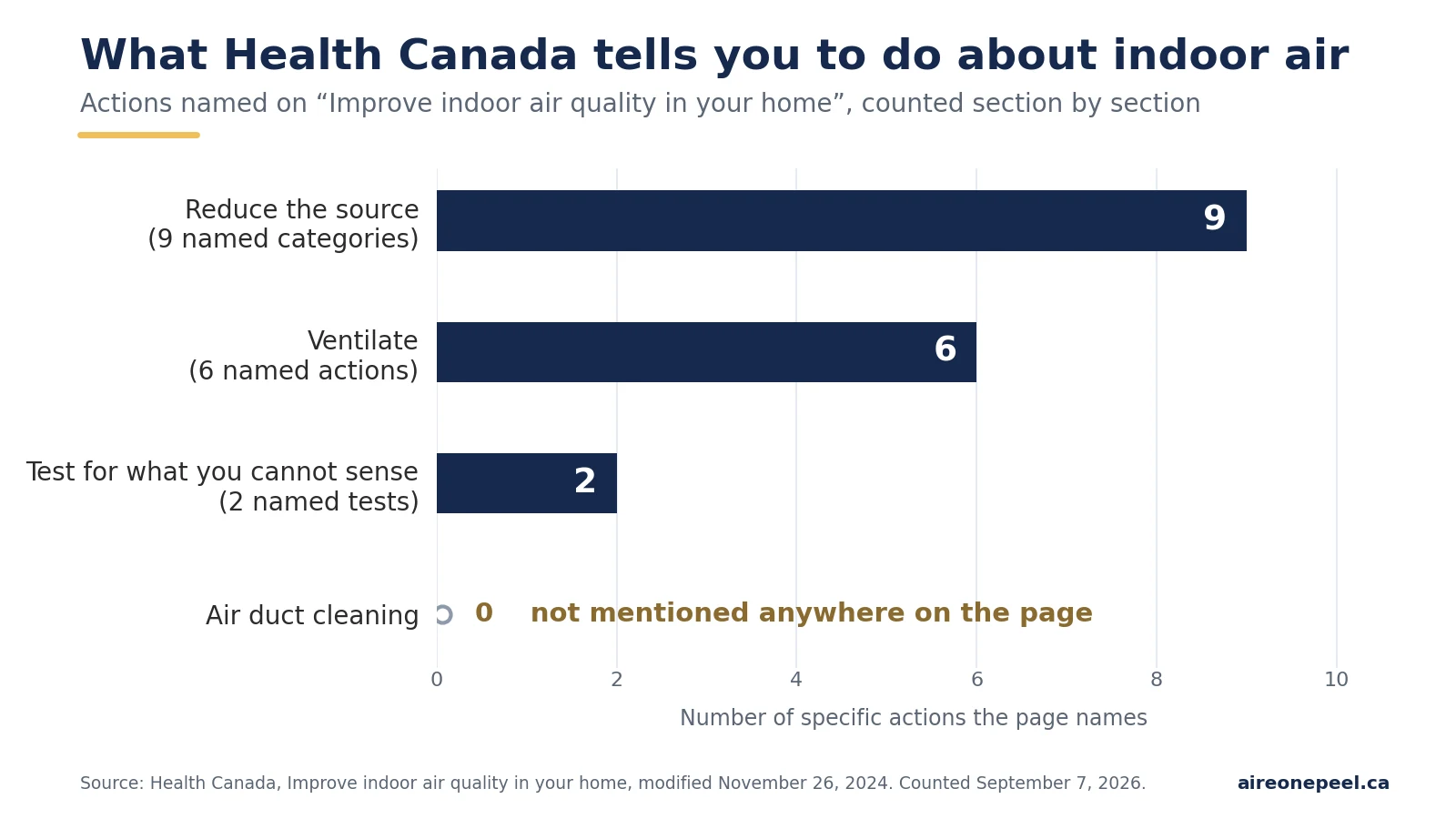
- Health Canada’s own guidance names 9 source categories, 6 ventilation actions and 2 tests. It does not mention air duct cleaning at all.
- If your Ontario house was built to a recent Building Code it already has a principal ventilation exhaust fan. A range hood does not count as one, and the code says so.
- A MERV 13 filter is the right target for fine particulate, but only if the system can move air through it. The same Health Canada document that recommends MERV 13 says the system has to handle the pressure drop.
- Radon is measured over months, not minutes, and paid mitigation work should go to a C-NRPP certified professional.
- Nothing here is a treatment for a symptom. If air quality is affecting someone’s health, that is a conversation for a doctor, not a contractor.
Three steps to improve indoor air quality, and why the order matters
The order is not a stylistic choice, it is a cost and effectiveness ranking: removing a pollutant at its source costs nothing and works completely, ventilation dilutes what is left for the price of running a fan, and filtration is the most expensive of the three and only catches particles that reach the filter. Health Canada states the principle directly in its guidance on portable air cleaners: the best ways to improve indoor air are to remove the source of the contaminants and to ventilate with clean, outdoor air.
Most home air quality content inverts this. It opens with a device you can buy, because a device is a product and an open window is not. The table below is the order as published.
| Step | What it means | Examples Health Canada names | Cost to you |
|---|---|---|---|
| 1. Reduce the source | Stop the pollutant entering the air in the first place | Smoke-free indoors, no idling in an attached garage, cook on back burners with the range hood on, fix damp and leaks, service fuel-burning appliances yearly | Usually nothing |
| 2. Ventilate | Dilute what is left with outdoor air | Leave interior doors open, run bathroom and kitchen fans, keep vents and baseboards clear, open windows when outdoor air is good | The cost of running a fan |
| 3. Filter | Catch the particles the first two steps did not remove | HVAC system filtration with filters replaced per the manufacturer, portable HEPA units, electrostatic precipitators, and no ozone generators | Filters, equipment, electricity |
| Separately: test | Measure the two hazards no person can detect unaided | Test for radon, install carbon monoxide alarms | A test kit and an alarm |
What good air looks like as a number
Canada publishes target values for indoor air, and knowing them turns a vague worry into something you can check. The list below is short because most indoor pollutants have no residential number attached, which is itself worth knowing before you buy a device that promises to score your air.
| Measure | Target | What moves it |
|---|---|---|
| Fine particulate, PM2.5 | As low as possible, and lower indoors than outdoors | Source control and filtration |
| Carbon monoxide | Below 10 ppm | Appliance servicing. A reading above zero at home is an emergency, not a tuning exercise |
| Carbon dioxide | Below 1,000 ppm | Ventilation only. Filters do nothing to it |
| Temperature | Below 26 C | Cooling and shading |
| Relative humidity | 35 to 50 per cent in the wildfire smoke guidance, 30 to 50 per cent on the general indoor air page | Humidifier, dehumidifier, ventilation, and fixing leaks |
| Radon | Below 200 Bq/m³ | Mitigation work under the slab and in the foundation, not ventilation upstairs |
The two humidity figures are both Health Canada’s. We are not going to average them and present the result as a single fact. Aim for the overlap, roughly 35 to 50 per cent, and you satisfy both. If your windows fog on cold mornings you are above it, and our guide to an air conditioner that is not removing humidity covers the summer half of that problem.
Step one: reduce the source
Source reduction is the only step that removes a pollutant rather than moving it around, and Health Canada devotes more of its guidance to this than to ventilation and testing combined. The nine categories it names are smoking, the attached garage, cooking, mould and dampness and water leaks, heating appliances, renovations, household items and furniture, hobbies, and house cleaning and laundry.
Three of those are worth pulling out for an Ontario house. The attached garage is one: Health Canada advises against idling a vehicle or running gas-powered equipment in it, storing fuel containers in a detached shed instead, and keeping the door between the garage and the house closed and well sealed. Cooking is another, and the instruction is specific: use the range hood on its high setting and cook on the back burners, because that is where the hood actually captures. The third is heating, where the advice is a yearly inspection of every fuel-burning appliance plus at least one certified carbon monoxide alarm near sleeping areas.
Mould and dampness carry their own instruction, which is to fix moisture problems as soon as they appear, keep relative humidity in range, and dry a flooded home within 48 hours. In this region that usually means a basement, and it is a repair job rather than an air quality product.
Step two: ventilate, and the fan your house may already be required to have
Ventilation is the step where Ontario stops being generic, because the Ontario Building Code sets out what a house must have rather than what a homeowner might like to buy. Section 9.32 of the code requires ventilation in both seasons, and for the heating season it names three things a house needs: a principal ventilation exhaust fan, supplemental exhaust fans, and protection against depressurization.
The detail most homeowners have never been told is in clause 9.32.3.3: a range hood cannot serve as the principal ventilation fan. If you have been treating the kitchen hood as your whole-house ventilation, the code disagrees, and so does the physics. The principal fan is usually a dedicated exhaust fan or the exhaust side of a heat recovery ventilator, and its required airflow is set by the number of bedrooms.
| Route | What it actually does | The Ontario position |
|---|---|---|
| Opening a window | The fastest dilution available, free, and uncontrolled | Accepted for the non-heating season under 9.32.2 where openings are available. Check outdoor air first |
| Bathroom exhaust fan | Removes moisture at the point it is produced | Counts as a supplemental exhaust fan, and may serve as the principal fan if it meets the rating |
| Range hood | Captures cooking particulate and moisture, if it vents outside | Cannot be the principal ventilation fan, clause 9.32.3.3 |
| Principal ventilation exhaust fan | Provides continuous whole-house ventilation through the heating season | Required under 9.32.3, with airflow set by bedroom count in Table 9.32.3.3 |
| Heat recovery ventilator | Brings outdoor air in and recovers heat from the air going out | Where used to meet SB-12, must have a low temperature ventilation reduction factor under 50 per cent, clause 9.32.3.12 |
| Recirculating the furnace fan | Moves and filters indoor air. Brings in no outdoor air at all | Not ventilation. Useful for filtration and for evening out temperature, and nothing else |
The practical version: go and look. If there is a fan in the basement with two insulated ducts running to the outside, that is a heat recovery ventilator, and a surprising number of them are switched off because somebody found them noisy. Turning it back on is the cheapest air quality improvement available in a newer Ontario home, and it costs one trip down the stairs. If you cannot find one, our indoor air quality services page covers what can be added to an existing system.
Step three: filter, and where the MERV 13 advice goes wrong
Filtration is the third step because it only ever treats the symptom, and the advice circulating about it is half right. Health Canada does recommend a MERV rating of 13 or more to remove fine particulate, and it does recommend a MERV 8 pre-filter alongside it. What almost nobody repeats is the condition attached in the same document: the system has to be able to handle the pressure drop that those filters create.
That condition matters in an Ontario basement. A furnace built around a one inch filter slot and a fixed-speed blower may not move enough air through a MERV 13 media, and the result is reduced airflow, a colder house at the far end of the duct run, and in the worst case a heat exchanger running hotter than it should. The right sequence is to check what the equipment is rated for before upgrading the filter, which is a five minute question for whoever services it. Our guide to how often to replace air filters covers the replacement interval separately.
| Option | What it catches | The condition attached |
|---|---|---|
| Furnace filter, MERV 8 | Larger dust, and it protects the equipment | Recommended as a pre-filter, not as the fine particulate filter |
| Furnace filter, MERV 13 or higher | Fine particulate, PM2.5 | Only where the system can handle the pressure drop. Confirm the equipment rating first |
| Portable HEPA air cleaner | Fine particulate in one room | Size it by clean air delivery rate. Health Canada suggests a smoke CADR of at least two thirds of the room area, and two to three room volumes per hour during smoke events |
| Activated carbon stage | Some gases and odours | Optional. Performance standards for gas removal are less established than for particulate |
| Electrostatic precipitator | Particulate, without a disposable media | Named as an option by Health Canada, alongside the warning about ozone |
| Ozone generator | Sold as an odour and germ treatment | Avoid. Health Canada advises against devices that produce ozone because ozone can harm your health |
The two hazards you cannot smell, see or filter
Radon and carbon monoxide sit outside the three steps because neither is caught by a filter and neither announces itself, so both are handled by measurement rather than by improvement. They are also the only two items on this page where getting it wrong has consequences beyond a stuffy room.
Safety
Carbon monoxide has no smell, no colour and no taste. A consumer air quality monitor is not a carbon monoxide alarm and must never be treated as one. If a carbon monoxide alarm sounds, get everyone outside into fresh air and call 911 from outside, then have the appliance inspected before it is used again.
Anything involving a gas appliance, a vent or a flue belongs to a TSSA-registered fuels contractor. Do not open a furnace, a water heater or a fireplace to look for the source yourself.
| Hazard | The published number | How it is measured | Who does the work |
|---|---|---|---|
| Radon | 200 Bq/m³ Canadian guideline. In the cross-Canada survey 4.6 per cent of Ontario homes were above it, against 6.9 per cent nationally | A long-term test of at least 91 days including the heating season, on the lowest lived-in level, 0.3 to 2.5 metres above the floor, and not in a kitchen, bathroom or laundry room | You can place the test kit yourself. Paid measurement and mitigation should go to a C-NRPP certified professional |
| Carbon monoxide | Below 10 ppm as a target condition, and any alarm activation is treated as an emergency | A certified alarm, adjacent to sleeping areas, as the Ontario Fire Code requires | You install the alarm. The appliance behind an alarm goes to a TSSA-registered fuels contractor |
The Ontario radon figure deserves one honest caveat. A provincial average of 4.6 per cent hides a lot: the same survey found more than 10 per cent of homes above the guideline in 13 of Ontario’s 36 health regions. A provincial number tells you nothing about your street, which is exactly why the guidance is to test rather than to estimate.
Before you open the window: your AQHI community
Health Canada’s ventilation advice comes with a condition attached, which is to close the windows when outdoor air quality is poor, and that turns “open a window” into a decision that needs a number. Environment and Climate Change Canada publishes the Air Quality Health Index for named communities, and the west GTA is not evenly covered: four of the seven cities we serve have a community of their own on the list and three do not.
| Your city | AQHI community to check | Note |
|---|---|---|
| Mississauga | Mississauga | Listed in its own right |
| Brampton | Brampton | Listed in its own right |
| Milton | Milton | Listed in its own right |
| Etobicoke | Toronto | No Etobicoke entry. Etobicoke is part of the City of Toronto |
| Georgetown | Milton, or Oakville | No Halton Hills or Georgetown entry |
| Caledon | Brampton | No Caledon entry |
| Bolton | Brampton | No Bolton entry |
This is the part of the advice that changes by address rather than by province, and no American page and no national referral site will ever publish it. If you live in Bolton and you are reading an index measured in Brampton, that is worth knowing before you decide the outdoor air is fine.
Where air duct cleaning actually fits
Air duct cleaning is not on Health Canada’s list of ways to improve indoor air, and that absence is the honest headline of this page even though we sell the service. It is not the same as saying the service is worthless. It is saying that duct cleaning is a remedy for a specific condition rather than a general air quality improvement, and that treating it as the latter is how homeowners end up paying for something that changes nothing they can measure.
The conditions that do justify it, and the pricing and scam patterns to watch for in this region, are set out in our guide to air duct cleaning in Ontario, and the service itself is on our vent and air duct cleaning page. If you want the honest sequence: work through steps one and two on this page first, because they cost almost nothing, and only then ask whether the ducts are the problem.
The possible downside of asking us: we install and service equipment, so our answer to an air quality problem will often be equipment. If your issue turns out to be a source you can remove or a window you can open, that is a better fix than anything we can sell you, and we would rather tell you so on the estimate than after the invoice. We also do not measure radon and we are not a C-NRPP certified firm, so that one goes to someone else.
What should you fix first?
Two questions, and every answer below already appears in the tables above.
1. What is actually bothering you?
How we know this
Every number and every ordering on this page was read off a government of Canada or Government of Ontario source on September 7, 2026, and each one is named with its date in the table caption where it appears. Seven sources were used: five Health Canada pages, one Environment and Climate Change Canada community list, and one summary of Section 9.32 of the Ontario Building Code published by the Heating, Refrigeration and Air Conditioning Institute of Canada.
The counts in the chart are ours: we counted the action categories section by section off Health Canada’s page, arriving at 9 source categories, 6 ventilation actions and 2 tests, and we searched the same page for any mention of duct cleaning and found none. That is a count anyone can reproduce in five minutes, which is the point of publishing it.
What this page does not have is first-party data. We have not yet published a figure from our own service records, and rather than invent one we are saying so. General Manager is a company role and not a trade credential, and no certification is claimed for the author of this page.
Watch: the team behind the advice
These are company and furnace clips from our own channel. None of them demonstrates the guidance above, and none should be read as evidence for it.
Indoor air quality, Peel Region
Do the free steps first, then call us
If ventilation or filtration equipment is what your house actually needs, we will tell you which one and why. Free in-home estimates across Mississauga, Brampton, Etobicoke, Milton, Georgetown, Caledon and Bolton. TSSA-registered fuels contractor FS R0076624709. 1625 Courtneypark Dr E, Mississauga, ON L5T 1V9.
Frequently asked questions
What is the most effective way to improve indoor air quality?
Removing the source of the pollutant, because it is the only action that eliminates rather than dilutes. Health Canada states that the best ways to improve indoor air are to remove the source of the contaminants and to ventilate with clean, outdoor air, and it puts source reduction first and gives it more space than anything else. Filtration comes third and only ever treats what the first two steps left behind.
What are the three most common ways to reduce pollutants in indoor air?
Source control, ventilation and air cleaning, in that order. Source control means stopping the pollutant entering the air, such as keeping the home smoke-free, not idling in an attached garage and fixing damp. Ventilation means diluting what remains with outdoor air. Air cleaning means filtering the particles that reach a filter, which excludes gases such as carbon dioxide and radon entirely.
What are the indoor air quality guidelines in Canada?
Health Canada publishes Residential Indoor Air Quality Guidelines for a short list of pollutants, and separate target conditions for cleaner air spaces: carbon dioxide below 1,000 ppm, carbon monoxide below 10 ppm, temperature below 26 C, relative humidity of 35 to 50 per cent, and fine particulate as low as possible. Radon is guided separately at 200 becquerels per cubic metre. Most household pollutants have no residential number at all.
How to purify air in home without an air purifier?
Use the two steps that come before filtration. Remove sources by keeping the home smoke-free, cooking on back burners with the range hood on high, storing fuel and running engines outside an attached garage, and fixing damp within 48 hours. Then ventilate: open interior doors, run bathroom and kitchen fans, keep vents clear, and open windows when outdoor air quality is good.
How to reduce indoor humidity with HVAC?
In summer the air conditioner is the dehumidifier, and it only removes moisture while the compressor runs, so an oversized unit that satisfies the thermostat in short bursts leaves the house cool and damp. Run the fan on auto rather than on, because a fan running after the coil stops re-evaporates water back into the air. In winter, reduce the humidifier setting instead and use exhaust fans, and target 35 to 50 per cent either way.
Can you run AC with poor air quality?
Yes, and during a smoke event it is usually the better option, because a central system with the windows closed lets you filter the air you are recirculating. Health Canada’s guidance for smoke events is to switch to recirculation while outdoor air is poor, then draw fresh air back in once conditions improve so that carbon dioxide does not build up. A window air conditioner with an outdoor air vent should have that vent closed.
The short version
Improve indoor air quality in the order the evidence supports. Reduce the source, because that is the only step that removes anything and it usually costs nothing. Ventilate second, and in an Ontario house that starts with finding out whether you already have a principal ventilation fan or a heat recovery ventilator, and whether it is switched on. Filter third, after confirming your system can handle the filter you are about to fit.
Then handle the two that sit outside the sequence. Put a long-term radon test on the lowest lived-in level for at least 91 days through a heating season, and make sure there is a certified carbon monoxide alarm near where people sleep, which Ontario law requires anyway.
Air duct cleaning is not on Health Canada’s list, and we would rather tell you that than sell it to you as an air quality upgrade. If after the free steps you still want equipment, call 905-564-8545 or book a free in-home estimate and we will tell you what would actually change the number.
Mario Vaghei
General Manager, Aire One Peel Heating & Cooling
Rebuilt this guide on September 7, 2026, counting the action categories off Health Canada’s indoor air quality page, reading the target conditions off the wildfire smoke guidance, the portable air cleaner sizing off Health Canada’s own page on the subject, the radon test duration and placement off the Guide for radon measurements in residential dwellings, the ventilation clauses off a summary of Section 9.32 of the Ontario Building Code, and the Air Quality Health Index community list off Environment and Climate Change Canada. General Manager is a company role and not a trade credential, and no certification is claimed for the author on this page.
Sources and references
- Health Canada, Improve indoor air quality in your home. The nine source categories, the six ventilation actions, the two tests, the 30 to 50 per cent humidity range and the 48 hour drying instruction. Date modified November 26, 2024. Read September 7, 2026.
- Health Canada, Guidance for Cleaner Air Spaces during Wildfire Smoke Events. MERV 13 or more with a MERV 8 pre-filter, the pressure drop condition, two to three room volumes per hour, and the target conditions for carbon dioxide, carbon monoxide, temperature and humidity. Date modified November 13, 2020. Read September 7, 2026.
- Health Canada, Using a portable air cleaner to improve indoor air. HEPA filtration, the clean air delivery rate rule of at least two thirds of the room area, the warning on ozone-producing devices, and the statement that the best ways to improve indoor air are to remove the source and to ventilate. Date modified December 24, 2021. Read September 7, 2026.
- Health Canada, Guide for radon measurements in residential dwellings. The minimum 91 day test through the heating season, the lowest lived-in level, and the 0.3 to 2.5 metre breathing zone placement. Date modified May 22, 2026. Read September 7, 2026.
- Health Canada, Cross-Canada Survey of Radon Concentrations in Homes. The 4.6 per cent Ontario figure against 6.9 per cent nationally, and the finding that 13 of Ontario’s 36 health regions exceeded 10 per cent. Published March 2012. Read September 7, 2026.
- Environment and Climate Change Canada, Air Quality Health Index, Ontario summary. The list of named Ontario communities, including Mississauga, Brampton, Milton, Oakville, Burlington and Toronto, and the absence of Etobicoke, Georgetown, Caledon and Bolton. Read September 7, 2026.
- Heating, Refrigeration and Air Conditioning Institute of Canada, What’s New in Section 9.32. The heating season requirement for a principal ventilation exhaust fan, supplemental exhaust and depressurization protection, the rule that a range hood cannot be a principal fan under 9.32.3.3, and the heat recovery ventilator condition in 9.32.3.12. The 2024 Ontario Building Code took effect January 1, 2025. Read September 7, 2026.
Related reading
- Air duct cleaning in Ontario: is it worth it, and the three cases where it is
- Are air quality monitors worth it? Three cases where one earns its price
- How often to replace air filters in your home
- Air conditioner not removing humidity in Ontario
- Humidifiers and indoor air quality products
- winter indoor humidity target. What Health Canada actually says about winter indoor humidity, and the dew point table that shows when your windows will condense.
- DIY vs professional air quality installation. What Health Canada actually says about winter indoor humidity, and the dew point table that shows when your windows will condense.