



Mario Vaghei, General Manager, Aire One Peel Heating & Cooling
Published May 21, 2024 · Facts verified September 9, 2026
There is a version of this question that is about confidence, and a version that is about the law. Almost everything written online answers the first one. In Ontario the second one decides most of it, and it does not split the way people expect: the wiring is the part you are allowed to do yourself, and the furnace is the part you are not. If you are still working out which equipment you need in the first place, start with how to improve indoor air quality and come back here once you know what you are installing.
On this page
- Who Ontario law lets do the work
- Device by device: which ones you can install yourself
- What Google's AI Overview tells Ontario homeowners to do
- The one that genuinely is a DIY job
- What a certified install includes that a DIY one does not
- Can you install it yourself? A three question check
- How we know this
- Watch: the team behind the advice
- Frequently asked questions
- The short version
Short answer
It depends on the trade the work belongs to, not on your skill. In Ontario nobody may install or service gas equipment without a certificate, and there is no homeowner exemption. Electrical work you may legally do in your own home if you file a notification first. A portable air cleaner is yours to unbox.
Applies to Mississauga, Brampton, Etobicoke, Milton, Georgetown, Caledon and Bolton. The regulations are provincial, so the rule is the same in each of them.
Who Ontario law lets do the work
Three different rulebooks cover the equipment people call air quality, and they do not agree with each other about homeowners. Gas is the strict one. Ontario Regulation 212/01, made under the Technical Standards and Safety Act, 2000, says it in one sentence at section 6 (1):
"No person shall install, alter, purge, activate, repair, service or remove any appliance, equipment or other thing employed or to be employed in the handling or use of gas unless the person is the holder of a certificate for that purpose."
O. Reg. 212/01, Gaseous Fuels, section 6 (1)
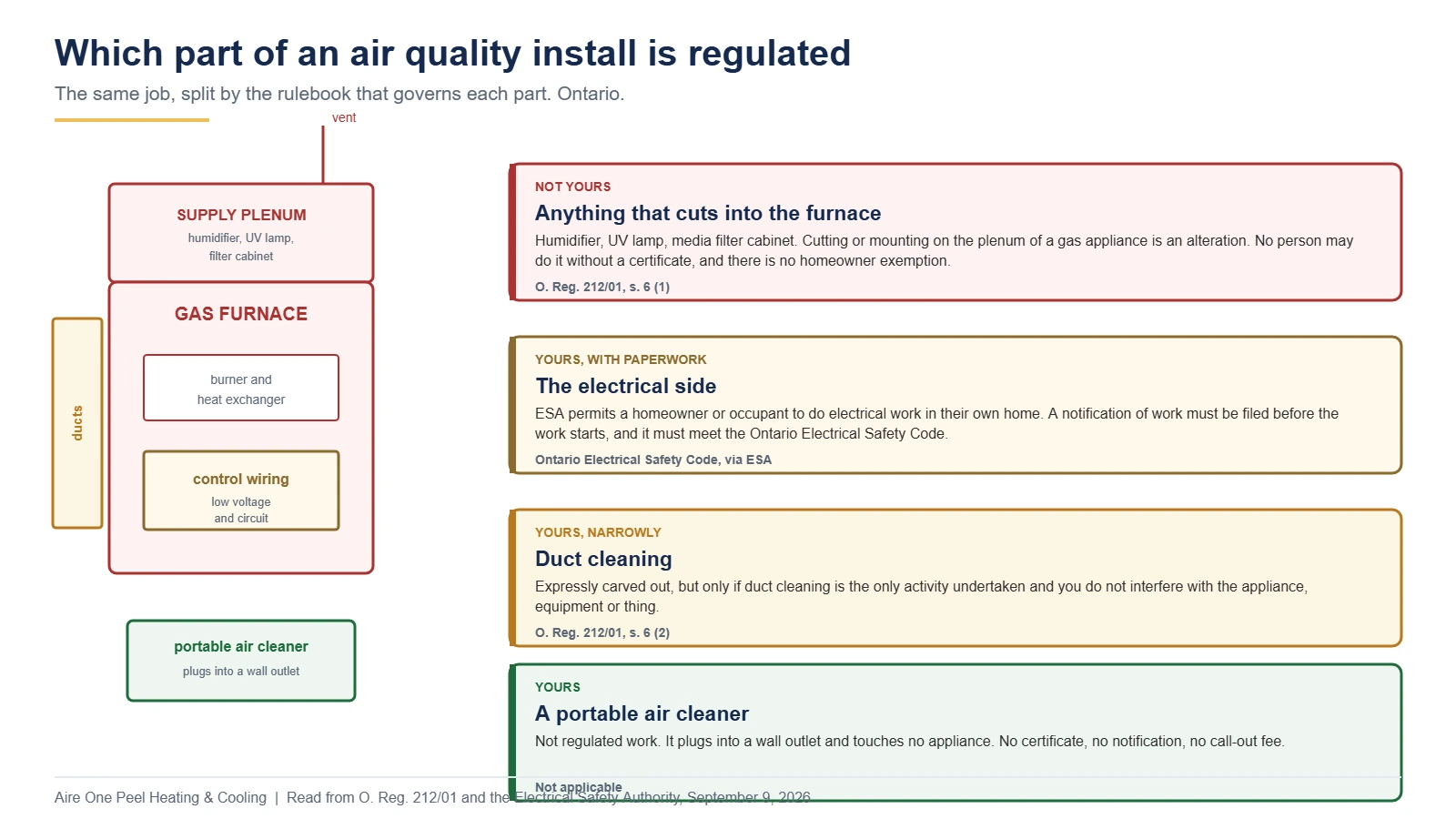
No person includes you, in your own house, on the furnace you paid for. We read the regulation looking for a homeowner exemption and there is not one. There are exactly two carve-outs and both are narrow: section 6 (2) lets a person clean ducts as long as that is the only thing they do and they do not interfere with the appliance, and section 6 (3) lets an uncertified person do the work while a certificate holder is present.
Electrical runs the other way, and this is the part that surprises people. The Electrical Safety Authority is direct about it: "Electrical work can also be done in a home by the homeowner or occupant." The catch is paperwork rather than permission. Work has to meet the Ontario Electrical Safety Code and, in ESA's words, must be reported "by filing a notification of work before the work starts." The same page notes that hiring is the restricted side, since only Licensed Electrical Contractors may do electrical work in your home for money.
| The work | Can a homeowner legally do it in their own home? | The instrument |
|---|---|---|
| Anything on the gas side of the furnace | No. Certificate holder only. No homeowner exemption exists | O. Reg. 212/01, s. 6 (1) |
| The same work, with a certified technician standing there | Yes, expressly permitted | O. Reg. 212/01, s. 6 (3) |
| Duct cleaning, and nothing else | Yes, if you do not interfere with the appliance | O. Reg. 212/01, s. 6 (2) |
| Electrical work in your own home | Yes, homeowner or occupant, with a notification filed before work starts | Ontario Electrical Safety Code, via ESA |
| Electrical work for hire | Licensed Electrical Contractor only | Ontario Electrical Safety Code, via ESA |
| Plugging in a portable appliance | Yes. Not regulated work | Not applicable |
One more piece worth knowing, because it is what you are actually checking when a technician arrives. The certificate classes themselves come from a separate regulation, O. Reg. 215/01, Fuel Industry Certificates, which defines the G.1, G.2 and G.3 classes. That regulation also says a person whose certificate has lapsed "shall not do any work under the certificate after the date of expiry", which is why the expiry date on the card matters as much as the class. If you want the full walk-through of verifying a company rather than a person, we wrote that up separately in five quick licence checks.
Before you open a furnace cabinet
Cutting into the plenum of a gas furnace puts you next to the heat exchanger, the vent connector and the burner compartment. A humidifier bypass collar fitted in the wrong place, or a screw driven through the wrong panel, can disturb the venting that carries combustion gases out of the house. That is the mechanism behind carbon monoxide, and it is why this work sits behind a certificate rather than behind a warning label.
If you smell gas, go outside first, then call 911 or Enbridge Gas at 1-866-763-5427 from outside the building. Do not assume somebody else has already called. If you want the detail on alarms and where they belong, we cover that on our furnace and carbon monoxide page.
Device by device: which ones you can install yourself
The phrase "air quality installation" covers about eight different jobs, and they do not share an answer. Sorting them by the trade they belong to gives a much clearer picture than sorting them by difficulty, because a job can be easy and still be one you are not allowed to do.
| Equipment | What the job actually touches | Yours to do? |
|---|---|---|
| Portable air cleaner | A wall outlet | Yes. Unbox it |
| Box-fan filter unit you build yourself | A fan and furnace filters | Yes. See the section below |
| Swapping the furnace filter in its existing slot | A filter rack the manufacturer put there for you | Yes. Routine owner maintenance |
| Cutting in a new media filter cabinet | The plenum of a gas appliance | No. Certificate holder |
| Bypass or fan-powered humidifier on the furnace | The plenum, plus low voltage wiring, plus a water line and drain | No. Certificate holder |
| Steam humidifier | The plenum, plus a dedicated electrical circuit | No. Certificate holder, and the circuit is notifiable |
| UV lamp mounted inside the plenum | The plenum of a gas appliance, plus a power feed | No. Certificate holder |
| HRV or ERV | New ducting, exterior wall penetrations, a circuit, and balancing | No in practice. Ask your municipality about a building permit |
| Duct cleaning | The ducts, and nothing attached to the appliance | Yes, within the s. 6 (2) carve-out |
The pattern is easy to hold on to. If the job ends with a hole in the furnace, it is not yours. If it ends at a wall outlet, it is. The awkward middle is the humidifier, because it looks like a plumbing job and is legally a gas appliance job, and it is the single most common thing homeowners in Peel Region try to fit themselves.
What Google's AI Overview tells Ontario homeowners to do
We checked what a homeowner in Ontario is actually shown when they search this, because that is the advice competing with this page. On September 9, 2026, searching for whole house humidifier installation from a Canadian location returned an AI Overview containing a six step installation procedure. It opens by telling the reader to shut off the power and the gas or oil switch, then to cut the template opening with tin snips, mount the unit to the duct with sheet metal screws, run a water line, run a drain, and wire the controls.
Every step is accurate as a description of the work. Performed by a homeowner on a gas furnace in Ontario, the sequence is a breach of section 6 (1). The sources under it were JustAnswer, Carrier and a YouTube video from a plumbing and heating company in the United States. Not one Canadian source appeared, and the words TSSA, certificate and Electrical Safety Authority did not appear at all.
There is a detail in there worth pointing out, because it shows how the advice got mangled rather than merely borrowed. The Carrier page cited underneath is titled as a description of how a Carrier dealer installs a whole-home humidifier, and its text refers to what the technician should do. It was written as a description of a trade procedure. What the reader is shown is that procedure merged with a do-it-yourself video and presented as instructions for them.
| What the AI Overview says | What it means in Ontario |
|---|---|
| "Shut off the power and gas/oil switch to your HVAC system" | The moment the job is defined as work on gas equipment, s. 6 (1) applies |
| "Cut the template opening... using tin snips" | Cutting the plenum of a gas appliance. Certificate holder only |
| "Mount the unit... using sheet metal screws" | Altering a gas appliance. Certificate holder only |
| "Wire the controls" | The one step you could lawfully do alone, and only with a notification filed first |
| Sources shown: JustAnswer, Carrier, YouTube | All American. No Ontario regulator appears |
The one that genuinely is a DIY job
A box-fan filter unit you build yourself is a real piece of air cleaning equipment, and the Canadian evidence on it is better than most people expect. We would rather tell you that than sell you something you do not need.
The National Collaborating Centre for Environmental Health reviewed the evidence in January 2023 and found that do-it-yourself air cleaners performed similarly to commercial portable air cleaners on clean air delivery rate and on energy efficiency. The cost difference is the striking part. The review put DIY units at $0.06 to $0.83 per unit of clean air delivery rate, against $0.64 to $6.80 for commercial ones. Field evaluations in homes and schools supported the effectiveness finding, though the review noted that long-term studies are still lacking.
| What NCCEH found | The figure |
|---|---|
| Cost per unit of clean air delivery rate, DIY | $0.06 to $0.83 |
| Cost per unit of clean air delivery rate, commercial | $0.64 to $6.80 |
| Filter grade used in the designs studied | MERV-13 to MERV-16, not HEPA |
| Fan age recommended, for fire and burn risk | 2012 or later, carrying CSA, UL or ETL certification |
| Handling a soiled filter | Mask and gloves, and bag it for disposal |
Nothing about that job is regulated. It plugs into a wall outlet, it touches no appliance, and it needs no certificate and no notification. If a portable unit in the room you actually sit in solves your problem, that is the answer, and the rest of this page does not apply to you. What it will not do is anything for the whole house at once, and it will not replace ventilation, which is a different job with a different fix.
What a certified install includes that a DIY one does not
Being fair about this matters, so start with where a competent homeowner genuinely wins. On a portable unit or a filter swap, a homeowner is faster, cheaper and every bit as effective as we would be, and paying anyone for those jobs is money wasted. The gap only opens once the work moves inside the appliance, and it is less about skill than about the things attached to a certificate.
| Element | Certified install | Homeowner install |
|---|---|---|
| Legality on a gas appliance | Compliant with O. Reg. 212/01 | Not permitted |
| Combustion venting checked after the alteration | Part of the job | Usually not done at all |
| Equipment warranty | Registered, with the installer on record | Read your own warranty document. Many require a licensed installer |
| Home insurance position after an incident | Work was lawful and documented | Ask your insurer before, not after. We cannot answer this for you |
| Who carries liability if it goes wrong | The registered contractor | You |
| Cost on a job that needs none of the above | A call-out you did not need | Free. This is the honest answer on filters and portables |
The possible downside of calling us on this, said plainly: on two of the nine jobs listed above there is nothing for us to do, and on a third the honest answer is a phone call to your municipality about a permit rather than a visit from us. We would rather you knew that before booking than after. When the job does sit inside the furnace, we install through the home air treatment side of the business, and every estimate is free and in your home.
Can you install it yourself? A three question check
Answer what you are installing and the finder routes you to the same answer the tables above give. Several of the paths end with "do it yourself and do not call us", because that is genuinely where they end.
What are you installing?
Is the furnace it mounts to gas fired?
Does it need a new electrical circuit run to it?
Your answer
Seven paths, seven distinct answers. Every one of them is also written out in the tables above, so nothing here depends on the script running.
How we know this
The legal claims on this page were read from the regulations themselves on Ontario e-Laws on September 9, 2026, not from a summary. We searched the full text of O. Reg. 212/01 for a homeowner exemption using the terms homeowner, own home, exempt and does not apply, and the only exemptions to section 6 (1) are the two named above. The Electrical Safety Authority quotations come from its own guidance pages, read the same day. The DIY air cleaner figures come from the NCCEH evidence review of January 2023 and are reproduced as published rather than converted or rounded.
The AI Overview described here was captured on September 9, 2026 from a Canadian location setting. AI Overviews are regenerated per query and change over time, so it is reported as a dated observation. Three narrower queries on the same subject returned no People Also Ask block at all, which is why the questions in the FAQ below come from the one query where the block was actually present rather than from questions we invented.
What we are not claiming. There is no first-party figure on this page. The number that belongs here is the share of humidifier calls we attend in Peel Region that turn out to be repairs to a homeowner install rather than new fittings, with the sample and the window stated, and we have not counted it to a standard we would put our name to. We would rather leave the gap visible than fill it with an estimate. The author's title is also a company role and not a trade credential: Mario Vaghei is General Manager, and no credentialed reviewer is confirmed for this page, so none is claimed.
Watch: the team behind the advice
Company footage from our own channel. None of it shows an air quality installation, so treat it as background on who would be doing the work rather than as evidence for anything above.
If it mounts to the furnace, it needs a certificate
We are a TSSA-registered fuels contractor and a Carrier Factory Authorized Dealer. If your job is one of the ones on this page that you can do yourself, do it yourself. If it is one of the ones that sits inside the appliance, the in-home estimate is free.
Aire One Peel Heating & Cooling · 1625 Courtneypark Dr E, Mississauga, ON L5T 1V9 · 905-564-8545
Book a free in-home estimate See our air treatment optionsFrequently asked questions
Can you install a whole-home humidifier yourself?
Not in Ontario, if the furnace burns gas. O. Reg. 212/01 section 6 (1) says no person may install, alter or service gas equipment without holding a certificate for that purpose, and there is no exemption for a homeowner working on their own house. Section 6 (3) does allow you to do the work in the presence of a certificate holder.
How much should it cost to install a whole house humidifier?
We do not publish a figure for this, because the honest range is too wide to be useful. What moves it is the humidifier type, whether a water line and drain already reach the furnace, and how the controls are wired. Installation is quoted at the free in-home estimate once someone has seen the furnace and the space around it.
Where does a whole house humidifier get installed?
On the ductwork at the furnace, with a bypass model normally fitted to the supply plenum and a duct connecting it back to the return. It also needs a cold water line, a drain, and a control wired in. That combination is why the job is treated as work on the appliance rather than as a plumbing job.
Is it a good idea to install a whole house humidifier?
It depends on what your windows do on a cold night, not on what the season is. A whole home humidifier helps only if your house genuinely runs dry, and the ceiling on how far you can raise it is set by the coldest surface in the room. We worked that out with a dew point table on our winter humidity page rather than repeating the usual target.
Can I install a UV light in my furnace myself?
No, because fitting one means cutting into the plenum of a gas appliance. That is an alteration under O. Reg. 212/01 and it needs a certificate holder, even though the lamp itself is a small electrical device. The power feed is separately governed by the Ontario Electrical Safety Code.
Do I need a permit to install an HRV in Ontario?
Ask your municipality, because building permit requirements are set locally and we will not guess at yours. What we can tell you is that the electrical side is notifiable to the Electrical Safety Authority before work starts, and that a heat recovery ventilator has to be balanced after fitting or it will not move the air it is rated for.
The short version
Stop asking whether you are handy enough. Ask which trade the job belongs to, because that is the question Ontario actually answers. Gas equipment is closed to you, with no homeowner exemption and only two narrow carve-outs. Electrical work in your own home is open to you, with a notification filed before you start. A portable unit or a filter swap is simply yours, and paying anyone for those is money you did not need to spend.
The reason this is worth spelling out is that the advice reaching Ontario homeowners is written for somewhere else. The top of the search results is Carrier, Bryant, a Michigan contractor and an American forum thread, and Google's own summary stitches a manufacturer's technician procedure to a do-it-yourself video and hands it over as instructions. None of it is wrong where it was written. All of it is the wrong answer here.
Sources and references
- O. Reg. 212/01, Gaseous Fuels, under the Technical Standards and Safety Act, 2000. Sections 5 and 6 read on Ontario e-Laws, September 9, 2026.
- O. Reg. 215/01, Fuel Industry Certificates. Certificate classes G.1, G.2 and G.3, and the expiry rule. Read September 9, 2026.
- Electrical Safety Authority, who can do electrical work at my property. Homeowner and occupant permission, and the notification requirement. Read September 9, 2026.
- Technical Standards and Safety Authority, contractor registration and certification. Read September 9, 2026.
- National Collaborating Centre for Environmental Health, do-it-yourself air cleaners. Evidence review, January 2023.
- Improve indoor air quality: the three steps, in order, our hub page for this cluster.
What we updated, September 9, 2026
Rewritten from the ground up. The 2024 version claimed compliance turned on "IEC 61439 standards", which is the European standard for low-voltage switchgear assemblies and has nothing to do with air quality equipment or with Ontario. That citation is gone, replaced by the regulations that actually govern this work, each quoted and linked.
Added: the section 6 (1) prohibition and both of its carve-outs, the ESA homeowner permission and notification rule, a device by device table covering nine jobs, the NCCEH figures on do-it-yourself air cleaners, a dated record of what Google's AI Overview currently tells Ontario homeowners to do, and a decision finder. Removed: three unsourced claims and several passages of unusable copy.
Mario Vaghei
General Manager, Aire One Peel Heating & Cooling
Mario ordered this rebuild after reading the 2024 version and finding a European switchgear standard cited as Ontario compliance law. He read both regulations through on e-Laws rather than accepting a summary, set the device list from the jobs our installers are actually called out to, and insisted the page keep the rows where the answer is that we are not needed.
Related reading
- Improve indoor air quality: the three steps, in order. The hub for this cluster, and the place to start if you have not chosen equipment yet.
- HVAC repair company: five quick licence checks. How to verify the certificate this page says the work requires.
- Selecting the best air purifier device for your home. Which device to buy, once you know who is allowed to fit it.
- Indoor humidity in winter. Whether a whole home humidifier is worth fitting at all, and what your windows will allow.
- How often to replace air filters. The one job on this page you should never pay anyone for.