





By Mario Vaghei, General Manager, Aire One Peel Heating & Cooling · Published June 21, 2024 · Facts verified September 8, 2026
We sell air conditioners outright and we offer rent-to-own, so treat what follows accordingly and check the arithmetic yourself. The honest position is that renting is not a trap and buying is not automatically smarter. Which one wins depends on three things: how long you will live in the house, whether you have the capital today, and what the contract says about getting out. This page does the arithmetic on all three, and it quotes the two Ontario laws that decide the parts most articles get wrong. If you only want the purchase price, that lives on our air conditioner installation cost guide instead.
On this page
- Rent or buy: what each one actually gives you
- The arithmetic, on your own quoted figure
- The two Ontario laws that decide the rest
- What to get in writing before you sign either one
- What happens when you sell the house
- Who each option actually suits
- Rent or buy: the two-question finder
- How we know this
- Watch: the team behind the advice
- Frequently asked questions
- The short version
- Sources and references
Short answer
Buy an air conditioner if you will stay in the house long enough to pass the crossover point, which on most contracts falls somewhere between year six and year ten. Rent if you cannot free the capital now, or if you expect to move before that point, and only after the buyout schedule is in your hands in writing.
Two Ontario rules decide the rest. Since March 1, 2018, air conditioners cannot be sold door to door, and a contract signed because of that marketing is void. Since June 6, 2024, notices of security interest on consumer goods are banned and existing ones are deemed expired.
Key takeaways
- A rental has no end. It is a monthly payment that continues for as long as the equipment is in the house, which is why the comparison is never price against price, it is price against a total.
- The number that decides everything is the buyout schedule, and it is the one number most people never ask for before signing.
- The old fear, a lien-like notice registered against your title, was real and is now gone. Ontario banned it in 2024 and deemed the existing ones expired.
- A contract for an air conditioner that came from an uninvited visit to your door is void under Ontario's door-to-door rules, and you may keep the goods without obligation.
- Renting genuinely wins for some households, and any page that tells you otherwise without asking how long you are staying is selling, not advising.
Rent or buy: what each one actually gives you
Renting buys you a low monthly cost and someone else's responsibility for repairs, and buying gives you an asset that stops costing you anything once it is paid for. Everything else in the debate is a variation on that trade. The table below is the honest version, including where renting wins, because it does win in places.
| What you are comparing | Renting | Buying |
|---|---|---|
| Money today | Little or nothing. This is the whole appeal and it is a real one | The full installed price, or a financed payment against a fixed balance |
| Money over time | A payment with no end date while the equipment stays. Many contracts also escalate annually | Stops when the price or the loan is paid. After that the unit costs only power and service |
| Who owns it | The provider, until a buyout is paid | You, from day one |
| Repairs and parts | Usually included. This is where renting genuinely wins, and it is worth real money on a system that fails twice | Yours, less whatever the manufacturer warranty and any plan cover |
| Choosing the equipment | Limited to what the provider rents | Any model, any efficiency, any brand you can get serviced locally |
| Rebates | Generally not yours to claim; the owner of the equipment claims them where they apply | Yours, where the equipment qualifies. On a plain central AC that is usually nothing either way |
| Getting out | Pay the buyout on the schedule, or keep paying | Nothing to get out of |
| Selling the house | The buyer assumes the contract or you buy it out at closing. It is a negotiating point either way | The unit goes with the house and nothing needs settling |
The line the old version of this page got wrong. It claimed that owning an air conditioner raises what your house sells for. We have no source for that and we are not going to publish it as though we do. What can be said honestly is narrower: a rental contract is one more thing for a buyer's lawyer to work through, and buyers in Peel Region do expect central air, which is a different claim from a dollar figure on the sale price.
The arithmetic, on your own quoted figure
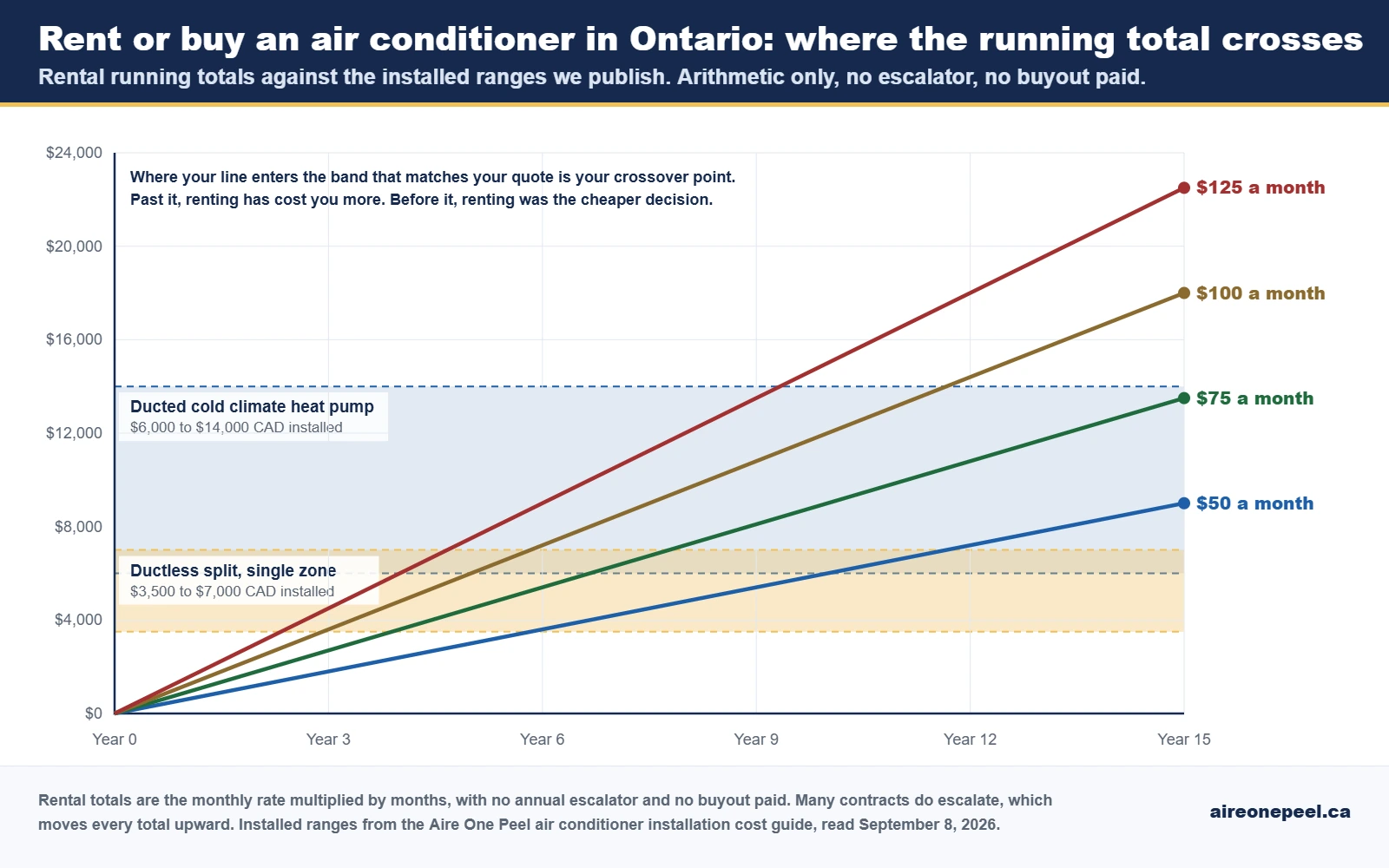
Renting looks cheaper every month and costs more in total the longer you stay, and the only question worth answering is where those two lines cross for your house. Take the monthly figure you have been quoted, find its row, and compare the totals against the installed price you have been quoted to buy. Nothing here is a price we charge or a price we have surveyed; it is multiplication, so that you can put your own number in.
| Monthly rental | 5 years | 10 years | 15 years |
|---|---|---|---|
| $50 CAD | $3,000 CAD | $6,000 CAD | $9,000 CAD |
| $75 CAD | $4,500 CAD | $9,000 CAD | $13,500 CAD |
| $100 CAD | $6,000 CAD | $12,000 CAD | $18,000 CAD |
| $125 CAD | $7,500 CAD | $15,000 CAD | $22,500 CAD |
| Buying, for comparison | Our installation cost guide does not publish a central air conditioner price, because it is quoted at the in-home estimate. It does publish the alternatives installed: a single zone ductless split at $3,500 to $7,000 CAD, and a ducted cold climate heat pump at $6,000 to $14,000 CAD | ||
Read the table with one question in mind: at your quoted monthly rate, in which year does the running total pass what buying would have cost? That year is your crossover point. Stay past it and renting has cost you more; move before it and renting was the cheaper decision. For most contracts and most installed prices the crossover lands somewhere between year six and year ten, which is why the length of your stay matters more than any other number on this page.
Two things the arithmetic does not capture, and both favour renting. Repairs are usually included in a rental, so a compressor failure in year nine costs a renter nothing and can cost an owner a great deal. And money you do not spend today is money you still have, which matters if the alternative is credit at a high rate. If you are weighing an ageing unit rather than a new install, the timing question is answered separately on when to replace an air conditioner.
The two Ontario laws that decide the rest
Two rules made in Ontario govern how these contracts can be sold and what a provider may attach to your home, and both changed the picture in ways most articles on this subject have not caught up with. One of them can make a contract void. The other retired the single most repeated warning about renting.
| The rule | Since | What it means for you |
|---|---|---|
| Air conditioners cannot be sold door to door | March 1, 2018 | Ontario restricts unsolicited door-to-door sales of furnaces, air conditioners, air cleaners, water heaters, water treatment devices and duct cleaning. A business may still come to your home if you invited them first |
| A contract from that marketing is void | March 1, 2018 | Ontario states that a contract signed as a result of restricted door-to-door marketing, or of misleading material left at your home, is void, and that you may keep the goods without obligation |
| A 10-day cooling-off period | Standing | Ten days from the day you receive a written copy of the agreement, for the contracts that carry the right |
| Notices of security interest are banned on consumer goods | June 6, 2024 | The Homeowner Protection Act, 2024 bans registering a NOSI for consumer goods, and the Personal Property Security Act now reads that the registration power does not apply with respect to collateral that is consumer goods |
| Existing notices are deemed expired | June 6, 2024 | Ontario deems consumer NOSIs already on title expired. They still appear on the title document, but the land is not affected, and there is no need to take immediate action |
The second pair matters because the warning it retired is still everywhere, including on pages written by companies in this industry. For years the strongest argument against renting was that the provider could register a notice against your property title, and that homeowners discovered it only at closing. That is what Ontario stopped. The exact wording now sitting in section 54 (1.1) of the Personal Property Security Act is short: the registration power does not apply with respect to collateral that is consumer goods, except as may be provided by the regulations.
What the ban did not do. It removed the registration, not the contract. If you signed a rental agreement, you still owe what it says, the provider may still enforce it, and the equipment is still theirs until a buyout is paid. So the change makes renting less frightening at the title level and changes nothing about the arithmetic above.
Two warnings worth the space
Nobody should be at your door selling you an air conditioner. If someone arrives uninvited offering an AC, a furnace, a water heater or duct cleaning, Ontario's rules say that visit should not be happening, and a contract that comes out of it is void. Do not sign, and do not let anyone into the house to inspect equipment you did not ask them to inspect.
Do not pay a company to remove an expired notice from your title. The Government of Ontario warns about exactly this. Expired consumer notices still show on the title document, but the land is not affected, and there is no need to act. If you want one physically discharged, that is a conversation with your own lawyer, usually at a sale, not a fee paid to whoever telephoned you about it.
What to get in writing before you sign either one
Ask for the buyout schedule before you sign anything, because it is the one term that decides whether a rental is a fair deal or an expensive one, and it is the term least likely to be offered unprompted. The rest of this list takes about ten minutes to work through with whoever is quoting you, including us.
| Ask for | Why it decides the deal |
|---|---|
| The buyout schedule, year by year | It is the only way to know what leaving costs in year three, year seven and year twelve. A schedule that barely falls is the warning sign |
| Whether the monthly amount escalates | An annual increase changes every total in the arithmetic table above, and it compounds quietly |
| The term, and what happens at the end of it | Some agreements end with ownership, some simply continue. Rent-to-own and rental are not the same product |
| Exactly what service is included | Parts, labour, annual maintenance and emergency calls are four separate things. Included repairs are the strongest argument for renting, so pin down what is actually included |
| What happens if you sell | Whether a buyer may assume the contract, on what approval, and what it costs to buy out at closing instead |
| The make and model being installed | You cannot compare two quotes, or check an efficiency rating, against equipment nobody will name |
| Who holds the manufacturer warranty | On a rental it is the provider's, which is fine, but it means the warranty terms are not your lever. Ours are set out on the air conditioner warranty page |
The possible downside of buying from us. If you buy, the repair bill after the warranty runs is yours, and we will quote it. That is the risk a rental transfers away from you, and it is a real one on a system that reaches year twelve. Our protection plans exist to cap it, but a plan is another monthly payment, and stacking one on top of a purchase narrows the gap this whole page is about. Weigh it, do not assume it.
What happens when you sell the house
A rented air conditioner does not stop you selling, it becomes a term of the deal: either the buyer takes the contract over or you pay the buyout at closing. That is the whole of it, and it is worth knowing in advance because it is a negotiating point rather than a surprise. Buyers and their lawyers will ask about rented equipment, and a clear answer with the buyout figure attached is a much better position than a shrug.
Since June 6, 2024 the older complication is gone. A consumer notice of security interest can no longer be registered, and any already sitting on a title is deemed expired, so it is no longer something that can hold up a closing on its own. Expect it to still be visible on the title document. Visible and expired is not the same as live.
Who each option actually suits
The decision follows the household rather than the equipment, so the useful version of this comparison sorts by circumstance rather than by feature. Find the row that describes you.
| If this is you | Lean | Because |
|---|---|---|
| Staying in the house ten years or more, capital available | Buy | You will pass the crossover and then pay nothing further for the equipment |
| Moving within about five years | Rent | You leave before the totals cross, and the contract goes to the buyer or gets bought out |
| Staying long, but the capital is not there today | Compare financing first | A fixed balance that ends beats an open-ended monthly payment, if the rate is sane. Rent-to-own sits between the two |
| Landlord, tenant pays the power | Usually buy | The property is held long, and an assumable contract is one more thing between you and the next sale |
| Fixed income, a large bill would hurt more than a monthly one | Rent | Included repairs remove the risk of a four-figure surprise, and that certainty is worth paying for |
| Your AC just died in a heat wave | Decide later | Nobody makes a good fifteen-year decision in a hot house. Get cooling, then read this page again in the autumn |
Rent or buy: the two-question finder
Two questions, and every answer it gives already appears in the tables above.
1. How long do you expect to be in this house?
How we know this
Every legal statement on this page was read off a Government of Ontario source on September 8, 2026 and is named with its date in the table caption and in the sources list. The wording of the notice of security interest ban was read from section 54 of the Personal Property Security Act on e-Laws, not from a summary. The door-to-door rules and the void-contract consequence come from Ontario's own consumer protection page and from the 2018 news release that set the date. The purchase comparison figures are our own published installation costs.
The arithmetic table is multiplication and nothing else. We have not surveyed rental prices in Peel Region and we are not going to publish a market rate we cannot evidence, which is why the rows are round numbers for you to match against your own quote.
This page also carries no first-party figure, and rather than invent one we are saying so. The number that belongs here is the share of our own customers who chose rent-to-own over purchase and why, with the sample and the window, and it has not been measured to a standard we would put our name to.
General Manager is a company role and not a trade credential, and this page is general information rather than legal advice.
Watch: the team behind the advice
Company footage from our own channel. None of it demonstrates a cost comparison or a contract term, so treat it as background on who would be doing the install rather than as evidence for anything above.
Cooling, Peel Region
Get both numbers before you decide
Ask us to quote the installed purchase price and the rent-to-own figure on the same visit, with the buyout schedule attached, so the arithmetic on this page is filled in with real numbers rather than round ones. Free in-home estimates, financing and rent-to-own, Carrier Factory Authorized Dealer. Mississauga, Brampton, Etobicoke, Milton, Georgetown, Caledon and Bolton. 1625 Courtneypark Dr E, Mississauga, ON L5T 1V9.
Frequently asked questions
Is it better to rent or buy an AC?
It depends almost entirely on how long you will stay in the house. Buying wins if you pass the point where the rental running total exceeds the installed purchase price, which on most contracts falls between year six and year ten. Renting wins if you move before that, or if a large bill would hurt more than a monthly one, because repairs are usually included.
What is the $5000 rule for AC?
It is an American rule of thumb for repair against replacement: multiply the unit's age in years by the repair quote, and if the result exceeds 5,000 you replace instead. It is a rough guide, not a Canadian standard, the figure is in US dollars, and it ignores efficiency, parts availability and refrigerant type. Treat it as a conversation starter rather than an answer.
How much does a new AC unit cost for 2000 sq ft?
Square footage alone does not set the price or the size, because the load depends on insulation, windows, ceiling height and orientation as well as area. Our air conditioner installation cost guide does not publish a central air conditioner price, because it is quoted at the in-home estimate. It does publish the alternatives installed: a single zone ductless split at $3,500 to $7,000 CAD, and a ducted cold climate heat pump at $6,000 to $14,000 CAD.
Does a rented air conditioner affect selling my house?
It becomes a term of the sale rather than an obstacle. Either the buyer assumes the rental contract or you pay the buyout at closing, and both are normal. Since June 6, 2024 a consumer notice of security interest can no longer be registered against your title in Ontario, and existing ones are deemed expired, so that older complication no longer applies.
Can you break a 12 month rental agreement?
For HVAC equipment the exit is the buyout figure in your contract, not a cancellation right, once any cooling-off period has passed. Ontario gives a 10-day cooling-off period from the day you receive a written copy of the agreement on the contracts that carry it. Separately, a contract that resulted from restricted door-to-door marketing is void, whatever it says about its term.
What are the new air conditioning rules for tenants in Ontario?
There is no provincial rule requiring a landlord to provide cooling. The rules are municipal: the City of Toronto requires that where a landlord provides air conditioning it is operated from June 1 to September 30 to keep a unit at or below 26 degrees, and from June 1, 2026 certain RentSafeTO buildings without cooling must keep an indoor amenity space at or below 26 degrees. Mississauga's by-law addresses heat rather than cooling.
The short version
Work out the year in which your quoted monthly rental passes the installed purchase price, then ask whether you will still be living in the house. That single comparison settles the decision for most households, and everything else on this page is detail hanging off it.
Renting is not the trap it is often painted as, particularly now. The strongest argument against it, a notice registered against your property title, was banned in Ontario on June 6, 2024 and the existing ones are deemed expired. What renting still is, is open-ended, so the term that matters is the buyout schedule, and you should have it before you sign rather than after.
Where we are not the right answer: if a rental with included repairs genuinely suits your circumstances, take it, from us or from anyone. We would rather quote you both numbers on the same visit and lose the sale honestly than have you sign something whose buyout schedule nobody showed you. Call 905-564-8545 or use the rent or buy an air conditioner page to start.
What we updated
September 8, 2026. Rebuilt from a 727-word page that argued buying is better without a single number. Removed a phone number that was not ours and not Canadian. Removed an unsourced claim that an air conditioner raises resale value, and an indoor air quality claim that contradicts our own guide to what actually improves indoor air. Added the arithmetic, the Ontario door-to-door rules, the 2024 ban on notices of security interest quoted from the Personal Property Security Act, the contract checklist, the selling section, and a decision finder. The slug was shortened and the old address now redirects here.
Sources and references
- Government of Ontario, door-to-door sales and home service contracts. The restricted product list including air conditioners, the void-contract consequence, the invitation exception and the 10-day cooling-off period. Page updated June 19, 2026. Read September 8, 2026.
- Ontario Newsroom, ban on door-to-door sales in effect as of March 1st. Sets the March 1, 2018 start date and the invitation rule. Released February 23, 2018. Read September 8, 2026.
- Government of Ontario, notices of security interest. The June 6, 2024 ban, the deeming of existing consumer notices as expired, the statement that the land is not affected and no immediate action is needed, and the warning about paying to have them removed. Page updated January 6, 2026. Read September 8, 2026.
- Personal Property Security Act, R.S.O. 1990, c. P.10, section 54. Subsection 54 (1.1), added by 2024, c. 18, Schedule 4, section 4 (2): the registration power does not apply with respect to collateral that is consumer goods, except as may be provided by the regulations. Read September 8, 2026.
- City of Toronto, indoor temperatures in apartment units. The 26 degree cooling rule from June 1 to September 30 and the June 1, 2026 amenity space requirement. Read September 8, 2026.
- Aire One Peel, air conditioner installation cost in Mississauga. The installed purchase figures used in the comparison row, including the $8,000 to $15,000 CAD cold climate heat pump range.
Mario Vaghei
General Manager, Aire One Peel Heating & Cooling
Rewrote this page on September 8, 2026 because the version that stood here argued for buying without publishing a single figure, and because it carried a phone number that was not ours. Read the notice of security interest wording off the Personal Property Security Act itself rather than off a summary, and left the rental rows as round arithmetic rather than inventing a market rate we have not surveyed. We sell both options, which is exactly why the buyout schedule is the thing this page tells you to ask for. General Manager is a company role and not a trade credential, and this is general information rather than legal advice.