



Mario Vaghei, General Manager, Aire One Peel Heating & Cooling
Published June 21, 2024 · Facts verified September 8, 2026
Air conditioning gets credit for cleaner air that it only partly earns. A central system does two real things to the air in your house and it does them well, but the two jobs that matter most for air quality are not among them, and no amount of running the fan will change that. If you want the full order of operations, our guide to how to improve indoor air quality lays it out in three steps.
On this page
Does air conditioning improve air quality? The four jobs
What the filter in your system is actually for
The HEPA claim, and why your air conditioner does not have one
The job it cannot do at all
Wildfire smoke, the one time recirculating is right
What no filter touches
Filtration, ventilation, or neither?
How we know this
Watch: the team behind the advice
Frequently asked questions
The short version
Sources and references
Short answer
Partly. A central air conditioner filters the air it moves and it removes moisture, and both genuinely help. It does not bring in outdoor air and it does not remove the source of a pollutant, and Health Canada names those two as the best ways to improve indoor air. So the air conditioner is a helper, not the fix.
Applies to Mississauga, Brampton, Etobicoke, Milton, Georgetown, Caledon and Bolton. The equipment behaves the same everywhere; only the outdoor air quality changes.
Does air conditioning improve air quality? The four jobs, and the two it does
Clean indoor air comes from four separate jobs, and a central air conditioner performs two of them. Removing the source of a pollutant and bringing in outdoor air are the two that Health Canada puts first, and a cooling system does neither. Filtering the air it circulates and pulling moisture out of it are the two it does, and on a humid Peel Region afternoon the second one is worth more than most people credit.
| The job | Does your AC do it? | What actually does it |
|---|---|---|
| Remove the source | No | You. Fixing the damp, changing the product, venting the appliance |
| Bring in outdoor air | No | An HRV or ERV, a fresh air intake, exhaust fans, open windows |
| Filter what is circulating | Yes, partly | The filter at the return, rated by MERV, only while the fan runs |
| Control moisture | Yes, in summer | The cold coil, but only while the compressor is running |
Read that table as a division of labour rather than a verdict on the equipment. The air conditioner is doing what it was designed to do, and doing it competently. The mistake is expecting it to cover the two rows above, which is where most of the confusion on this subject starts.
What the filter in your system is actually for
The filter in a residential system exists first to protect the equipment and second to clean your air. That is not cynicism, it is the design brief: an unfiltered return would load the indoor coil and the blower wheel with dust, and a fouled coil loses capacity and eventually fails. Cleaning the air you breathe is a genuine second benefit, and how much of it you get depends entirely on the rating of the filter you buy and on how often the fan is actually moving air.
Two consequences follow, and both surprise people. The filter only does anything while the blower runs, so on a mild day when the system barely cycles, it is doing almost nothing. And a filter can only catch what reaches it, which means a pollutant produced in a closed bedroom two floors from the return is not being filtered in any meaningful sense.
| Filter | Typically catches | Where it sits | Note |
|---|---|---|---|
| MERV 1 to 4 | Large dust, lint, hair | System return | Equipment protection, little air quality benefit |
| MERV 8 to 11 | Dust, pollen, pet dander, mould spores | System return | The common residential range |
| MERV 13 | The above, plus fine particulate | System return | Health Canada: a MERV value of 13 or more is recommended to remove fine particulate matter |
| True HEPA | At least 99.97 per cent at 0.3 microns | A portable unit, or a dedicated bypass | Not a drop-in replacement for your furnace filter |
If you want the replacement intervals rather than the ratings, we cover those separately in how often to replace air filters. A filter left in past its life is worse than a cheaper filter changed on time, because a loaded filter chokes airflow and a system starved of air neither cools nor filters properly.
The HEPA claim, and why your air conditioner does not have one
Your central air conditioner almost certainly does not contain a HEPA filter, whatever you have read. HEPA is a specific performance standard, not a marketing adjective, and the filter slot on a residential furnace or air handler is not built to hold one. When you see HEPA in a home, it is nearly always a portable air cleaner sitting in a room, which is exactly the form Health Canada discusses.
The number attached to HEPA is also widely quoted backwards, including in the earlier version of this page. A HEPA filter removes at least 99.97 per cent of particles at 0.3 microns. That is not a floor above which everything is caught; 0.3 microns is the hardest size for a filter to catch, and the US Environmental Protection Agency is explicit that particles larger or smaller are trapped with even higher efficiency. Saying "0.3 microns and larger" gets the physics exactly the wrong way round.
| Question | MERV filter | True HEPA |
|---|---|---|
| What it is | A rating scale for filters fitted to a duct system | A performance standard a filter either meets or does not |
| Where you find it | The return of your furnace or air handler | A portable air cleaner, or a purpose-built bypass unit |
| Covers the whole house | Yes, while the blower runs | No, one room at a time |
| Can you just fit one | Yes, up to what your system can take | No. It is not a swap for a furnace filter |
| How to size it | By the filter slot and the system's airflow | By room. Health Canada suggests a tobacco smoke CADR of at least two thirds of the room's area |
Neither one is better in the abstract. They do different jobs, and a house that needs both is a normal house. If you are shopping for the portable side of that pair, our guide to selecting an air purifier covers sizing and the devices to avoid, and Health Canada is blunt that anything producing ozone belongs in the second category.
The job it cannot do at all
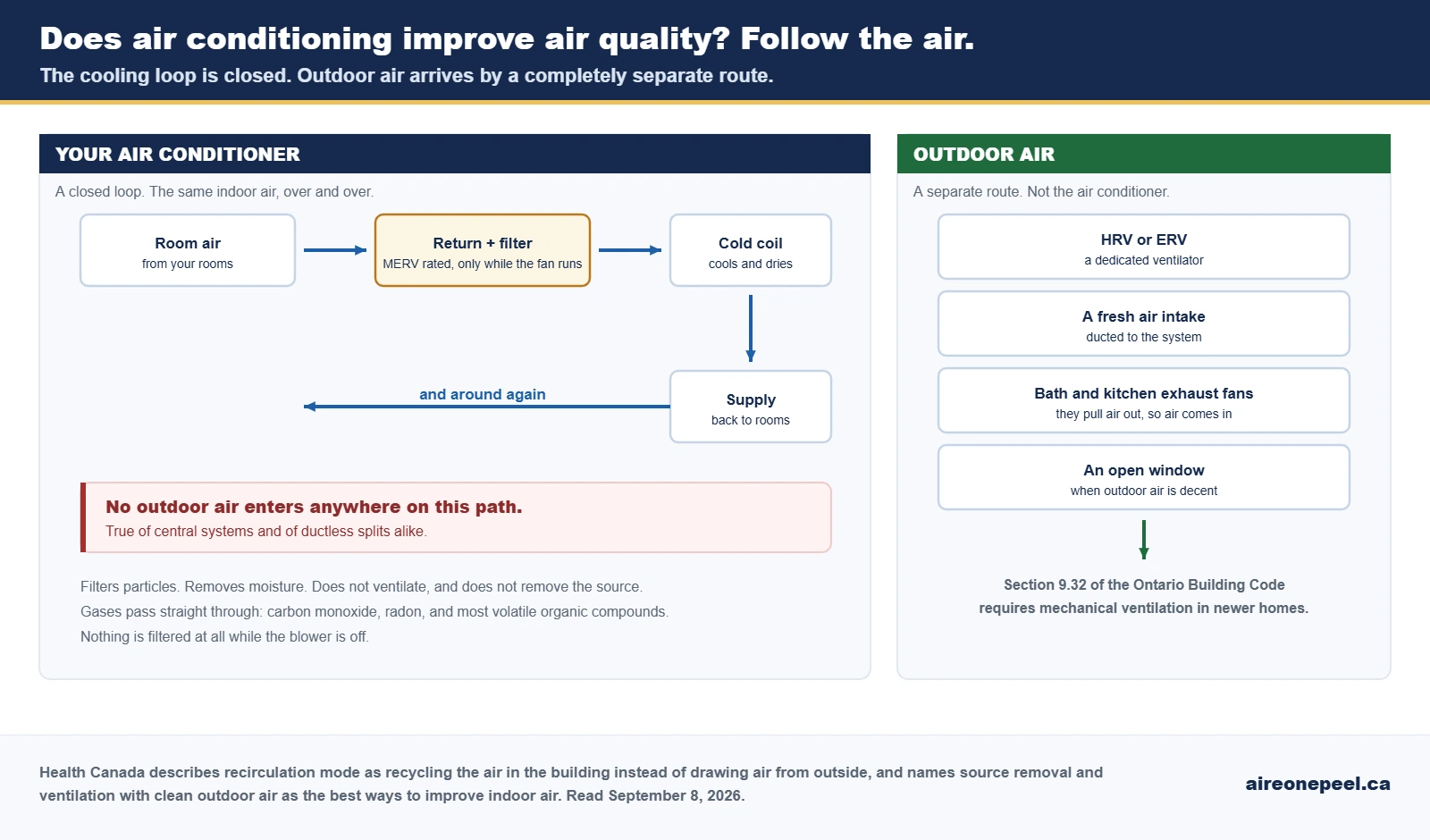
A conventional central air conditioner does not bring outdoor air into your house, and this is the single most repeated error on this topic. The system pulls air from your rooms through the returns, passes it over a cold coil, and pushes the same air back out the supply registers. Nothing enters from outside along that path. Health Canada describes recirculation mode as recycling the air in the building instead of drawing air from outside, which is precisely what your cooling system does all summer.
The same is true of a ductless split, despite claims to the contrary published by contractors who should know better. The indoor head takes room air in at the top, cools it, and blows it back into the same room. Fresh air in an Ontario house comes from somewhere else entirely: an HRV or ERV, a dedicated fresh air intake, your bathroom and kitchen exhaust fans, or an open window. Under Section 9.32 of the Ontario Building Code, newer homes are required to have mechanical ventilation for exactly this reason.
Key takeaway
If the air in your house feels stuffy rather than dusty, filtration is not your answer and neither is a colder setting. Stuffiness is a ventilation problem, and the machine that solves it is not the air conditioner.
| The claim | Verdict | What is actually true |
|---|---|---|
| Air conditioners typically include HEPA filters | False | Residential systems take MERV rated filters. HEPA lives in a portable unit or a purpose-built bypass |
| HEPA catches 99.97 per cent of particles 0.3 microns and larger | Backwards | 0.3 microns is the hardest size to catch. Larger and smaller particles are trapped with even higher efficiency |
| Air conditioning replaces stale indoor air with outdoor air | False | A conventional system recirculates. Outdoor air comes from an HRV or ERV, an intake, exhaust fans or a window |
| A ductless split brings fresh outside air into the room | False | The indoor head takes room air in and blows the same air back out |
Wildfire smoke, the one time recirculating is right
During a smoke event the air conditioner's inability to bring in outdoor air stops being a limitation and becomes the point. When the outdoor air is the problem, a system that recycles indoor air through a good filter is doing exactly what you want. Health Canada's guidance for cleaner air spaces recommends installing a high quality filter in homes with forced air ventilation, setting the system to recirculation mode, keeping windows and doors closed and properly sealed, and limiting exhaust fans when you are not cooking.
Two practical notes for Peel Region. Check the Air Quality Health Index from Environment and Climate Change Canada for your own community rather than assuming from how the sky looks, because smoke aloft and smoke at ground level are different things. And a portable HEPA cleaner in the room where you sleep is a reasonable addition, not a replacement for the filter in the system.
What no filter touches
A filter catches particles, and several of the things that matter most in a home are not particles. Carbon monoxide is a gas and passes straight through any filter at any rating. So does radon. So do most of the volatile organic compounds that come off new furniture, paint and cleaning products, unless the filter carries activated carbon, which a standard furnace filter does not.
Safety
No air conditioner, filter or air purifier protects you from carbon monoxide. Only a working CO alarm does. If a CO alarm sounds, get everyone outside into fresh air and call 911 from outside. Do not go back in to investigate, and do not assume it is a false alarm because nobody feels unwell.
Radon is not detectable by smell or by any filter either, and it is tested for rather than filtered out.
This is the honest limit of the equipment we sell and service. An air conditioner in good order, with the right filter changed on schedule, improves two things about your air. It is not a health device and we will not describe it as one.
| What you notice | You can do this yourself | When to call a technician |
|---|---|---|
| Dust returns within a day | Check and change the filter, then run the fan more | To find the highest MERV rating your system can take safely |
| Stuffy, stale air | Run bath and kitchen exhaust fans, open a window when outdoor air is decent | To confirm whether the house has an HRV or ERV, and whether it works |
| Clammy air, foggy windows | Check the thermostat fan is on auto, not on | If the unit short cycles or is oversized for the house |
| Smoke outside | Close and seal up, recirculate, run a portable unit where you sleep | To fit a MERV 13 filter if your equipment allows it |
| A CO alarm sounds | Get everyone outside and call 911 from outside | After the fire service clears the house, before any appliance is used again |
Not sure what your system can take?
A technician can tell you the highest filter rating your specific furnace or air handler will tolerate without starving it of airflow, and whether your house already has mechanical ventilation. That is a conversation, not a sale.
Book a free in-home estimate Call 905-564-8545Aire One Peel Heating & Cooling, 1625 Courtneypark Dr E, Mississauga, ON L5T 1V9
Filtration, ventilation, or neither?
Answer two questions and this points you at the row of the first table that applies to you. Every answer it gives already appears in the tables and prose above, so nothing here depends on the script running.
1. Which is closest to what you actually notice?
How we know this
Every claim on this page traces to a named public source or to how the equipment is built, and nothing here rests on our own opinion of it. Four sources were used: two Health Canada guidance pages, one US Environmental Protection Agency definition page, and the Heating, Refrigeration and Air Conditioning Institute of Canada's summary of Section 9.32 of the Ontario Building Code. All four were read on September 8, 2026 and are listed below with links.
Two things we are not claiming. We have no first-party figure on this page. The number that belongs here is the share of Peel Region homes we service that already have mechanical ventilation, with the sample size and the window it was collected over, and we have not measured it to a standard we would put our name to. Publishing a guess would be worse than the gap. And the author's title is a company role, not a trade credential. Mario Vaghei is General Manager. No credentialed reviewer is confirmed for this page, so none is claimed.
The honest downside of calling us about this: a good portion of what this page recommends costs nothing and needs no technician. Change the filter, run the exhaust fans, open a window on a decent day. If those fix it, they fix it, and we would rather you find that out from this page than from an invoice.
Watch: the team behind the advice
Company footage from our own channel. None of it demonstrates filtration or ventilation, so treat it as background on who would be doing the work rather than as evidence for anything above.
Frequently asked questions
Is it normal for AC to improve air quality?
Yes, within limits, and the improvement is real rather than imagined. A central system filters the air it circulates and removes moisture from it while the compressor runs, and both reduce common complaints like dust and clamminess. What it does not do is bring in outdoor air or remove whatever is producing the pollutant, so the improvement stops well short of solving an air quality problem on its own.
Does running central air improve indoor air quality?
It helps while it runs, because nothing is filtered when the blower is off. Running the fan alone moves house air through the filter without cooling, which is useful during a smoke event and wasteful the rest of the time. The larger point is that running it more does not add ventilation, since the system recycles indoor air rather than drawing air from outside.
Do I need an air purifier if I have AC?
Sometimes, and the two are not alternatives. The filter in your system covers the whole house at a moderate rating whenever the fan runs, while a portable air cleaner covers one room at a much higher rating. Health Canada suggests matching a portable unit to the room, with a tobacco smoke CADR of at least two thirds of the room's floor area, and avoiding any device that produces ozone.
Do air conditioners help clean up indoor air pollution?
They remove some of it and are blind to the rest. Particles such as dust, pollen and dander are caught by the filter, and higher rated filters catch finer ones. Gases are a different matter entirely: carbon monoxide, radon and most volatile organic compounds pass straight through a standard filter, because catching them needs activated carbon or, in the case of the first two, a completely different response.
How well do air conditioners clean the air in smoke-affected areas?
Better than people expect, and this is where recirculating becomes an advantage. Health Canada recommends fitting a high quality filter in homes with forced air ventilation, a MERV value of 13 or more to remove fine particulate matter, and setting the system to recirculation mode with windows and doors closed and sealed. Confirm your equipment can take that rating before fitting one.
What are signs of poor indoor air quality?
The useful ones are patterns rather than single moments. Dust that returns within a day of cleaning, condensation on windows, odours that linger long after cooking, and stuffiness that lifts when you open a window all point somewhere specific. Each points at a different job: dust at filtration, condensation at moisture, and lingering odours and stuffiness at ventilation.
The short version
So, does air conditioning improve air quality? In two specific ways, yes, and it leaves the two most important jobs untouched. Filter it and dry it, yes. Ventilate it and remove the source of the problem, no. Once you know which of those four your complaint belongs to, the right next step is usually obvious and often free.
If your complaint is dust, start with the filter. If it is stuffiness, you have a ventilation question and the cooling system is not part of the answer. If it is clamminess, the air conditioner is exactly the right tool and may simply be oversized. And if the problem is smoke outside, close everything up, run it on recirculation and use the best filter your system will take. The full sequence, in order, is on our indoor air quality guide, and if you would rather have someone look at what your specific equipment can handle, our home air treatment team does that as part of a free in-home estimate.
Sources and references
All four sources were read on September 8, 2026.
Health Canada, Guidance for Cleaner Air Spaces during Wildfire Smoke Events. Source of the MERV 13 recommendation and the definition of recirculation mode.
Health Canada, Using a portable air cleaner to improve indoor air. Source of the CADR sizing guidance, the ozone warning, and the statement that source removal and ventilation with outdoor air are the best ways to improve indoor air.
US Environmental Protection Agency, What is a HEPA filter? Source of the HEPA definition and the most penetrating particle size explanation.
Heating, Refrigeration and Air Conditioning Institute of Canada. Summary of Section 9.32 of the Ontario Building Code, mechanical ventilation requirements.
Mario Vaghei
General Manager, Aire One Peel Heating & Cooling
Mario rewrote this page after the earlier version repeated two claims that do not hold up: that air conditioners typically contain HEPA filters, and that they replace stale indoor air with outdoor air. Both are corrected here against Health Canada and the EPA, and the corrections are stated rather than quietly removed.