




24/7 Emergency, No After-Hours Charge
Carrier Factory Authorized Dealer
BBB Accredited Business
Free In-Home Estimates

By Mario Vaghei, General Manager, Aire One Peel Heating & Cooling · Published October 24, 2024 · Facts verified September 4, 2026
Choosing a heat pump for your home comes down to three decisions: the type, the capacity, and the cold weather rating. Get the capacity wrong and you pay for it twice, once on the invoice and again on the rebate, because Ontario pays per ton. If you are still deciding between a heat pump and a gas furnace at all, start with our heat pump versus furnace guide and come back here once that is settled.
On this page
- Why square footage is the wrong sizing question
- Four kinds of heat pump for your home, and which suits Ontario
- How the size you choose sets your rebate
- The ratings that matter in a Peel Region winter
- What a proper heat pump quote must show you
- Where we would tell you not to buy one
- Which heat pump path fits your home?
- How we know this
- Watch: the team behind the advice
- Frequently asked questions
- The short version
- Sources and references
Short answer
Size a heat pump from a heat loss calculation, not from square footage. In Canada that calculation is CSA F280, the standard for determining the required capacity of residential heating and cooling appliances, and it accounts for insulation, windows, air leakage and orientation, none of which floor area can tell you.
Capacity is measured in tons, where one ton is 12,000 BTU/h. Ontario’s Home Renovation Savings program pays per ton, $500 CAD a ton in a gas heated home to a maximum of $2,000 CAD, and $1,250 CAD a ton in an electrically heated home to a maximum of $7,500 CAD, read September 4, 2026.
Key takeaways
- Every square-footage rule of thumb you will read for Ontario is guesswork. Two identical floor plans, one insulated to modern standards and one not, need very different capacity.
- Natural Resources Canada advises sizing to cover the majority of annual heating energy and letting a supplementary system meet the occasional peak, rather than sizing for the coldest hour of the year.
- The model must be on Natural Resources Canada’s qualified products list to earn the rebate, and pre-approval is mandatory. Installations done before approval are not eligible.
- Renting instead of buying caps the rebate at $500 CAD a ton whatever your fuel, which costs an electrically heated home up to $5,500 CAD.
- Ratings are SEER2 for cooling and HSPF2 for heating. The older SEER and HSPF numbers are not the same scale and are not comparable.
Why square footage is the wrong sizing question
Square footage cannot size a heat pump for your home because it describes the floor, not the heat loss. The number that matters is how much heat the building loses on a design day, and that depends on insulation levels, window area and type, air tightness, orientation and how the house is used. Two 1,500 square foot homes on the same street, one built in 1962 and one built last year, can differ by more than a full ton.
In Canada the calculation has a name and a standard: CSA F280, which sets out how to determine the required capacity of residential space heating and cooling appliances. A contractor who quotes you a size before measuring the house has skipped it. That is the single clearest signal you will get about the quality of the quote in front of you.
| The rule of thumb assumes | Reality in Peel Region | Effect on capacity |
|---|---|---|
| All homes of a size lose heat at the same rate | Insulation levels differ by decades of building practice | Large. This is usually the biggest single variable |
| Windows are a minor factor | Area, glazing and orientation change both heat loss and summer gain | Moderate to large |
| Air leakage is the same everywhere | An older house can lose several times the air of a newer one | Moderate |
| Ductwork will deliver whatever you install | Existing ducts were sized for a furnace, not for lower supply temperatures | Can cap the practical size regardless of the calculation |
There is a second reason not to round up. Natural Resources Canada’s guidance is to size the heat pump to cover the majority of the annual heating energy and to let a supplementary system meet the occasional peak, rather than sizing for the coldest hour of the year. An oversized unit short cycles, dehumidifies poorly in summer, and costs more to buy.
Four kinds of heat pump for your home, and which suits Ontario
Four kinds of heat pump for your home are realistic in this market, and the choice between them is usually decided by your ductwork and your budget rather than by preference. The rebate treatment differs sharply between them, which is worth knowing before you fall in love with one.
| Type | Suits | Rebate treatment | The caveat |
|---|---|---|---|
| Cold climate air source, ducted | A home that already has ductwork | $500 CAD per ton on gas heat, $1,250 CAD per ton on electric, oil, propane or wood | Must be on the Natural Resources Canada qualified products list |
| Ductless mini split | Homes without ducts, additions, and rooms nothing else reaches | Treated as air source, subject to the same list | Zoned comfort, but a head in every room you want conditioned |
| Ground source, water to air | Properties with land and a long horizon | $3,000 CAD on gas heat, $2,000 CAD per ton to a maximum of $12,000 CAD on electric heat | Ground loop work makes this the largest project of the four |
| Any type, rented rather than bought | Households avoiding the up-front cost | Capped at $500 CAD per ton, maximum $2,000 CAD, whatever your fuel | On an electrically heated home this is up to $5,500 CAD of rebate given up |
How the size you choose sets your rebate
In Ontario the capacity you install is also a money decision, because the cold climate air source rebate is paid per ton rather than as a flat amount. That makes sizing the one part of this process where getting it right pays you twice, and it is the part most articles skip entirely.
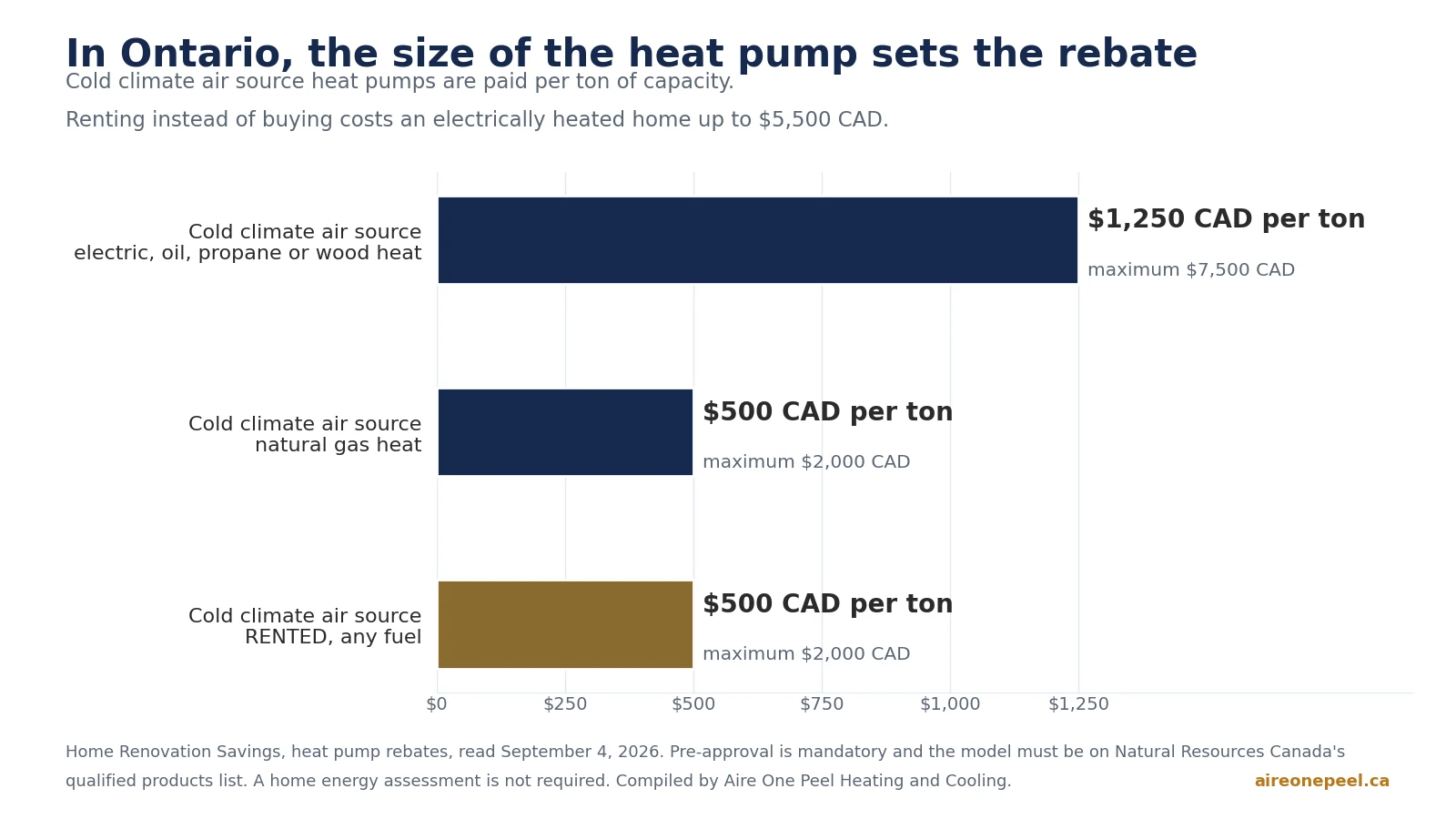
Home Renovation Savings heat pump rebates, read September 4, 2026. Pre-approval is mandatory and a home energy assessment is not required.
| Equipment | Natural gas heated home | Electric, oil, propane or wood | Rented, any fuel |
|---|---|---|---|
| Cold climate air source | $500 CAD per ton, maximum $2,000 CAD | $1,250 CAD per ton, maximum $7,500 CAD | $500 CAD per ton, maximum $2,000 CAD |
| Ground source | $3,000 CAD | $2,000 CAD per ton, maximum $12,000 CAD | $3,000 CAD |
| Conditions that apply to all of them | Pre-approval is mandatory and installations done before approval are not eligible. A home energy assessment is not required. The model must be an active listing on Natural Resources Canada’s qualified products list. Furnaces and standalone air conditioners are not eligible at all | ||
Two rules decide whether the money arrives at all. Pre-approval is mandatory, and the program states plainly that installations done before approval are not eligible. And the equipment must be an active model on Natural Resources Canada’s qualified products list. A contractor who tells you to book the install now and sort the paperwork later is costing you the rebate. For the full installed cost picture, our heat pump installation cost guide carries the price bands; this page deliberately does not repeat them.
The ratings that matter in a Peel Region winter
Two ratings and one measured figure tell you what a heat pump will do here. SEER2 rates cooling efficiency, HSPF2 rates heating efficiency, and the coefficient of performance tells you how much heat you get per unit of electricity at a stated outdoor temperature. The last one is the honest one, because it changes with the weather.
| Outdoor temperature | Coefficient of performance | What it means |
|---|---|---|
| +8 degrees Celsius | 2.0 to 5.4 across models | Mild autumn and spring, the cheapest heat you will run |
| -8 degrees Celsius | 1.1 to 3.7 across models | A normal Peel Region winter day. The spread between models is the whole argument for buying carefully |
| -21.1 degrees Celsius, measured | 1.5 on a ducted cold climate unit | Still producing more heat than resistance backup, in a real house |
| -25 degrees Celsius, measured | close to 2.0 on a mini split | The cold climate label is not marketing. These units were tested here |
| Minimum operating temperature | -15 to -25 degrees Celsius on newer models | Below it, the backup carries the house |
One more number to ask for, and almost nobody volunteers it: the economic balance point. Natural Resources Canada defines it as the temperature below which the ratio of electricity to the supplementary fuel makes the supplementary system the cheaper way to heat. That single figure decides how your system should be set up, and how a control should switch between the two. Our page on smart thermostats and heat pumps covers what happens when it is set wrong, and heat pumps in cold weather covers what an Ontario winter actually does to one.
What a proper heat pump quote must show you
A quote you can act on shows five things, and any contractor who cannot produce them is asking you to buy on trust. Ask for them in writing, from us as readily as from anyone else.
| Ask for | Why it matters | Worry if |
|---|---|---|
| The heat loss calculation, and the design temperature used | It is the only defensible basis for the capacity | A size was named before anyone measured the house |
| The exact model number, and confirmation it is on the qualified products list | Rebate eligibility depends on the specific active model | Only a brand and a tonnage are given |
| SEER2, HSPF2 and the capacity retained at low temperature | Cold performance varies enormously between models | Only a single headline efficiency number appears |
| The backup heat plan and the balance point | It decides your winter running cost more than the sticker efficiency does | Backup is described as “it has electric heat” and nothing more |
| Written confirmation that rebate pre-approval will be obtained first | Installations done before approval are not eligible | You are urged to book the install now and apply later |
Where we would tell you not to buy one
A heat pump is the wrong purchase in three situations we meet often enough to name, and saying so costs us installation work.
- Ductwork that cannot carry it. Heat pumps deliver a larger volume of cooler air than a furnace does. On undersized or poorly laid out ducts, the practical capacity is capped no matter what the heat loss calculation says, and the fix is duct work rather than equipment.
- A gas furnace with years left, in a gas heated home. The rebate on gas heat is $500 CAD a ton to a maximum of $2,000 CAD, a quarter of what an electrically heated home receives, and the running cost comparison in Ontario is not automatic. Our running cost arithmetic shows the break-even honestly.
- A household that will not tolerate a warm-air feel. Supply air from a heat pump is cooler than furnace air. Most people stop noticing within a week. Some never do, and it is better to know that about yourself before the equipment is on the wall.
The possible downside of asking us. We install heat pumps, so our advice runs toward the ones we carry and are trained on, and that is a real bias you should read as one. If you want a brand we do not carry, an independent contractor who does will serve you better on that model, and we would rather say it than talk you out of the right machine. What we will not do is quote a size before we have measured the house. Our heat pump installation team works across Mississauga, Brampton, Etobicoke, Milton, Georgetown, Caledon and Bolton.
Which heat pump path fits your home?
Two questions, and every answer it gives also appears in the tables above, so nothing here is exclusive to the tool.
Heat pump path finder
1 of 2. How is the home heated today?
This finder needs JavaScript. Every answer it gives also appears in the tables above.
How we know this
Every rebate amount, performance figure and rule on this page was read from the body that publishes it on September 4, 2026, and where we have no number we say so instead of estimating one.
The rebate amounts, the per ton structure, the rental cap, the mandatory pre-approval and the qualified products list requirement come from the Home Renovation Savings heat pump page. The coefficient of performance ranges, the minimum operating temperatures, the service life and the sizing guidance come from Natural Resources Canada. The measured cold weather figures come from the Canadian Centre for Housing Technology assessments of a ducted cold climate heat pump and a mini split, published by Natural Resources Canada. The sizing standard is CSA F280.
What this page does not claim: any installed price, which lives on our cost guide rather than here; any brand recommendation; and any first-party statistic about our own installations, because we have not published a counted one. Compiled by Mario Vaghei, General Manager. General Manager is a company role and not a trade credential. Refrigeration work is a compulsory trade in Ontario and belongs to a certified mechanic; no certification is claimed for the author on this page.
Watch: the team behind the advice
These are company and furnace clips from our own channel rather than heat pump footage, which is honest rather than ideal. There is no heat pump installation video on the channel yet.
Video 1 of 3
Heat pumps, Peel Region
We will measure the house before we name a size
Free in-home estimates across Mississauga, Brampton, Etobicoke, Milton, Georgetown, Caledon and Bolton, including the rebate pre-approval before anything is ordered. Financing and rent-to-own available. 1625 Courtneypark Dr E, Mississauga, ON L5T 1V9.
Frequently asked questions
What to look for when buying a heat pump?
Look for four things: a capacity taken from a heat loss calculation rather than from floor area, a model listed on Natural Resources Canada’s qualified products list so the rebate is available, SEER2 and HSPF2 figures with the capacity retained at low temperature, and a written backup heat plan with a stated balance point. Price matters, but those four decide whether the system performs here.
How do I know what size heat pump to get?
The size comes from a heat loss calculation of your specific house, done to CSA F280, which accounts for insulation, windows, air leakage and orientation. Capacity is expressed in tons, one ton being 12,000 BTU/h. Natural Resources Canada advises sizing to cover most of the annual heating energy and letting backup handle the occasional peak, rather than sizing for the coldest hour.
What size Heat Pump for a 1500 sqft House in Ontario?
There is no honest answer from floor area alone, and any page giving you one is guessing. Two 1,500 square foot Ontario homes can need very different capacity depending on insulation, windows and air tightness, and the difference can exceed a full ton. The calculation is inexpensive and it is the basis for both the equipment and the rebate, so have it done.
What is the recommended size heat pump for my home?
The recommended size is whatever the heat loss calculation for your house produces, rounded to an available model rather than rounded up for safety. Oversizing causes short cycling, poorer summer dehumidification and a higher purchase price. In Ontario it also changes the rebate, because cold climate air source heat pumps are paid per ton of installed capacity.
How many square feet will a 12000 BTU heat pump do?
12,000 BTU/h is one ton, and how far it goes depends entirely on the building rather than on the area. In a well insulated, tight modern space one ton covers considerably more floor than it does in an uninsulated older one. Treat any square-foot-per-ton figure as a sales shortcut, not as a specification you can rely on.
How many heat pumps do I need in my house?
A ducted home normally needs one outdoor unit serving the whole house through the existing ductwork. A home without ducts uses a multi zone mini split, where one outdoor unit serves several indoor heads, and the number of heads is decided by the rooms you want conditioned rather than by the room count. More heads means more cost, so choose the rooms you actually use.
Does the size of the heat pump change my Ontario rebate?
Yes, directly. Home Renovation Savings pays cold climate air source heat pumps per ton of capacity: $500 CAD a ton to a maximum of $2,000 CAD in a gas heated home, and $1,250 CAD a ton to a maximum of $7,500 CAD in a home heated by electricity, oil, propane or wood. Renting instead of buying caps the rate at $500 CAD a ton whatever the fuel. Read September 4, 2026.
The short version
Choose a heat pump for your home in this order: settle the type from your ductwork, take the capacity from a CSA F280 heat loss calculation rather than from floor area, then check the exact model against Natural Resources Canada’s qualified products list and get rebate pre-approval before anything is ordered. Skipping the last step is how households lose thousands.
Watch the cold weather numbers rather than the headline efficiency. At -8 degrees Celsius the coefficient of performance across models runs from 1.1 to 3.7, and that spread, not the SEER2 sticker, is what your January bill will reflect.
If you want the calculation done properly and the pre-approval handled before an order is placed, call 905-564-8545 or book a free in-home estimate. If the ducts turn out to be the real problem, our heat pump installation team will tell you that before you spend anything on equipment.
Mario Vaghei
General Manager, Aire One Peel Heating & Cooling
Rebuilt this guide on September 4, 2026, reading the rebate structure and the pre-approval rule off the Home Renovation Savings heat pump page, the performance ranges and sizing guidance off Natural Resources Canada, and the measured cold weather figures off the Canadian Centre for Housing Technology assessments. General Manager is a company role and not a trade credential, and no certification is claimed for the author on this page.
Sources and references
- Home Renovation Savings, heat pump rebates. The per ton amounts and maximums, the rental cap, the mandatory pre-approval, and the requirement that the model be on the Natural Resources Canada qualified products list. Read September 4, 2026.
- Natural Resources Canada, heating and cooling with a heat pump. Coefficient of performance ranges at +8 and -8 degrees Celsius, minimum operating temperatures, service life, sizing guidance and the economic balance point. Read September 4, 2026.
- Natural Resources Canada, cold climate air source heat pump assessment. The measured coefficient of performance of 1.5 at -21.1 degrees Celsius on a ducted unit. Read September 4, 2026.
- Natural Resources Canada, mini split cold climate heat pump assessment. The measured performance close to 2.0 at -25 degrees Celsius. Read September 4, 2026.
- CSA F280:12 (R2025). Determining the required capacity of residential space heating and cooling appliances, the Canadian sizing standard. Read September 4, 2026.