




By Mario Vaghei, General Manager, Aire One Peel Heating & Cooling · Published June 19, 2025 · Facts verified September 1, 2026
Ask five sources how often to replace air filters and you will get "every 1 to 3 months" from all five. It is not wrong, but it is the answer to a question nobody asked, because a 1-inch fiberglass filter and a 5-inch media cabinet do not live in the same universe. One needs replacing monthly. The other can run most of a year. This guide gives the interval by the filter you actually own, the five conditions that shorten it, the five signs you are already overdue, and the part almost every article skips: a higher MERV number is not automatically a better filter, and choosing one your blower cannot pull air through will cost you more than a dirty filter would. If your rooms are cool but sticky rather than dusty, our guide to an AC not removing humidity is the better starting point.
In this guide
The interval by filter type · What Health Canada actually says · What shortens the interval · Five signs you are overdue · MERV, and the trade-off · What happens if you never change it · Washable filters · Filter finder · Who does what · How we know this · FAQ · Final verdict
Short answer
Replace a 1-inch air filter every 30 to 90 days, a 4-inch every 3 to 6 months, and a 5-inch media filter every 6 to 12 months. Pets, allergies, renovation dust and wildfire smoke shorten all three. Thickness matters more than any other single factor, because a thicker filter simply holds more.
Check the interval table below against the size printed on the edge of your filter.
Key takeaways
- Thickness sets the baseline. Everything else adjusts it. Read the size printed on the cardboard edge before you trust any schedule.
- Health Canada's advice for homes is to replace or clean the filter as per the manufacturer's instructions. It does not publish a 30, 60 or 90 day rule for houses.
- A higher MERV is not automatically better. Health Canada itself notes the system must be capable of handling the pressure drop.
- A badly restricted filter makes a furnace run hot. Repeated overheating is how heat exchangers crack, and that is a carbon monoxide question, not a comfort one.
How often should you replace air filters?
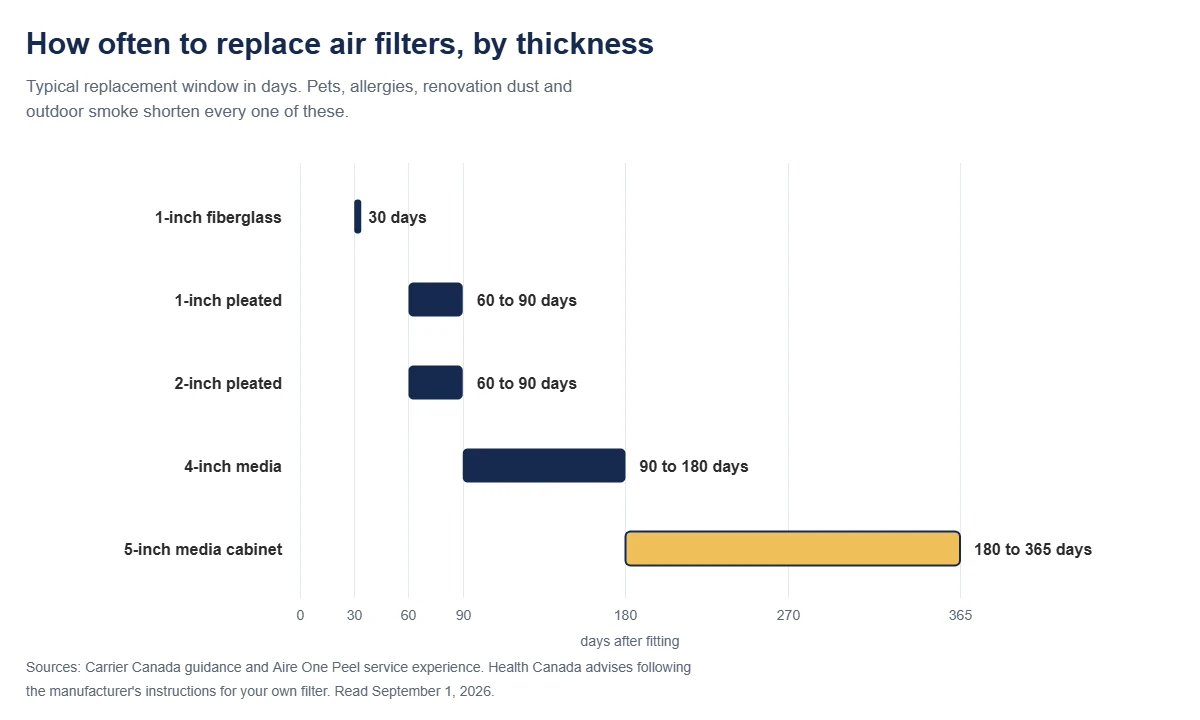
You should replace air filters every 30 days for 1-inch fiberglass, every 60 to 90 days for 1-inch pleated, every 3 to 6 months for a 4-inch, and every 6 to 12 months for a 5-inch media cabinet, then shorten all of those for pets, allergies or dusty conditions. The number printed on the cardboard edge of the filter tells you which row you are in, and it is the single most useful thing to know before reading any advice about intervals.
The reason thickness dominates is unglamorous: a thicker filter has more pleated surface area, so it holds more dust before airflow suffers. A 5-inch media filter can have several times the surface of a 1-inch panel in the same duct opening. That is also why the thick ones cost more per filter and less per year.
| Filter | Typical interval | Why |
|---|---|---|
| 1-inch fiberglass (the flat blue or green panel) | Every 30 days | Almost no surface area. It protects the equipment, not your lungs |
| 1-inch pleated | Every 60 to 90 days | Pleats multiply the surface in the same slot. The common default in Peel Region homes |
| 2-inch pleated | Every 60 to 90 days | More depth, more capacity, but usually a higher MERV that loads faster |
| 4-inch media | Every 3 to 6 months | A dedicated cabinet rather than a slot. Needs to have been installed with the system |
| 5-inch media cabinet | Every 6 to 12 months | The most surface area of anything in a house. Lowest cost per year despite the sticker price |
| Washable or electrostatic | Wash monthly, replace per the maker | Must be bone dry before it goes back in. See the section below |
What Health Canada actually says, and what it does not
Health Canada's advice to homeowners is to use an HVAC system with filtration built into the ductwork and to replace or clean the filter as per the manufacturer's instructions. That is the whole of it. There is no federal 30, 60 or 90 day rule for houses, which matters because the "every 1 to 3 months" line gets repeated as though a health authority set it. It did not. Manufacturers and retailers set it, and it is a reasonable average rather than a standard.
Health Canada does get specific in one place, and it is worth knowing about because it is where the MERV advice comes from. In its guidance for cleaner air spaces during wildfire smoke events, it states that a MERV value of 13 or more is recommended to remove fine particulate matter, and that a MERV 8 pre-filter is recommended ahead of it. Two honest caveats belong with that. First, the guidance is written for community cleaner air spaces such as public buildings, not for a bungalow in Brampton. Second, and more important, the same document says the HVAC system must be capable of handling a pressure drop from installing a filter stack of MERV 13/14. That single sentence is the one every consumer article leaves out.
What shortens the interval
Five conditions shorten the interval on any filter: pets, allergies or asthma in the household, renovation or construction dust, running the system hard through a heat wave or cold snap, and outdoor smoke. Each one loads the filter faster than the manufacturer's test conditions assume, so treat the interval on the box as a ceiling rather than a promise.
| Condition | What it does | Adjust to |
|---|---|---|
| Shedding pets | Hair and dander mat across the pleat faces | Roughly half the baseline. Check monthly on a 1-inch |
| Allergies or asthma in the house | Not faster loading, but less tolerance for a loaded filter | Monthly checks on a 1-inch; do not stretch the interval |
| Renovation or construction dust | Drywall dust is fine and abundant, and it loads a filter in days | Check weekly during the work, then fit a fresh one after |
| Heat wave or deep cold | The system runs far more hours, so more air passes the filter | Check at the midpoint of the usual interval |
| Wildfire smoke outdoors | Health Canada notes particulate can quickly overload filters | Check during and after the event, and keep a spare on hand |
The smoke line is the one that has changed for Ontario households in recent years rather than a piece of generic advice. Environment and Climate Change Canada publishes the Air Quality Health Index for Mississauga, Brampton and the rest of the Greater Toronto Area, and it is the practical local trigger: when the index sits high because of smoke, that is your cue to look at the filter, not the calendar.
Five signs you are overdue
Five signs tell you the filter is overdue regardless of the date: weak airflow at the registers, the system running longer to reach the same setpoint, dust settling faster than usual, a filter that looks grey against a light, and heating or cooling that shuts off early and restarts. The last one is the one to act on quickly, because short cycling means the equipment is protecting itself.
| Sign | What it means | What to do |
|---|---|---|
| Weak airflow at the registers | The filter is restricting the return | Replace it, then re-check the airflow |
| Longer run times for the same setpoint | Less air across the coil or heat exchanger per minute | Replace it. If nothing improves, book a diagnosis |
| Dust settling faster on surfaces | Particles are bypassing or passing through | Replace, and check the filter sits square with no air gap at the edges |
| Grey against a light | The direct test. If light does not pass, air is not passing either | Replace it now, whatever the calendar says |
| Short cycling, on and off every few minutes | A safety limit may be tripping on high temperature | Replace the filter first. If it continues, stop and call a technician |
MERV, and why a higher number is not automatically better
MERV stands for Minimum Efficiency Reporting Value, defined by ANSI/ASHRAE Standard 52.2, and it rates how well a filter captures particles from roughly 0.3 to 10 micrometres. A higher number does capture more. It also resists airflow more, and a residential blower sized for a MERV 8 panel does not gain filtration by having a MERV 13 pushed into the same slot; it loses airflow, which shows up as longer run times, a colder or hotter house, and equipment working against itself.
This is exactly why the Health Canada sentence quoted earlier matters so much. The recommendation of MERV 13 or higher arrives with the condition that the system must be capable of handling the pressure drop. Whether yours is depends on the blower, the duct sizing and the depth of the filter slot, which is a five-minute check for a technician and guesswork for everyone else. The honest general rule for an average Peel Region home on a 1-inch slot is that MERV 8 to 11 is the safe band, and going higher is a decision to make with someone who has looked at your blower, not a decision to make in a hardware aisle.
| MERV band | Roughly what it holds | The trade-off in a house |
|---|---|---|
| 1 to 4 | Lint, large dust, carpet fibre | Protects the equipment only. Very little airflow penalty |
| 5 to 8 | Mould spores, hair spray, dust mite debris | The usual factory default. Safe in almost any system |
| 9 to 12 | Fine dust, some pollen and pet dander | A sensible upgrade on most systems. Check run times after fitting |
| 13 and up | Fine particulate, smoke particles | What Health Canada recommends for smoke, conditional on the system handling the pressure drop. Verify before fitting |
What happens if you never change it
A filter left in place does not simply stop working, it starts causing problems, because it goes from filtering air to blocking it. Airflow drops, the system runs longer for the same result, and the equipment operates outside the conditions it was designed for. In cooling that shows up as a coil running colder than intended and sometimes icing over. In heating it shows up as heat building where it should be carried away.
That heating case is the one worth taking seriously. A furnace starved of return air runs hotter than designed, and the high-limit switch shuts it down to protect it. Repeated overheating cycles stress the heat exchanger, and a cracked heat exchanger is a carbon monoxide question rather than a comfort one. It is not a common outcome from one late filter change, and we are not going to pretend otherwise, but it is the actual mechanism behind the warnings, and it is why a short-cycling furnace deserves attention rather than tolerance.
Two hard limits: changing a filter is homeowner work, but opening the furnace cabinet is not. Turn the system off at the thermostat before you slide a filter out, and never run the system with no filter in place while you wait for a new one, because the coil and the blower collect what the filter would have caught. If your furnace keeps shutting off early on a fresh clean filter, stop swapping parts and book a TSSA-certified gas technician. And if a carbon monoxide alarm sounds, leave the house and call from outside; every Ontario home with a fuel-burning appliance or an attached garage is required to have one under the Ontario Fire Code.
Washable filters, and when they make sense
A washable or electrostatic filter can be rinsed and reused rather than replaced, typically monthly, and it makes sense if you will genuinely do that every month and let it dry completely. Those two conditions are where most of them fail. A washable filter put back damp is a moisture source sitting in your ductwork, which is the opposite of what you were trying to achieve.
Being straight about the trade-off: washables usually sit at a lower MERV than a good disposable pleated filter, so you are trading filtration performance for not buying filters. If your reason for asking about filters at all is allergies or smoke, a disposable pleated filter at an appropriate MERV is the better tool. If your reason is cost and you are diligent, a washable is defensible. Whichever you choose, follow the maker's instructions on replacement, since even washables have a service life.
Filter finder: your interval in three questions
Three questions turn the tables above into one interval for your house. Answer them in order, using the size printed on the edge of the filter you have now. Every answer the finder gives already exists in the tables on this page.
Look at the cardboard edge of your current filter before you start.
What you can do, and what needs a technician
Changing a filter is homeowner work and always has been; what needs a technician is anything behind the cabinet panel, anything involving the blower, and any decision about raising MERV on a system nobody has measured. The line is not about skill, it is about what you can see without opening sealed equipment.
| Task | Who | Why |
|---|---|---|
| Sliding the filter out, the light test, fitting a new one the same size | You | No panel comes off and no tools are needed. Note the airflow arrow direction |
| Deciding whether the system can take a higher MERV | HVAC technician | Depends on blower capability and duct sizing, which need measuring rather than guessing |
| Adding a 4 or 5-inch media cabinet to an existing system | HVAC technician | It is ductwork, cut and sealed into the return |
| Cleaning the blower or the evaporator coil after a long neglected filter | HVAC technician | Sealed cabinet, sharp fins, and a coil that bends beyond repair easily |
| A furnace that keeps tripping its limit on a clean filter | TSSA-certified gas technician | TSSA requires fuel-fired appliances to be maintained by registered contractors employing certified gas technicians |
This is where we come in, and the honest caveat first. Aire One Peel is a TSSA-registered fuels contractor and a Carrier Factory Authorized Dealer, and we handle filter sizing, media cabinet installs, airflow checks and the MERV question across Mississauga, Brampton, Etobicoke, Milton, Georgetown, Caledon and Bolton. The possible downside of calling us about a filter is that a filter is the cheapest part in your house and a service visit is not, so if the answer turns out to be a $20 CAD pleated panel you did not need us for it. That is why the tables come before the phone number. Where it genuinely pays is the sizing and MERV question, or when a filter change does not fix what it should, and our indoor air quality and furnace repair teams handle both. Filter changes are also included in the maintenance visits on our protection plans.
How we know this
Every figure here traces to a named source you can open, and where a source does not exist we say so rather than borrowing someone else's number.
The residential filter advice comes from Health Canada's "Improve indoor air quality in your home", modified November 26, 2024. The MERV 13 recommendation, the MERV 8 pre-filter and the pressure-drop condition all come from Health Canada's "Guidance for Cleaner Air Spaces during Wildfire Smoke Events", a document written for community cleaner air spaces rather than houses, which is why it is quoted here with that scope attached. MERV itself is defined by ANSI/ASHRAE Standard 52.2. The interval ranges by thickness are manufacturer figures, principally Carrier's Canadian guidance, since Aire One Peel is a Carrier Factory Authorized Dealer. Fuels rules are from the TSSA. All were read on September 1, 2026.
What this page does not claim: any percentage from our own service calls, any energy-saving figure, and any lifespan claim for a specific brand of filter. We have not published a counted sample of filter-related service calls, so the ordering of the signs above reflects how our service department triages them rather than a measured frequency, and it is described that way rather than dressed up with a number we cannot defend.
See who you would be calling
Three short videos from our own channel.
Not sure what your system can take?
We will size the filter, check the airflow and give you a straight answer on MERV. Free in-home estimates, 24/7 with no after-hours charge. Aire One Peel Heating & Cooling, TSSA-registered fuels contractor FS R0076624709, 1625 Courtneypark Dr E, Mississauga, ON L5T 1V9.
Frequently asked questions
How long should a home air filter last?
It depends almost entirely on thickness. A 1-inch fiberglass panel lasts about 30 days, a 1-inch pleated 60 to 90 days, a 4-inch media filter 3 to 6 months, and a 5-inch cabinet 6 to 12 months. Pets, allergies, renovation dust and outdoor smoke shorten every one of those figures.
How do I know if my home air filter needs replacing?
Hold it up to a light. If light does not pass through the pleats, air is not passing either and it needs replacing whatever the date says. Weak airflow at the registers, longer run times for the same setpoint, dust settling faster than usual, and heating or cooling that cuts out early all point the same way.
What happens if I don't change my furnace air filter?
Airflow drops, so the furnace runs longer and hotter than designed and the high-limit switch begins shutting it down to protect it. Repeated overheating stresses the heat exchanger over time, and a cracked heat exchanger is a carbon monoxide risk. Dust also passes to the blower and coil, which is a paid cleaning rather than a filter swap.
Can I wash and reuse a furnace filter?
Only if it is sold as a washable or electrostatic filter. A disposable pleated filter cannot be washed; rinsing damages the media. A washable filter must be completely dry before it goes back in, because a damp filter puts moisture into your ductwork. Washables also tend to sit at a lower MERV than a good disposable.
What is the best MERV rating for a home furnace filter?
For most Peel Region homes with a 1-inch filter slot, MERV 8 to 11 is the safe band: real filtration without starving the blower. Health Canada recommends MERV 13 or more for fine particulate, but adds that the system must be capable of handling the pressure drop, so treat 13 and above as a decision to confirm with a technician.
Is MERV 13 too high for a furnace?
It can be, and it depends on the system rather than the number. A 4 or 5-inch media cabinet usually handles MERV 13 comfortably because it has the surface area to spare. A 1-inch slot on an older single-stage blower often does not, and the result is reduced airflow. Health Canada's own guidance makes the same conditional point.
Do more expensive furnace filters really make a difference?
Up to a point. Moving from a fiberglass panel to a pleated filter is a genuine improvement in what gets captured. Beyond that you are paying for higher MERV, which only helps if your system can move air through it. The bigger money question is depth: a 4 or 5-inch cabinet usually costs less per year than 1-inch filters bought monthly.
Final verdict
Read the thickness off your filter before you trust any schedule, because that number does more work than every other factor combined. Take 30 days for 1-inch fiberglass, 60 to 90 for 1-inch pleated, 3 to 6 months for a 4-inch and 6 to 12 for a 5-inch, then shorten it for pets, allergies, renovation dust, heavy running or smoke. Use the light test whenever you are unsure; it is free and it settles the question. Do not treat "every 1 to 3 months" as a health standard, because Health Canada's actual advice for homes is to follow the manufacturer. And do not buy the highest MERV on the shelf on the assumption that more is better, because the airflow your system can deliver is the constraint nobody at the hardware store can see. If a fresh clean filter does not fix what you were trying to fix, that is the point to stop swapping parts and get the airflow measured.
What we updated
September 1, 2026: full rebuild of the June 2025 article, which contained several errors including a passage about lubricating oil that belonged to an automotive filter, and language that should never have been published. This version is rebuilt around the interval by filter thickness, and adds the interval table, the adjustment table, the signs table, the MERV table and the who-does-what table, Health Canada's residential advice and its wildfire smoke guidance quoted with its scope, the ANSI/ASHRAE 52.2 definition of MERV, the filter finder, the safety callout, the video gallery, a named author and full schema. This page is now the canonical air-filter guide for the site and several older filter posts redirect here.
Sources and references
- Health Canada, Improve indoor air quality in your home: replace or clean the filter as per the manufacturer's instructions
- Health Canada, Guidance for Cleaner Air Spaces during Wildfire Smoke Events: MERV 13 recommendation and the pressure-drop condition
- ANSI/ASHRAE Standard 52.2, the method of test that defines MERV
- Carrier Canada, how often to change air filters in your home
- Environment and Climate Change Canada, Air Quality Health Index
- Technical Standards and Safety Authority, hiring registered contractors and certified technicians
Related reading
- Improve indoor air quality: the three steps, in order
- The role of air filters in spring HVAC efficiency for the seasonal efficiency angle.
- AC not removing humidity for when the complaint is damp rather than dusty.
- Get your AC ready for summer in Ontario for the full seasonal checklist.
- Vent and air duct cleaning for when dust is coming from the ducts themselves.
Mario Vaghei
General Manager, Aire One Peel Heating & Cooling
Mario directed this rebuild after the previous version was found to contain copy that did not describe HVAC filters at all, set the interval table from manufacturer guidance and our own service experience, and checked the Health Canada, ASHRAE, Carrier and TSSA references cited above on September 1, 2026.