



Carrier Factory Authorized Dealer
Carrier President's Award
Navien Tankless Dealer
BBB Accredited Business
Free In-Home Estimates

By Mario Vaghei, General Manager, Aire One Peel Heating & Cooling · Published August 24, 2026 · Facts verified August 24, 2026
The tankless vs tank water heater decision in Ontario is almost always made with the wrong number. A tank and a tankless water heater do the same job on very different terms. This guide separates the fuel saving, which is modest, from the lifespan difference, which is not, and links to our tankless water heater installation page for the equipment we fit.
In this guide
What each type costs to install ·
Which costs less to run ·
How long each one lasts ·
The 20 year comparison ·
Water hardness by city ·
Gas line, venting and electrical ·
Rebates in 2026 ·
Rent or buy ·
What size you need ·
Choose a tank if, choose tankless if ·
FAQ
Short answer
A gas tankless water heater uses about 27 to 35 per cent less gas than a storage tank, which is worth roughly $59 to $76 CAD a year for an Ontario household of four at current rates, and it is rated to last about 20 years against 8 to 12 for a tank. Tankless wins on lifespan, not on fuel.
That saving is smaller than the $85 to $120 a year figure circulating on Ontario installer blogs. Our arithmetic is shown in full below, so you can check it yourself.
Key takeaways
- Fuel is not the argument. At Ontario Energy Board rates in effect July 1, 2026, the gas saving is about $31 CAD a year for a couple and about $101 CAD a year for a household of five or more.
- Paid annual descaling can cost more than the fuel saving. Nobody selling tankless puts those two numbers next to each other. We do, below.
- The real case for tankless is one unit over 20 years instead of two, plus endless hot water and no tank on the floor to leak.
- There is no Ontario rebate for a gas tank or a gas tankless unit as of August 24, 2026. The only water heater rebate is $500 CAD for a heat pump water heater.
What does each type cost to install in Ontario in 2026?
An installed price depends on the venting route, the gas line and the electrical, so the only honest number is a quote on your own basement. The table below gives the market ranges an Ontario homeowner should expect in 2026, so you can sanity check any quote you are handed, including ours. Ontario installers disagree with each other by thousands of dollars, which is exactly why the range matters more than any single advertised price.
What a tank buys you is the lowest cost of entry and a two to three hour swap. What a tankless install buys you is a longer job, usually four to eight hours, and a set of line items a tank does not need. We fit both: see our hot water tank service page for storage models and our buy or finance a water heater options for either.
| Job | Typical installed price, CAD | Time on site |
|---|---|---|
| Gas storage tank, 40 or 50 gallon, atmospheric vent | $1,600 to $2,800 | 2 to 3 hours |
| Gas storage tank, power vent | Top of the tank range above; PVC side-wall venting adds labour | 3 to 5 hours |
| Gas condensing tankless, mid-tier (Navien NPE-180 class) | $3,000 to $3,800 | 4 to 7 hours |
| Gas condensing tankless, high output (Navien NPE-210 class) | $3,900 to $5,000 | 4 to 7 hours |
| Gas condensing tankless, 199,000 BTU class (Navien NPE-240 class) | $3,800 to $5,200 | 5 to 8 hours |
| Tank to tankless conversion, whole job | $3,400 to $4,400 simple; $4,200 to $5,500 with a gas line upgrade | Total, not an adder |
Possible downside. Our tankless installs are not the cheapest quote in Peel. We size on winter flow and we price the gas line, condensate and electrical as line items rather than discovering them on the day, which puts our number above a contractor who quotes the unit and sorts the rest out later. If the lowest bid is what matters most to you, say so and we will tell you honestly whether a tank is the better fit.
Which costs less to run, tank or tankless?
Tankless, by about 27 to 35 per cent of the gas, which is worth less money than most Ontario pages suggest. A storage tank spends most of the day holding water hot for nobody: the United States ENERGY STAR program reports that standby can account for 96 per cent of a storage water heater's operating time each day.
Natural Resources Canada's Water Heater Guide gives gas tankless units energy factors from 0.64 to 0.98 with an average of 0.85, against 0.53 to 0.70 with an average of 0.62 for gas storage tanks. A current condensing unit is better again: the Navien NPE-240A2 carries a Uniform Energy Factor of 0.95. Turn those into dollars at the delivered gas rate the Ontario Energy Board approved for Enbridge Gas on July 1, 2026 and the picture is clear but small.
| Household | Gas tank, EF 0.62 | Tankless, EF 0.85 | Condensing, UEF 0.95 | Annual saving, with HST |
|---|---|---|---|---|
| One or two people, 120 L/day | 355 m³, $116 CAD | 259 m³, $85 CAD | 232 m³, $76 CAD | $31 to $40 CAD |
| Family of four, 225 L/day | 665 m³, $218 CAD | 485 m³, $159 CAD | 434 m³, $142 CAD | $59 to $76 CAD |
| Five or more, 300 L/day | 887 m³, $291 CAD | 647 m³, $212 CAD | 579 m³, $190 CAD | $79 to $101 CAD |
How we know this
We calculated it rather than quoted it, and here is the whole method so you can repeat it. Useful heat equals litres per day multiplied by a 45 degree Celsius rise multiplied by 4.186 kilojoules per litre per degree, over 365 days. Divide by the energy factor to get gas input, divide by 37.5 megajoules per cubic metre to get volume, multiply by 29.0 cents. Energy factors are the Natural Resources Canada averages, not manufacturer best cases. The rate is the Ontario Energy Board approved Enbridge figure for July 1, 2026 and it changes quarterly, so re-run it after every rate change rather than trusting a page that was right last year.
What this method does not include is your own hot water habit, which is the largest single variable and the one no published figure can know.
How long does each one last in an Ontario home?
The ENERGY STAR technical bulletin puts the life expectancy of demand water heaters at 20 years, much longer than that of conventional storage water heaters. Navien backs the NPE-2 residential heat exchanger for 15 years, with 5 years on parts and 1 year on labour. Storage tanks in this region are generally replaced somewhere between year 8 and year 12.
The failure modes differ in a way that matters more than the warranty. A tank fails by leaking onto the basement floor, which is why many Ontario homeowners replace on schedule around year 10 rather than run one to the end. A tankless unit fails by scaling up, which is gradual, visible in the error codes and preventable. Over a 20 year window the tank household usually buys two units and the tankless household usually buys one. Our water heater repair or replacement guide covers the warning signs on both, and water heater repair is what we do when one fails at an awkward hour.
The 20 year comparison, with the maintenance nobody adds up
Over 20 years the two paths land closer together than either side admits, and the deciding line is the one usually left out: annual descaling. A tankless unit that is descaled every year is the one that reaches year 20, and paid descaling in Peel typically costs more per year than the gas it saves.
| Over 20 years, household of four | Gas storage tank | Gas condensing tankless |
|---|---|---|
| Units purchased | 2 | 1 |
| Equipment and installation | 2 × $1,600 to $2,800 | 1 × $3,900 to $5,000 |
| Gas, 20 years, with HST | $4,360 CAD | $2,840 CAD |
| Recommended annual service | Tank flush | Descaling at $150 to $300 per visit |
| Annual fuel saving vs the tank | Baseline | $76 CAD |
| Rebate available | None | None |
| Rated life | 8 to 12 years | 20 years (ENERGY STAR) |
Read it this way. The tankless path saves about $1,520 CAD of gas over 20 years and one whole replacement job. Against that it carries 20 descaling visits. If descaling costs more than about $76 CAD a year, the fuel saving is gone and the case rests entirely on avoiding the second unit, on endless hot water and on the floor space. That is still a real case, and for most households of three or more it is the winning one. It is just not the case the fuel figure is usually asked to make.
Where a tank wins outright. If you will sell within about five years, the tank is cheaper for you and the next owner inherits whichever decision you make. If your household is one or two people, a $31 CAD annual saving will not repay a conversion in any timeframe worth planning around. And if the basement has no practical route for two inch venting and a condensate drain, the conversion cost can double.
Water hardness by city, and why it decides your maintenance bill
Scale is what kills a tankless heat exchanger, and hardness in this service area is not one number. The Region of Peel reports treated South Peel water, which serves Mississauga, Brampton and south Caledon from Lake Ontario, at 120 to 130 milligrams per litre as calcium carbonate, or 7.0 to 7.6 grains per US gallon, which the Region's own report classifies as moderately hard. Caledon's groundwater systems are reported separately and run harder. Private wells in rural Caledon and Halton Hills are harder again and are the homeowner's own responsibility to test.
| Where you live | Who publishes your hardness figure | Reported hardness |
|---|---|---|
| Mississauga, Brampton, south Caledon | Region of Peel, South Peel Drinking Water System | 120 to 130 mg/L, 7.0 to 7.6 grains per gallon, moderately hard |
| Caledon East, Palgrave, Caledon Village, Alton, Inglewood, Cheltenham | Region of Peel, individual groundwater system reports | Reported per system, groundwater sourced, generally harder than South Peel |
| Milton | Halton Region annual water quality report | Mixed groundwater and Lake Ontario supply, check the current report |
| Georgetown and Halton Hills | Halton Region annual water quality report | Groundwater sourced, check the current report |
| Etobicoke | City of Toronto annual drinking water report | Lake Ontario sourced, check the current report |
| Rural properties on a private well | Nobody. The owner tests it. | Test before choosing tankless |
Why this belongs in a cost comparison: on moderately hard lake water an annual descale is maintenance, and on hard well water it is closer to a requirement, sometimes with a softener or scale filter in front of the unit. That single fact moves the 20 year total more than the difference between two brands. No national comparison page and no United States utility guide will ever publish your municipality's number.
What gas line, venting and electrical work does a tankless install need?
This is where two tankless quotes on the same house differ by thousands, so ask about each item by name. A 40 gallon tank draws roughly 40,000 BTU/h. A whole home tankless unit draws up to 199,900 BTU/h at full fire on the Navien NPE-240A2, which has an input range of 13,300 to 199,900 BTU/h.
| Line item | What it is | When you need it |
|---|---|---|
| Gas line capacity | Navien states the NPE-2 series can run on a half inch gas pipe up to 24 feet, subject to local codes | Longer runs, shared lines or an undersized meter usually force a three quarter inch upgrade |
| Venting | Two inch or three inch PVC, CPVC, approved polypropylene or stainless steel, to 75 feet on two inch with up to six elbows | Always. Cost rises with distance from an outside wall |
| Condensate drain and neutralizer | Condensing units make acidic condensate that must be neutralized and drained | Always on a condensing unit |
| Electrical outlet | A 120 volt receptacle at the unit | Whenever one is not already there |
| Scale protection | Softener or scale filter ahead of the unit | On hard well water, and worth costing on Caledon groundwater |
| Recirculation | A pump, or a Navien A model with built in ComfortFlow buffer tank and pump | When the far bathroom waits a long time for hot water |
Safety. Natural gas appliances, venting and combustion air are not homeowner work in Ontario. The Technical Standards and Safety Authority (TSSA) requires that fuels fired appliances be installed and maintained by TSSA registered contractors employing TSSA certified gas technicians. An improperly vented or undersized gas appliance can produce carbon monoxide, which is colourless and odourless. If your CO alarm sounds, leave the building and call 911 from outside, then call for service. Do not relight, reset or seal anything yourself. Aire One Peel is a TSSA registered fuels contractor, licence FS R0076624709.
Are there rebates for water heaters in Ontario in 2026?
Not for a gas tank or a gas tankless unit. Checked August 24, 2026, the Home Renovation Savings program run by Enbridge Gas and Save on Energy lists a $500 CAD rebate for a heat pump water heater, under the upgrades that do not require a home energy assessment, and lists nothing for gas storage or gas tankless models. The Canada Greener Homes Loan is closed: Natural Resources Canada states that funding is now fully committed and that new applications cannot be approved. The separate Oil to Heat Pump Affordability stream closed to applications on July 31, 2026.
So plan on no rebate and decide on lifetime cost. If your home heats water with electricity rather than gas, price a heat pump water heater against both options first, because it is the only one of the three that earns a rebate today. Our Ontario HVAC rebate guide tracks changes, and rebate figures on this page are re-verified on every program change.
Should you rent or buy?
Buy if you are staying more than a few years, especially with tankless, because the long service life is exactly what a rental fee keeps charging you for. The Ontario Energy Board is explicit that it does not regulate what companies charge to rent, repair or maintain water heaters, so the contract is the only protection you have. Read the buyout schedule, the annual escalation clause and whether the agreement follows the house on sale before signing anything. We offer purchase, financing and rental on both types, and we put the terms of each in writing before you decide. Our rent or buy a water heater article works the decision through properly.
What size do you actually need?
Size a tank on capacity and a tankless on winter flow, and it is the winter part that gets missed. Natural Resources Canada gives the warning plainly: a unit delivering 15 litres per minute with 18 degree Celsius summer inlet water delivers only about 11 litres per minute once the inlet drops to 5 degrees.
Navien rates the NPE-240A2 at 5.6 gallons per minute at a 67 degree Fahrenheit rise, and a Peel January inlet takes real flow below that. For scale, NRCan puts a low flow shower head under 9.5 litres per minute and a kitchen tap at 8 to 12. Our water heater sizing guide has the full method, and we run the flow calculation on every tankless quote.
Choose a tank if, choose tankless if
- Choose a gas tank if: your household is one or two people, you are moving within five years, the budget is the constraint, or your basement has no practical venting and condensate route.
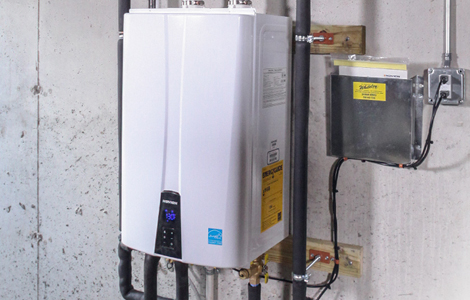
- Choose gas tankless if: your household is three or more, you are staying five years or longer, you will actually pay for annual descaling, and running out of hot water bothers you. See our tankless water heater installation page for the Navien range we fit.
- Choose a power vent tank if: your furnace has just been replaced with a condensing model and the old chimney no longer serves a natural draft tank on its own. Price it against tankless on the same visit.
- Choose a heat pump water heater if: you heat water with electricity and have a warm basement or utility room. It is the only option with a rebate in 2026.
- In every case: get the gas line, venting, condensate and electrical priced as named line items, and confirm the contractor is TSSA registered before work starts.
Tank or tankless? A 30-second check
Three questions, same answers as the tables above.
This check needs JavaScript. The same answers are in the Choose a tank if, choose tankless if list above and in the 20 year comparison table.
From our channel
Aire One Peel on site
Video 1 of 3
Get both options priced on the same visit
We quote a power vent tank and a Navien tankless side by side, with the gas line, venting, condensate and electrical itemised and the winter flow calculation included, so you are comparing two real numbers instead of two brochures. Aire One Peel Heating & Cooling, TSSA-registered fuels contractor FS R0076624709, 1625 Courtneypark Dr E, Mississauga, ON L5T 1V9. Serving Mississauga, Brampton, Etobicoke, Milton, Georgetown, Caledon and Bolton.
Tankless vs tank water heater: frequently asked questions
How much does a tankless water heater cost in Ontario in 2026?
An installed gas tankless unit is priced per house, because the gas line, venting route, condensate drain and electrical outlet vary. Ask any contractor to itemise those four line items separately from the unit price, then compare quotes on the line items rather than the headline. Aire One Peel quotes a tank and a tankless on the same visit at no charge.
Is a tankless water heater cheaper to run than a tank?
Yes, by about 27 to 35 per cent of the gas, which is roughly $59 to $76 CAD a year for an Ontario household of four at rates in effect July 1, 2026. That is real but modest, and paid annual descaling can cost more than the saving. The stronger argument for tankless is a 20 year rated life against 8 to 12 for a tank.
How long does a tankless water heater last?
The ENERGY STAR technical bulletin rates the life expectancy of demand water heaters at 20 years, much longer than conventional storage tanks. Navien warranties the NPE-2 residential heat exchanger for 15 years, parts for 5 years and labour for 1 year. Annual descaling is what gets a unit to year 20, and skipping it is what gets it to year 10.
Do I need a bigger gas line for a tankless water heater?
Sometimes. A whole home tankless unit draws up to 199,900 BTU per hour against roughly 40,000 for a 40 gallon tank. Navien states the NPE-2 series can run on a half inch gas pipe up to 24 feet, subject to local codes. Longer runs, shared lines or an undersized meter usually require a three quarter inch upgrade, which is priced on site.
Are there rebates for tankless water heaters in Ontario?
No, as of August 24, 2026. The Home Renovation Savings program lists a $500 CAD rebate for heat pump water heaters only, under the upgrades that do not require a home energy assessment, and lists nothing for gas storage or gas tankless models. The Canada Greener Homes Loan is closed to new applications.
Should I rent or buy a water heater in Ontario?
Buy if you are staying more than a few years, especially with tankless, because a rental keeps charging for exactly the long life you are paying for. The Ontario Energy Board does not regulate water heater rental, repair or maintenance charges, so the contract is your only protection. Read the buyout schedule, the escalation clause and whether the agreement transfers on sale.
What size tankless water heater do I need?
Size it on winter flow, not summer. Natural Resources Canada notes that a unit delivering 15 litres per minute at an 18 degree Celsius inlet delivers only about 11 litres per minute at a 5 degree inlet. A three bedroom home running two showers at once is typically a 180,000 BTU class unit. Homes with a soaker tub or four bathrooms want the 199,000 BTU class or two units.
Final verdict
For an Ontario household of three or more staying put, gas tankless is the better buy, and the reason is the second tank you do not have to install in year ten, not the gas you save.
For a couple, a short stay or a tight budget, a gas storage tank is the honest recommendation and we will tell you so on the estimate. If your water heating runs on electricity, look at a heat pump water heater before either, because it is the only one carrying a rebate in 2026. Whichever way you go, the number that decides your 20 year total is not the brand, it is whether the gas line, venting and descaling were priced properly at the start.
Sources and references
- Natural Resources Canada, Water heaters, water heating share of household energy
- Natural Resources Canada, Water Heater Guide, energy factors and winter flow (PDF)
- ENERGY STAR, Technical Bulletin: Demand Water Heaters, 20 year life expectancy and 96 per cent standby (PDF)
- Ontario Energy Board, Enbridge Gas rate schedule effective July 1, 2026 (PDF)
- Ontario Energy Board, Natural gas rates, water heater rental not regulated
- Navien, NPE-240A2 specification
- Home Renovation Savings, Enbridge Gas and Save on Energy
- Natural Resources Canada, Canada Greener Homes Loan, closed
- Technical Standards and Safety Authority, Be Fuels Wise
- Region of Peel, 2024 Water Quality Report, South Peel Drinking Water System (PDF)
- Region of Peel, water quality reports index, Caledon groundwater systems
- Halton Region, drinking water quality reports
Mario Vaghei
General Manager, Aire One Peel Heating & Cooling
Mario runs the Peel Region branch of Aire One Heating & Cooling from Courtneypark Drive in Mississauga. For this page he set the pricing structure, pulled the Region of Peel and Halton water hardness sources, and pushed back on the annual saving figure until the arithmetic was shown line by line rather than quoted from another contractor's blog. General Manager is a business role and not a trade credential, and no gas technician has reviewed this page.
What we updated. August 24, 2026: first publication. Replaces an internal draft that sourced its cost figures from two competitor marketing blogs, overstated the annual fuel saving, described the $500 heat pump water heater rebate as requiring a home energy assessment, and called Peel water hard without the Region's own figure.
Related reading: Rent or buy a water heater · Sizing your water heater · Mistakes to avoid buying a tank or tankless